 Art
Art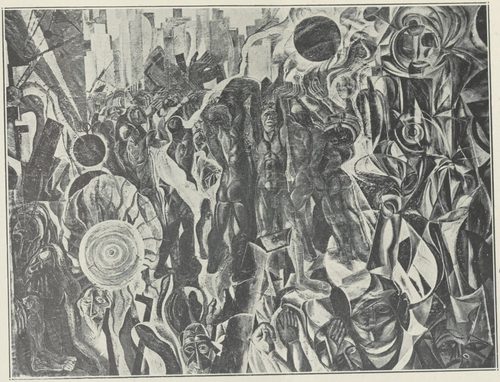

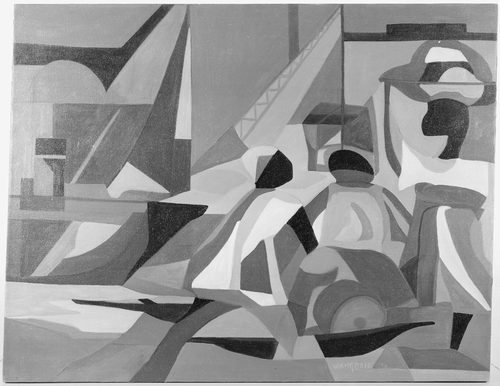
Vorticism was Britain's sharper-edged, more static answer to Italian Futurism's cult of speed and motion. Futurism launched in Milan in 1909 when Filippo Tommaso Marinetti published his manifesto glorifying machines, speed, and violence, urging artists to paint dynamic, blurred motion instead of static academic scenes. The idea spread across Europe, and in London a circle around the painter and writer Wyndham Lewis admired Futurism's energy but rejected its blurry, chaotic effect. Formed in 1914 and named by the poet Ezra Pound, Vorticism instead built compositions from hard, angular, machine-like forms frozen at the vortex, the still point where force concentrates, rather than smeared across the canvas. The group published its ideas in the magazine BLAST and largely dissolved by 1918 as World War One scattered its members. Futurism, by contrast, continued in Italy for another decade, eventually aligning uncomfortably with Fascism.
Futurism vs. Vorticism at a glance
| Futurism | Vorticism | |
|---|---|---|
| Years | 1909–1930 | 1914–1918 |
| Origin | Milan, Italy | London, England |
| Movement | Obsessed with speed and motion; forms blur and repeat to suggest a car, dancer, or crowd in motion. | Suspicious of blur; forms stay hard-edged and static, frozen at a single sharp moment of tension. |
| Line & form | Curved, radiating lines and overlapping silhouettes create a sense of continuous movement across the canvas. | Straight, angular lines and diagonal shafts create rigid, machine-like geometric structures. |
| Subject matter | Speeding cars, trains, crowds, dancers, and urban energy dominate Futurist painting and sculpture. | Industrial cities, war, and abstracted human figures rendered as faceted, mechanical forms. |
| Key figures | Filippo Tommaso Marinetti, Umberto Boccioni, and Giacomo Balla led the movement. | Wyndham Lewis led the group, with sculptor Jacob Epstein closely associated. |
| Politics | Glorified war, speed, and youth, and later drifted toward alliance with Italian Fascism. | Largely apolitical in aim, though the group scattered when its members served in World War One. |
| Lifespan | Persisted for two decades, evolving through multiple phases into the 1920s. | Burned briefly, essentially collapsing after only a few years and one wartime magazine. |
How to tell them apart
If the painting shows a figure or vehicle multiplied into overlapping, blurred silhouettes, like a dog's legs smeared into motion, that's Futurism chasing speed. If instead you see hard, angular shards arranged around a still, forceful center, almost like shattered glass frozen mid-break, that's Vorticism. Futurist color tends toward energetic, sometimes lurid brights; Vorticist work leans starker, often near-monochrome with sharp black lines. Futurism loves crowds, cars, and cities in motion; Vorticism prefers isolated, machine-like figures and industrial forms held in tension. The magazine BLAST's jagged typography is a strong giveaway for Vorticism.
What they share
Both movements admired the machine age and rejected the soft, pastoral traditions of academic painting, embracing hard, modern, urban subject matter instead. Vorticism openly borrowed Futurism's energy and its manifesto-driven, provocative public style, including bold typographic broadsides. Both also produced sculpture as well as painting, and both were led by charismatic founder-figures who wrote as forcefully as they painted.
Try both
Settle it yourself — generate the same subject in each style and compare the results.
Frequently asked questions
Is Vorticism a British version of Futurism?
Vorticism was influenced by Futurism's energy and manifesto style but deliberately rejected its blurred motion, favoring static, hard-edged geometric forms instead. Wyndham Lewis's circle saw themselves as a distinct, more disciplined movement, not simply a British copy of the Italian original.
Which came first, Futurism or Vorticism?
Futurism came first, launched in Milan in 1909. Vorticism followed five years later, forming in London in 1914 partly in reaction to Futurism's ideas.
Did Futurism and Vorticism have direct contact?
Yes. Marinetti toured London and lectured there, and Futurist exhibitions reached British artists directly. Wyndham Lewis and his circle knew Futurist work firsthand before founding Vorticism partly as a critical response to it.