 Art
Art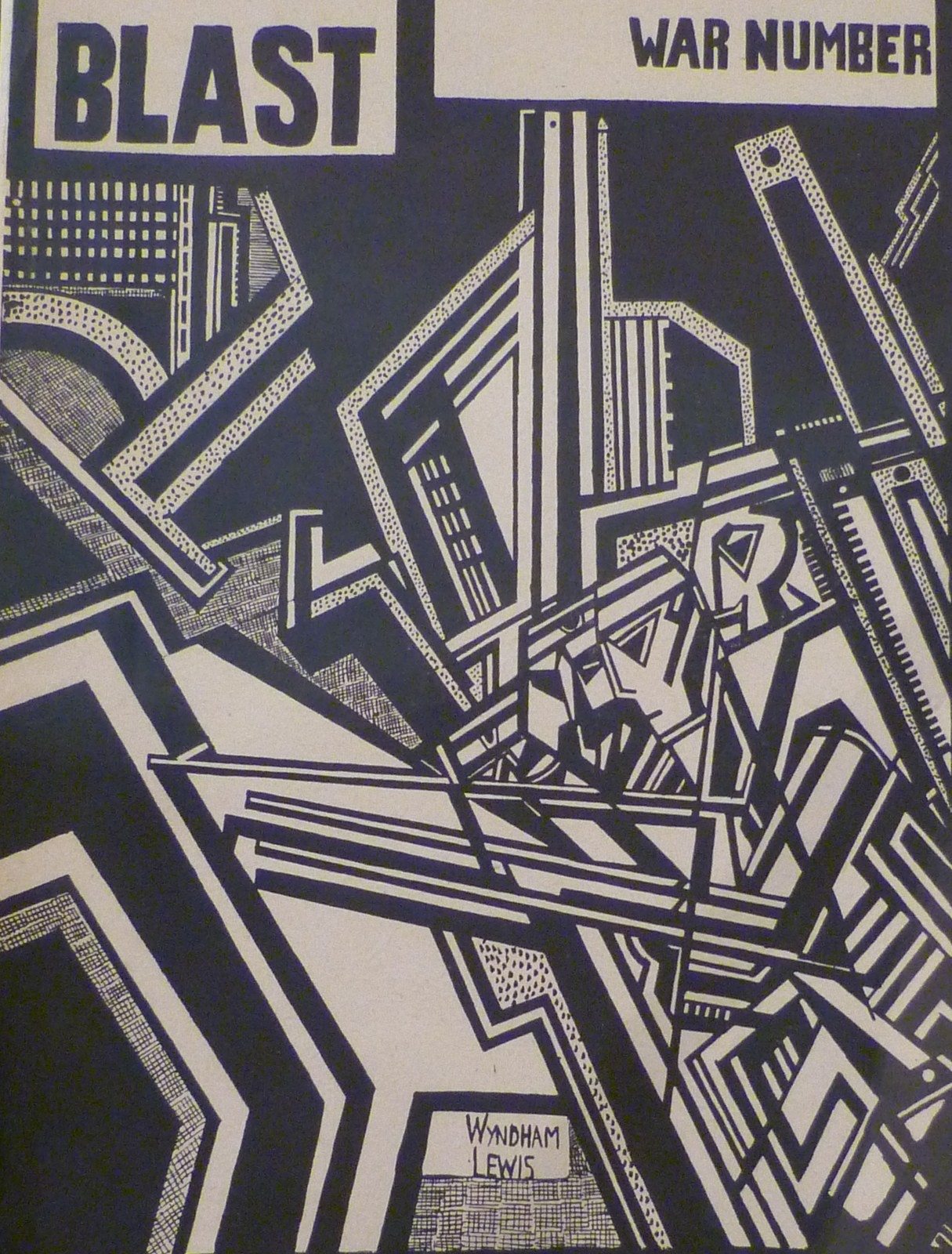
Blast 2 (detail). Image: Philafrenzy · CC BY-SA 4.0 · Wikimedia Commons, accessed 2026-08-04
Vorticism was Britain's most radical contribution to pre-World War I modernism, a short-lived movement centered in London from 1914 to roughly 1918 and led by the painter and writer Wyndham Lewis. It took its name from a phrase coined by the American poet Ezra Pound, who described the movement's ideal artwork as a "vortex," a still point of maximum energy from which and into which ideas rush—an image meant to distinguish Vorticism from what Pound and Lewis saw as Futurism's undisciplined obsession with depicting motion for its own sake.
Visually, Vorticist painting combined Cubism's faceted fragmentation of form with Futurism's dynamism, but rendered both through hard, precise, machine-like edges rather than Cubism's muted analytical planes or Futurism's blurred, streaking lines. Compositions favored sharp diagonals, angular zigzags, and stark contrasts of light and dark, often abstracted to the point where a subject—an industrial worker, a piece of machinery, a battlefield—became difficult to identify amid the interlocking geometric structure. The sculptor Jacob Epstein extended similar ideas into three dimensions with works like the drill-mounted figure "Rock Drill," while David Bomberg produced tightly gridded, near-abstract figure compositions closely aligned with the group.
The movement announced itself through BLAST, a large-format literary and artistic magazine edited by Lewis, whose first issue in 1914 combined manifestos, typographic experimentation, and satirical attacks on British cultural institutions with reproductions of Vorticist art. Vorticism rebelled against both the sentimental pastoralism still common in British art and against what its members saw as Futurism's excessive Italian romanticism, positioning itself instead as a distinctly English response to continental modernism, suited to Britain's own industrial landscape.
Vorticism matters as the primary British entry point into international avant-garde abstraction before 1914, and as a rare instance of a modernist movement organized explicitly around a literary-visual alliance, with poets, critics, and painters working in close coordination. Its life was brutally short: World War I, which broke out just months after BLAST's first issue, killed or scattered many of its members and effectively ended the movement by 1918.
What defines Vorticism
Hard-edged, machine-like geometry
Forms are broken into sharp, precise angular facets with clean, ruled-looking edges, evoking industrial machinery rather than Cubism's softer analytical planes or Futurism's blurred motion.
Diagonal and zigzag structure
Compositions are dominated by strong diagonals and interlocking zigzag patterns that create tension and implied energy without depicting literal movement.
Restrained, often stark color
Vorticist painting frequently favors high-contrast blacks, whites, grays, and ochres, with color used sparingly to heighten a sense of industrial hardness rather than decorative appeal.
Abstraction of industrial and urban subjects
Machinery, factories, ships, and city structures are broken down into near-abstract geometric arrangements, reflecting the group's interest in Britain's industrial modernity.
Typographic and graphic experimentation
Through the journal BLAST, Vorticists extended their angular, forceful visual language into bold typography and page design, treating the printed word as a visual as well as literary medium.
Sculptural mechanization
Vorticist sculpture, notably Jacob Epstein's, incorporated real or implied machine elements and hard, faceted surfaces, presenting the human figure as fused with or dominated by industrial technology.
History
Vorticism crystallized in London in 1914, though its roots lay in overlapping circles of English avant-garde activity in the two or three years prior, including the Rebel Art Centre that Wyndham Lewis and others established after breaking from Roger Fry's more decorative Omega Workshops. The American poet Ezra Pound, already a champion of literary modernism in London, coined the term "Vorticism" to describe the group's aesthetic and helped position it internationally through his critical writing.
The movement's public launch came with BLAST, a large pink-covered magazine edited by Lewis and first published in June 1914, mixing manifestos, typographic experiment, poetry, and reproductions of Vorticist painting and sculpture with deliberately provocative, satirical lists blasting and blessing various figures and institutions of British culture. A second and final issue of BLAST followed in 1915, largely devoted to responses to the outbreak of war. Signatories and close associates of the movement included Lewis, the painter and printmaker David Bomberg, though his formal ties to the group were looser than others', the sculptor Jacob Epstein, the painter Edward Wadsworth, and the sculptor Henri Gaudier-Brzeska.
The Vorticists staged a single group exhibition in London in June 1915 at the Doré Galleries. By then World War I had already begun reshaping the group's fortunes: Gaudier-Brzeska was killed in combat in France in 1915, and other members enlisted or turned to war-related work, including official war art commissions that Lewis, Bomberg, and others later undertook. With its key members scattered by the war and its founding energy spent, Vorticism did not survive as an organized movement past 1918, though Lewis attempted a brief revival under the name "Group X" in 1920, without lasting success.
Key works
| Work | Artist | Year | Why it matters |
|---|---|---|---|
| Workshop | Wyndham Lewis | 1914 | A hard-edged, angular composition of interlocking planes suggesting an industrial interior, characteristic of Lewis's mature Vorticist style. |
| Rock Drill | Jacob Epstein | 1913 | A startling sculpture combining a robotic figure with a real mechanical drill, later reworked into the bronze torso fragment 'Torso in Metal from The Rock Drill' after the war changed Epstein's view of machinery. |
| The Mud Bath | David Bomberg | 1914 | A boldly geometric, near-abstract composition of figures in a bathhouse, rendered in flat interlocking red, white, and blue forms. |
| The Crowd | Wyndham Lewis | 1915 | A fragmented, grid-like depiction of massed urban figures, reducing the crowd to an abstracted architecture of repeated angular forms. |
| BLAST (first issue) | Wyndham Lewis (editor) | 1914 | The movement's founding publication, combining manifestos and bold typographic design that extended Vorticist aesthetics into print. |
How to make art in this style
Working in the Vorticist Style Today
Palette: Favor a restrained, high-contrast range—black, white, gray, and ochre or rust—with color used sparingly and deliberately rather than decoratively. Where a stronger color like red or blue is introduced, use it to anchor a composition's structure rather than to add warmth or atmosphere.
Composition: Build the image from sharp diagonals and interlocking angular shapes, avoiding curves almost entirely. Think of the composition as an engineering drawing or blueprint: forms should feel precise, machine-cut, and structurally load-bearing rather than organic. Let shapes overlap and interlock tightly, leaving little open, uncomposed space.
Brushwork/technique: Keep edges hard and clean—ruled lines and flat, unmodulated planes of tone rather than blended shading or visible brushwork. If working digitally or with ink, favor crisp, precise linework; if painting, mask edges or work with a straightedge to keep facets sharp.
Subjects: Industrial and urban subjects suit the style best—factories, machinery, ships, city crowds, workshops, and figures merged with mechanical elements. Avoid soft, pastoral, or naturalistic subjects, which run against Vorticism's deliberately hard, modern character.
Practical tip: Start from a photograph or sketch of an industrial or mechanical scene, then redraw it using only straight lines and sharp angles, deliberately eliminating any curve or soft transition—this forced translation from organic to geometric is close to how the Vorticists actually worked from observed urban and industrial subject matter.
Legacy
Vorticism's active life was brief, and unlike Cubism or Futurism it never developed a large international following, but it remains historically significant as Britain's clearest entry into pre-World War I abstraction and as an unusually tight alliance between avant-garde painting and literature. Its hard-edged, machine-derived visual language influenced later British art interested in industrial and mechanical subject matter, and Wyndham Lewis's typographic experiments in BLAST are frequently cited as an early instance of graphic design treating text as visual form, anticipating later approaches to bold, expressive typography.
Jacob Epstein's "Rock Drill" remains one of the most discussed sculptures of early British modernism, its fusion of a human figure with an actual machine drill, and Epstein's later decision to dismember and soften the piece after the horrors of mechanized war became clear, often read as a prescient commentary on technology's double-edged promise. The movement's abrupt end at the hands of the war it had, in some respects, aesthetically anticipated gives Vorticism a particular poignancy in British cultural memory, and its rediscovery by later scholars and curators, especially from the mid-twentieth century onward, has secured its place as a distinct, nationally specific counterpart to the better-known continental avant-gardes of Cubism and Futurism.
Frequently asked questions
What is Vorticism?
Vorticism was a British art movement centered in London from 1914 to about 1918, led by Wyndham Lewis, that combined Cubist fragmentation with Futurist dynamism into hard-edged, angular compositions evoking industrial machinery.
Where does the name "Vorticism" come from?
The poet Ezra Pound coined the term, describing the ideal Vorticist artwork as a "vortex"—a still point of maximum energy from which and into which ideas and forms radiate.
How is Vorticism different from Futurism?
Futurism, founded in Italy, emphasized blurred, streaking depictions of literal motion and speed. Vorticism instead used sharp, static, hard-edged geometry to suggest concentrated energy, criticizing Futurism's approach as too focused on surface movement rather than underlying structural force.
What was BLAST magazine?
BLAST was the large-format literary and artistic magazine edited by Wyndham Lewis that served as Vorticism's manifesto and mouthpiece, mixing bold typographic design, poetry, satirical writing, and reproductions of Vorticist art across two issues published in 1914 and 1915.
Who were the key Vorticist artists?
Wyndham Lewis was the movement's central figure, alongside sculptor Jacob Epstein, painter David Bomberg, painter Edward Wadsworth, and sculptor Henri Gaudier-Brzeska.
Why was Vorticism so short-lived?
World War I broke out within months of the movement's public launch in 1914, killing Gaudier-Brzeska in combat and scattering other members into military service or war-related work, which effectively ended the movement's organized activity by 1918.
![Cats (rayist percep.[tion] in rose, black, and yellow) — Rayonism](https://media.artmovements.com/encyclopedia/rayonism/commons-0-thumb.jpg)