 Art
Art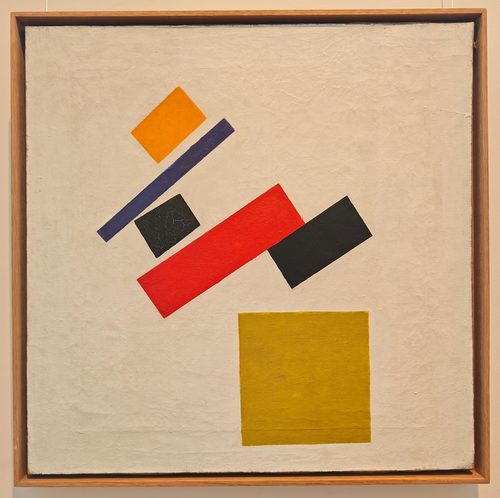
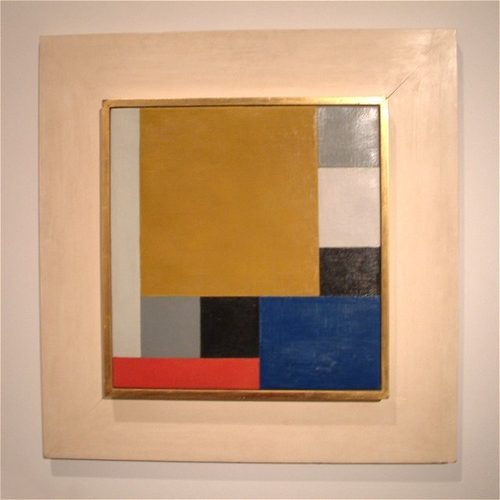
Suprematism sought pure feeling through abstract geometric shapes floating in white space, while Constructivism rejected pure abstraction for art that served practical, industrial, revolutionary purposes. Kazimir Malevich launched Suprematism in Russia in 1915, exhibiting his stark Black Square as a declaration that painting could abandon depicting the visible world entirely and instead express what he called pure artistic feeling through simple forms like squares and circles. In the years around the 1917 revolution, artists including Vladimir Tatlin pushed in a different direction, arguing that art should stop being a private, contemplative object and instead build useful things: posters, furniture, architecture, and propaganda for the new Soviet state. This became Constructivism, which treated materials like wood, metal, and glass as the point rather than illusionistic painting. The two movements overlapped in Russia's revolutionary art scene for years, sharing exhibitions and even artists, most notably El Lissitzky, before Constructivism's utilitarian bent won official favor.
Suprematism vs. Constructivism at a glance
| Suprematism | Constructivism | |
|---|---|---|
| Years | 1915–1925 | 1915–1930 |
| Origin | Russia | Russia |
| Purpose | Art for its own sake, expressing pure feeling through abstract form, detached from any practical use. | Art in service of society: posters, buildings, and objects meant to be used, not just contemplated. |
| Materials | Primarily flat painting: geometric shapes like squares, circles, and crosses on canvas. | Actual industrial materials: wood, metal, glass, and wire, often built into three-dimensional structures. |
| Form | Simple floating shapes on plain white or colored backgrounds, often asymmetrical and weightless-seeming. | Interlocking structural forms, diagonals, and grids that suggest engineering and architecture. |
| Key figures | Kazimir Malevich led the movement, with Black Square as its defining statement. | Vladimir Tatlin and Alexander Rodchenko led the movement, alongside El Lissitzky. |
| Political stance | Largely spiritual and philosophical in intent, not tied to a specific political program. | Explicitly aligned with Bolshevik ideals of art serving workers and the revolution. |
| Legacy | Influenced later abstract painting and minimalism through its radical reduction of form. | Shaped graphic design, architecture, and industrial design through its functional approach. |
How to tell them apart
If you see flat geometric shapes, a square, a cross, a circle, floating alone on a plain white ground with no reference to real objects, that's Suprematism. If instead you see diagonal struts, wire, and industrial materials assembled into something that looks like it could be built, a tower model, a poster layout, a piece of furniture, that's Constructivism. Suprematist paintings feel weightless and contemplative; Constructivist works feel structural and purposeful, often literally functional. Tatlin's proposed spiral tower is the clearest visual shorthand for Constructivism, just as Malevich's Black Square is for Suprematism.
What they share
Both erupted from the same revolutionary Russian art scene and shared a rejection of representational, illusionistic painting in favor of pure geometric abstraction. Several artists, especially El Lissitzky, moved fluidly between the two, blending Suprematist form with Constructivist purpose. Both also believed abstract art carried real social and spiritual weight, not just decoration, even though they disagreed sharply about what that weight should serve.
Try both
Settle it yourself — generate the same subject in each style and compare the results.
Frequently asked questions
Is Constructivism a type of Suprematism?
No. They developed in parallel in revolutionary Russia around the same years, sharing a geometric abstract vocabulary, but Constructivism explicitly rejected Suprematism's purely contemplative aims in favor of art built for practical, industrial use.
Which came first, Suprematism or Constructivism?
Suprematism came first, launched by Malevich in 1915. Constructivism took shape as a named movement after the 1917 revolution, growing out of the same Russian avant-garde circles and Tatlin's earlier constructions.
Did any artist work in both movements?
El Lissitzky is the clearest example, moving from Suprematist-influenced abstract compositions toward Constructivism's architectural and design-driven approach as Soviet art policy shifted toward utilitarian goals in the 1920s.