 Art
Art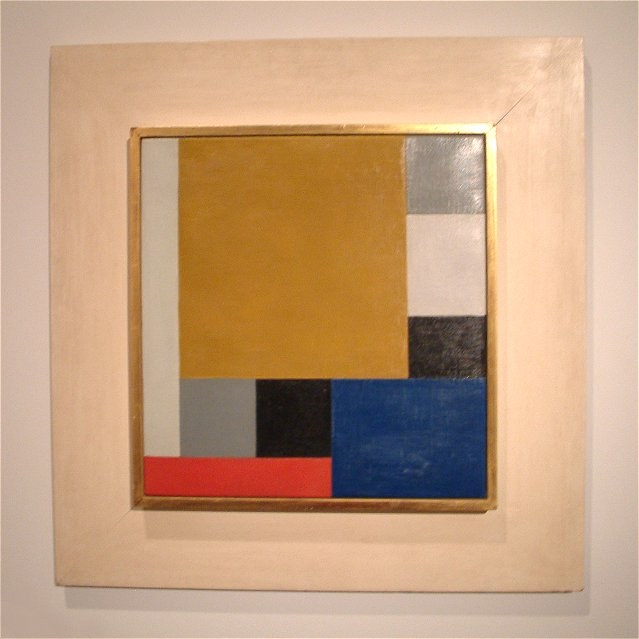
Composition XXII. Image: Theo van Doesburg · CC BY-SA 3.0 · Wikimedia Commons, accessed 2026-08-04
Constructivism emerged in Russia around 1915–1921 as artists working in the wake of Cubism and Suprematism concluded that abstraction alone was not enough — art, they argued, should be actively useful, participating in building the new society promised by the 1917 Russian Revolution. Where Malevich's Suprematism pursued pure, non-objective feeling, Constructivists such as Vladimir Tatlin, Alexander Rodchenko, and Lyubov Popova insisted that the artist should function more like an engineer, using industrial materials — wood, metal, glass, wire — to construct three-dimensional structures rather than paint illusionistic pictures.
Visually, Constructivism favored geometric, machine-derived forms: diagonal lines suggesting dynamic energy, interlocking planes, exposed structural elements, and a restrained palette dominated by red, black, white, and grey that echoed industrial materials and Soviet propaganda graphics. The movement extended well beyond painting and sculpture into architecture, theater set design, textiles, furniture, and above all graphic design and photomontage, where Rodchenko's bold typography, diagonal compositions, and photographic collage became some of the most recognizable visual language of early Soviet culture.
Constructivism rebelled against the idea of art as a precious, individual object made for private contemplation or the art market. Instead, it proposed art as "production" — useful, reproducible, and socially engaged, ideally serving the practical needs of workers and the new Soviet state through posters, book design, worker's clubs, and architectural proposals. Tatlin's unbuilt "Monument to the Third International," a spiraling iron tower intended to house revolutionary government offices and broadcast propaganda, became the movement's most famous (if never realized) symbol of this ambition: art fused directly with engineering and political purpose.
Constructivism matters because it fundamentally challenged what art was for. Rather than asking art to represent the world or express private feeling, it asked art to build the world — a proposition that reshaped twentieth-century graphic design, architecture, and industrial design far beyond Russia, and that continues to inform how designers think about function, structure, and the relationship between form and material.
What defines Constructivism
Industrial materials
Constructivist works favored real industrial materials — sheet metal, wood, glass, wire, and machine parts — over traditional painting media, treating construction itself as the artistic act rather than illusionistic representation.
Geometric, diagonal dynamism
Compositions rely on strong diagonals, interlocking planes, and angular structural lines that suggest engineering, motion, and modern industrial energy rather than static balance.
Exposed structure
Rather than concealing how a work was built, Constructivist sculpture and architecture typically exposed its structural framework, treating visible construction as an honest expression of material and process.
Restrained industrial palette
Color is limited and functional, dominated by red, black, white, and grey — a palette drawn from industrial materials and adopted widely in Soviet propaganda and graphic design.
Bold typography and photomontage
Constructivist graphic design combined dramatic diagonal typography with cut photographic imagery, creating dynamic posters and book covers designed for mass reproduction and clear political messaging.
Art as production
The movement rejected the idea of the unique art object made for private ownership, instead favoring reproducible, socially useful design applied to posters, textiles, furniture, and architecture.
History
Constructivism developed in Russia in the years immediately following the 1917 Revolution, growing out of the geometric abstraction of Suprematism and the material experiments Vladimir Tatlin had begun with his painterly reliefs and counter-reliefs from 1913–15. Tatlin's 1919–20 design for a "Monument to the Third International," a proposed 400-meter spiraling iron tower intended to house Comintern offices and broadcast revolutionary messages, became the movement's foundational, if unbuilt, statement — art conceived explicitly as engineering in service of the new state.
Through the early 1920s, Constructivism split along productivist lines, with figures like Rodchenko and Popova increasingly rejecting easel painting altogether in favor of applied design: textiles, posters, theater sets, and typography intended for direct social use. Debates within Moscow's art institutions, particularly INKhUK (the Institute of Artistic Culture), formalized this shift toward "production art," arguing that under socialism the artist's role was to design useful objects for daily life rather than create autonomous artworks for galleries.
El Lissitzky served as a crucial bridge figure, carrying Suprematist geometric vocabulary into Constructivist design and, through his international travels and contacts with the Bauhaus and De Stijl in the early-to-mid 1920s, spreading Constructivist ideas across Western Europe. Constructivist principles shaped Soviet architecture, exhibition design, and propaganda throughout the 1920s, producing landmark buildings and iconic poster and book design.
By the late 1920s and into the 1930s, however, official Soviet cultural policy under Stalin turned decisively against avant-garde abstraction, promoting Socialist Realism as the only acceptable style and branding Constructivism as elitist formalism disconnected from ordinary audiences. Many Constructivist artists were forced to abandon abstract work or shifted into more conventional propaganda illustration. The movement's ideas, however, had already spread internationally through emigres and contacts with the Bauhaus, ensuring its survival in Western modernist design long after it was suppressed at home.
Key works
| Work | Artist | Year | Why it matters |
|---|---|---|---|
| Monument to the Third International | Vladimir Tatlin | 1919 | An unbuilt spiraling iron tower design intended to house Comintern offices, the movement's most famous symbol of art fused with engineering and political purpose. |
| Beat the Whites with the Red Wedge | El Lissitzky | 1919 | A propaganda poster translating Suprematist geometric abstraction into a stark political symbol of the Bolshevik struggle against White Army forces. |
| Spatial Force Construction | Lyubov Popova | 1921 | A key painted work bridging Suprematist geometric abstraction and Popova's move toward Constructivist textile and stage design. |
How to make art in this style
Working in a Constructivist style
Palette: Limit color to a functional, industrial range — black, white, and red form the essential Constructivist triad, with grey and occasionally a single accent color (often a strong blue or yellow) used sparingly. Avoid decorative or naturalistic color; each hue should feel purposeful, almost like a warning color or structural marker.
Composition: Build the composition around strong diagonals and interlocking geometric planes rather than static horizontal-vertical grids. Think in terms of structural tension — forms that appear to push, pivot, or brace against one another, as if the composition were an engineering diagram as much as a picture.
Technique: If working two-dimensionally, favor flat, hard-edged color planes, bold sans-serif lettering, and photographic or photomontage elements cut and reassembled at dynamic angles. If working three-dimensionally, use real, honestly displayed materials — wood, wire, sheet metal — and let the joints and structural logic of the piece remain visible rather than hidden.
Subjects: Favor subjects tied to modern labor, industry, and collective life — workers, machinery, urban infrastructure, political messaging — rather than private or domestic themes. Typography and text are frequently part of the subject itself, not just a caption.
Practical tip: Design from a functional brief rather than a purely aesthetic idea — ask what the piece is meant to communicate or do (announce an event, organize information, brace a structure), and let that function visibly drive the composition's geometry.
Legacy
Constructivism's insistence that design should be structurally honest, materially direct, and socially useful became one of the central premises of twentieth-century modernist design. El Lissitzky's direct contact with Bauhaus figures carried Constructivist ideas about typography, geometric form, and functional design into German modernism, from which they spread into international graphic design, advertising, and architecture over the following decades.
Rodchenko's photomontage and dynamic diagonal photography reshaped advertising and editorial photography, while Constructivist typography — bold sans-serif type, diagonal layouts, strong red-and-black color schemes — remains instantly recognizable and is still widely quoted in contemporary graphic design, from album covers to political posters to corporate branding, often deliberately evoking revolutionary-era urgency.
In architecture, Constructivist ideas about exposed structure and functional form fed into International Style modernism, and unbuilt visions like Tatlin's tower continue to be cited as touchstones for utopian architectural ambition. Because Constructivism was suppressed within the Soviet Union itself after the early 1930s, much of its long-term influence traveled through international channels rather than direct continuation at home, making it one of the clearest examples in art history of a movement whose visual language far outlived its original political and institutional context.
Frequently asked questions
What is Constructivism in art?
Constructivism is a Russian art movement of the late 1910s and 1920s that treated art as a form of useful construction, applying geometric abstraction, industrial materials, and structural design to sculpture, architecture, and graphic design in service of the new Soviet society.
Who founded Constructivism?
Vladimir Tatlin is generally credited as the founding figure, with his abstract material constructions and his 1919 design for the Monument to the Third International; Alexander Rodchenko, El Lissitzky, and Lyubov Popova developed the movement further.
Constructivism vs Suprematism: what's the difference?
Suprematism pursued pure, non-objective abstraction as an expression of feeling, while Constructivism, which absorbed Suprematist geometric vocabulary, insisted art should be socially useful, built from real industrial materials and applied to practical design rather than kept as autonomous painting.
What was Tatlin's Tower?
Tatlin's Tower, formally the Monument to the Third International, was an unbuilt 1919–20 design for a spiraling iron tower intended to house Comintern government offices and broadcast revolutionary propaganda, and it remains Constructivism's most famous symbolic statement.
Why did Constructivism end?
Soviet cultural policy under Stalin turned against avant-garde abstraction in the late 1920s and 1930s, mandating Socialist Realism instead and branding Constructivism as elitist formalism, which forced most Constructivist artists to abandon abstract work.

![Cats (rayist percep.[tion] in rose, black, and yellow) — Rayonism](https://media.artmovements.com/encyclopedia/rayonism/commons-0-thumb.jpg)