 Art
Art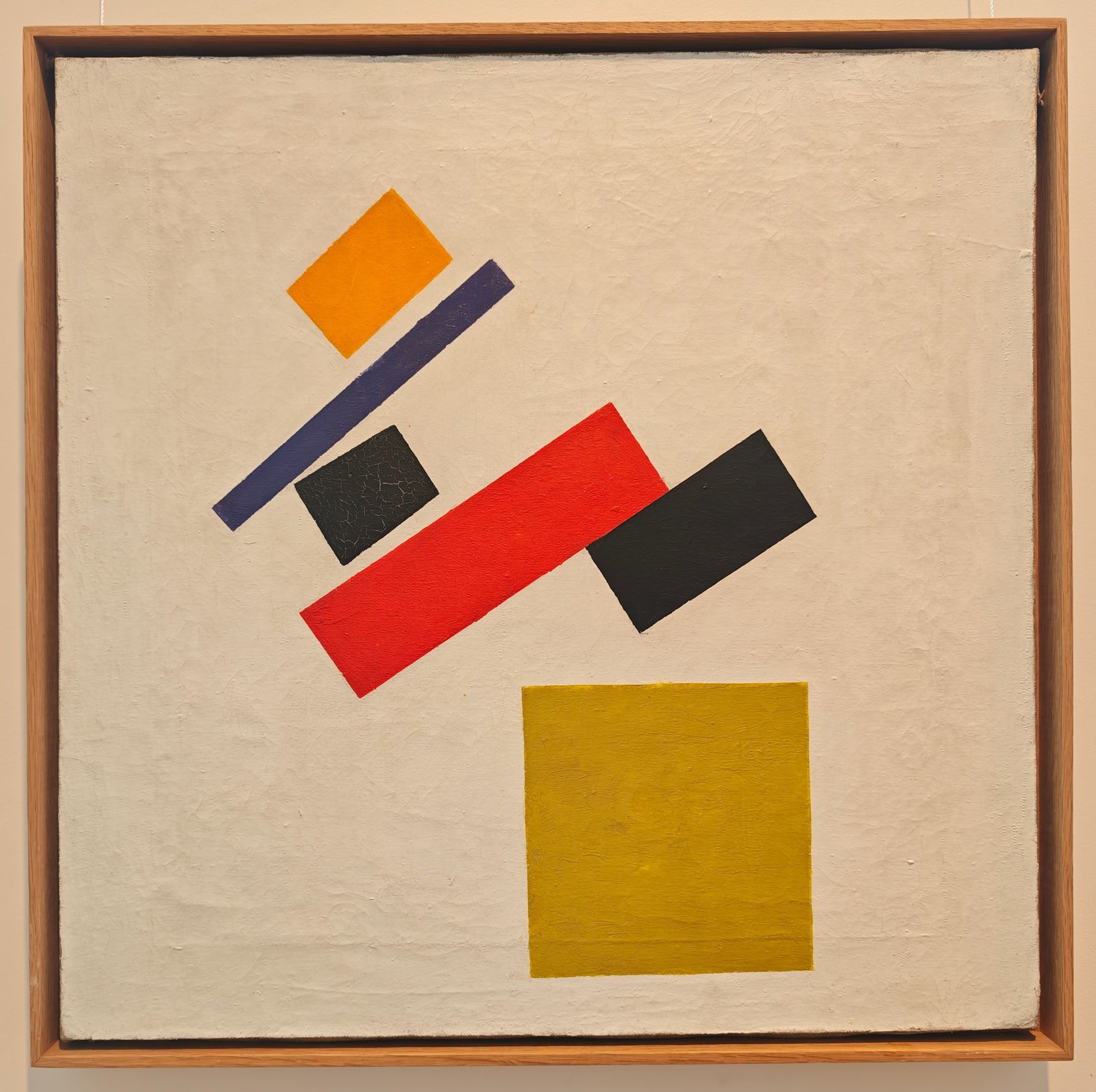
Ivanovo art museum - Kazimir Malevich - Suprematism. Image: Unknown · Public domain · Wikimedia Commons, accessed 2026-08-04
Suprematism was a movement of radical geometric abstraction founded by the Kyiv-born painter Kazimir Malevich (a Russian avant-garde artist of Polish descent) around 1913–15, reaching its defining public statement at the "0.10" (Zero-Ten) exhibition in Petrograd in December 1915. There Malevich unveiled "Black Square," a black quadrilateral floating on a white ground, hung high in the corner of the room in the position traditionally reserved for a religious icon. The gesture was deliberate: Malevich was proposing geometric abstraction itself as a new kind of spiritual object, freed from any obligation to depict the visible world.
Malevich named the movement "Suprematism" to signal the supremacy of pure artistic feeling over the depiction of objects. Where Cubism and Futurism, which had shaped Malevich's earlier work, still anchored their fractured compositions in recognizable subjects, Suprematism discarded representation entirely. Its vocabulary is deliberately minimal: squares, circles, crosses, and rectangles in flat, often primary colors, arranged with a sense of weightlessness and dynamic tilt against blank white or near-white grounds, as though the shapes were suspended in an infinite, non-gravitational space.
The movement developed in two broad phases. The earlier, "black period" works, including "Black Square" and its companion "Black Circle" and "Black Cross," reduced the vocabulary to essentials in near-monochrome. Later, Malevich introduced color and multiplied forms into dynamic diagonal arrangements suggesting flight and cosmic movement, as in his "Suprematist Composition: Airplane Flying." The culmination came with his 1918 "White on White" paintings, in which a white square is barely differentiated from a white ground by texture and the faintest tonal shift — pushing abstraction to what Malevich considered its logical, near-invisible limit.
Suprematism rebelled against centuries of representational painting and against the utilitarian, socially engaged art that Constructivist colleagues were beginning to champion in the same milieu; Malevich insisted that art's highest purpose was non-objective feeling, not depiction or utility. The movement matters because it pushed abstraction further and faster than almost any other early-twentieth-century movement, treating pure geometric form as a vehicle for something close to spiritual or cosmic experience, and it decisively shaped the vocabulary of twentieth-century abstract art, architecture, and graphic design.
What defines Suprematism
Reduction to basic geometry
Compositions are built from a minimal vocabulary of squares, circles, crosses, and rectangles rather than any representational content. The shapes are treated as self-sufficient carriers of feeling rather than symbols standing in for real objects.
Floating, weightless arrangement
Forms are typically tilted and scattered across the canvas as though suspended in a gravity-free space, rather than resting on a ground line. This creates a sensation of drift or flight rather than static balance.
Flat, unmodulated color
Shapes are painted in flat, even color with no shading or gradation, emphasizing their status as pure geometric planes rather than three-dimensional objects. Red, black, and white dominate, with other primary and secondary hues used sparingly.
Expansive white ground
Most Suprematist canvases place their geometric forms against a large, empty white or near-white field, which Malevich treated as a symbol of infinite, non-objective space.
Dynamic diagonal composition
Later Suprematist works organize multiple shapes along diagonal axes to suggest velocity and movement, echoing the era's fascination with flight and modern technology without depicting any actual machine.
Near-monochrome extremes
In its most radical works, such as the white-on-white paintings, Suprematism pared color contrast down to almost nothing, testing how far abstraction could go before a composition dissolved into pure surface.
History
Suprematism grew directly out of Kazimir Malevich's engagement with Cubism and Italian Futurism in the years before 1915, styles he had absorbed and pushed toward increasing abstraction in works exhibited in Moscow and St. Petersburg. The movement's public birth came at the "0.10" (Zero-Ten: The Last Futurist Exhibition of Paintings) in Petrograd in December 1915, where Malevich exhibited around three dozen non-objective canvases, including "Black Square," alongside a written manifesto declaring the "supremacy of pure feeling" over depiction. Fellow exhibitors at 0.10 included Olga Rozanova and Ivan Puni, who explored related geometric abstraction within the same circle.
Through the later 1910s, Malevich developed the style's vocabulary from the stark black-on-white works toward more complex, multi-form, colored compositions suggesting motion and cosmic space, and he began teaching his ideas formally, first in Moscow and then, from 1919, at the art school in Vitebsk, where he found a close collaborator in El Lissitzky. Lissitzky adapted Suprematist geometric language into his own "Proun" works and into graphic and propaganda design, carrying Suprematist form into Constructivism and into Soviet visual culture more broadly.
Suprematism reached its most extreme statement in Malevich's 1918 "White on White" series, after which he increasingly turned toward theoretical writing and teaching rather than painting, and later, under mounting Soviet pressure against abstract art in the 1920s and 1930s, returned to figuration in his own late work. Official Soviet policy under Stalin came to reject non-objective art as bourgeois formalism, effectively ending Suprematism's development inside Russia by the mid-1930s, though Malevich continued to sign some later figurative paintings with a small black square, quietly asserting his earlier convictions until his death in 1935. The movement's ideas nonetheless survived through Lissitzky's international travels and through emigre artists who carried Suprematist principles into Western European abstraction and design.
Key works
| Work | Artist | Year | Why it matters |
|---|---|---|---|
| Black Square | Kazimir Malevich | 1915 | The movement's founding icon, first shown hung in the corner of the room like a religious image, proposing pure abstraction as a new kind of spiritual object. |
| Black Circle | Kazimir Malevich | 1915 | A companion work to Black Square that extends the same reduction of form to a single elemental geometric shape. |
| Suprematist Composition: Airplane Flying | Kazimir Malevich | 1915 | A dynamic arrangement of tilted rectangles that evokes flight and modern speed without depicting any actual aircraft. |
| White on White | Kazimir Malevich | 1918 | Malevich's most radical reduction, a white square barely distinguishable from its white ground, pushed abstraction to near-total dissolution. |
| Suprematism (Supremus No. 56) | Kazimir Malevich | 1916 | A complex, multi-form composition demonstrating the movement's mature vocabulary of colored geometric shapes scattered across white space. |
How to make art in this style
Working in a Suprematist style
Palette: Keep the palette restrained and flat — black, white, and red form the movement's core triad, with occasional additions of pure blue, yellow, or green used sparingly and never blended or shaded. Color should read as a solid, unmodulated plane, not as light falling on a surface.
Composition: Begin with a large, open white or near-white ground and treat it as infinite space rather than a wall or floor. Place a small number of geometric shapes — squares, rectangles, circles, crosses — at varying scales and tilted angles, avoiding horizon lines or any sense of gravity. Aim for a feeling of drift or suspension rather than static, centered balance.
Brushwork and technique: Paint each shape as a flat, hard-edged plane with a clean, even application of color; avoid visible brushwork, texture, or gradation, since the goal is geometric purity rather than painterly expression. Edges should be crisp enough to read as cut forms rather than soft-bordered shapes.
Subjects: There are no subjects in the traditional sense — do not depict objects, figures, or landscapes. Instead, think of each composition as an arrangement of pure form meant to evoke a feeling or sensation (weightlessness, velocity, silence) directly through shape, scale, and placement alone.
Practical tip: Try composing with cut paper shapes on a white ground before painting, moving them until the arrangement feels dynamically balanced rather than symmetrical — Suprematist compositions rely on tension between forms, not mirror-image order.
Legacy
Suprematism's insistence that geometric abstraction could carry emotional and spiritual weight independent of any subject became one of the foundational premises of twentieth-century modern art. His Vitebsk colleague and collaborator El Lissitzky translated Suprematist form into Constructivist design, propaganda graphics, and exhibition architecture, seeding a visual vocabulary that spread through the Bauhaus and into international modernist design, typography, and advertising.
Later abstract movements, from geometric abstraction and Concrete Art in the mid-century to Minimalism in the 1960s, inherited Suprematism's reduction of the canvas to essential shape, flat color, and open ground, even when their practitioners had different theoretical concerns. "Black Square" in particular has become one of the most recognized and reproduced images in modern art history, regularly invoked as the symbolic starting point of pure non-objective painting.
Because Suprematism was suppressed inside the Soviet Union under Stalinist cultural policy, much of its influence traveled westward through emigres and through Lissitzky's international contacts, meaning the movement's impact on Western abstraction and design was, for decades, better documented outside Russia than within it. Today, Suprematism is recognized as a pivotal hinge between the last representational vestiges of Cubism and Futurism and the fully non-objective abstraction that would dominate much of twentieth-century art, and its flat geometric planes remain a visible reference point in contemporary graphic design, architecture, and minimalist visual culture.
Frequently asked questions
What is Suprematism?
Suprematism is a movement of radical geometric abstraction founded by Kazimir Malevich in Russia around 1915, built from basic shapes like squares and circles arranged on white grounds to express pure feeling independent of any recognizable subject.
Who started Suprematism?
Suprematism was founded by the Kyiv-born painter Kazimir Malevich (a Russian avant-garde artist of Polish descent), who introduced the movement publicly at the 1915 "0.10" exhibition in Petrograd with his painting Black Square.
What does Black Square mean?
Malevich intended Black Square as a symbolic zero point for painting, a rejection of representation in favor of pure non-objective form; he hung it in the corner of the exhibition room, the position traditionally reserved for a religious icon in Russian homes.
Suprematism vs Constructivism: what's the difference?
Suprematism pursued pure, non-objective form as an expression of feeling, while Constructivism, which grew partly out of it, insisted that art should serve social and utilitarian purposes using industrial materials and techniques; the two movements shared a geometric vocabulary but disagreed sharply about art's purpose.
Why was Suprematism suppressed in the Soviet Union?
Soviet cultural policy under Stalin favored Socialist Realism and rejected abstract art as elitist bourgeois formalism disconnected from the working class, effectively ending official Suprematist activity inside Russia by the mid-1930s.
![Cats (rayist percep.[tion] in rose, black, and yellow) — Rayonism](https://media.artmovements.com/encyclopedia/rayonism/commons-0-thumb.jpg)