 Art
Art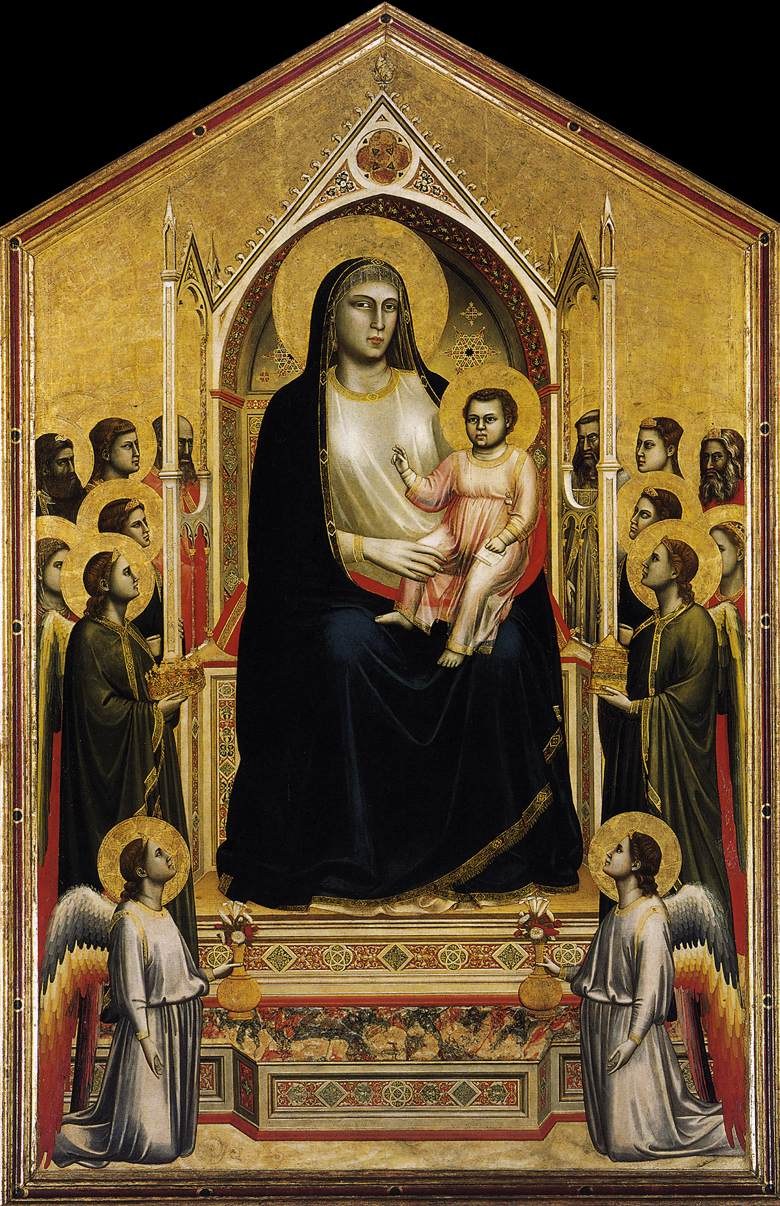
Madonna Enthroned (Ognissanti Madonna). Image: Giotto · Public domain · Wikimedia Commons, accessed 2026-08-04
The Proto-Renaissance, often called the Trecento after the Italian for the 1300s, marks the moment Italian painting began pulling away from the flat, gold-ground iconography of Byzantine art toward a new interest in volume, space, and human emotion. It is not a unified movement with a manifesto so much as a shared shift in ambition among painters working in Florence, Siena, and other Italian city-states between roughly 1290 and 1400.
Byzantine and Byzantine-influenced Italian painting (the maniera greca) had for centuries rendered holy figures as symbolic presences: gold backgrounds erased any sense of real space, faces were stylized rather than individualized, and bodies were flattened beneath heavy, patterned drapery. Proto-Renaissance painters, above all Giotto di Bondone, began to model figures with light and shadow so they read as solid bodies occupying real, if shallow, space. Giotto's mourners at the Arena Chapel grieve with their whole bodies; his architecture, however schematic, implies a stage the figures stand within rather than float against.
This was, in effect, a rebellion against symbolic abstraction in favor of observed human experience — grief, tenderness, wonder — expressed through gesture and weight rather than iconographic code. Cimabue, Giotto's presumed teacher, still worked largely within the Byzantine manner, which makes the leap in Giotto's own work all the more visible by contrast. In Siena, Duccio di Buoninsegna and Simone Martini pursued a parallel but gentler transformation: they kept the gold grounds and decorative elegance of the Byzantine tradition but softened it with narrative subtlety, courtly grace, and increasingly individualized faces.
The Proto-Renaissance matters because it supplied the technical and conceptual groundwork the Early Renaissance would build on: the conviction that painting should describe a believable world, that sacred narrative could be told through convincingly human actors, and that a painter's individual hand and reputation were worth recording. Giotto was celebrated in his own lifetime — Dante mentions him in the Divine Comedy — as a painter who had surpassed his predecessors. Later, Giorgio Vasari would credit him as the figure who single-handedly revived the art of painting after centuries of decline. Whether or not that claim is fair to the artists working around him, it captures how decisively the Trecento reoriented Italian art toward the naturalism that would define the Renaissance.
What defines Proto-Renaissance
Modeled, weighty figures
Giotto and his followers used gradations of light and shadow to give bodies a sense of mass and physical presence, replacing the flat, linear drapery of Byzantine icons with folds that suggest real cloth over a real body.
Emotional narrative gesture
Figures express grief, tenderness, and wonder through pose and facial expression rather than symbolic attributes alone. Mourning figures at the Arena Chapel turn, reach, and collapse with visible physical feeling.
Shallow architectural stage-space
Buildings, rocky outcrops, and simple interiors frame scenes as a believable, if compressed, setting rather than a decorative backdrop. This is an early, intuitive step toward the systematic perspective the next century would formalize.
Persistent gold grounds
Many Trecento panels, especially from Siena, still use gold leaf backgrounds and haloes, holding onto Byzantine luxury and sacred symbolism even as the figures within grow more solid and individualized.
Large-scale fresco cycles
Extended narrative sequences painted directly onto church and chapel walls told continuous biblical stories across many scenes, a format Giotto brought to new dramatic and compositional sophistication.
Sienese linear elegance
Duccio and Simone Martini balanced the new naturalism with decorative pattern, elongated grace, and refined line, producing a gentler, more courtly counterpart to Florentine solidity.
History
The Proto-Renaissance emerged in Florence and Siena in the final decade of the 1200s, as Italian painters trained in the Byzantine manner began experimenting with greater naturalism. Cimabue, active in Florence in the late 1200s, still worked largely within Byzantine convention, but his pupil (by tradition) Giotto di Bondone pushed decisively beyond it.
Giotto's frescoes for the Arena Chapel (also called the Scrovegni Chapel) in Padua, painted around 1305, are the movement's landmark achievement: a continuous cycle depicting the lives of the Virgin and Christ, rendered with unprecedented physical and emotional realism. His earlier and later work in Florence, including frescoes in Santa Croce and the Ognissanti Madonna panel, extended the same approach across religious commissions throughout Tuscany.
In Siena, a rival but related tradition developed under Duccio di Buoninsegna, whose Maestà — a monumental double-sided altarpiece completed for Siena Cathedral in 1311 — combined Byzantine gold-ground splendor with a new narrative subtlety in its smaller predella panels. Simone Martini, trained in Duccio's circle, carried this Sienese elegance forward into the 1330s and beyond, producing courtly, linear work such as the Annunciation of 1333.
The movement's momentum was interrupted by the Black Death, which struck Florence and Siena in 1348 and killed a substantial share of the population, including several leading painters of the following generation. Some historians have argued the plague produced a temporary conservative retreat toward more traditional, devotional imagery in the following decades, though this reading remains debated.
By the early 1400s, painters and sculptors in Florence — Masaccio, Donatello, Ghiberti — would take up Giotto's naturalistic ambitions again, combined with new theories of linear perspective, launching the Early Renaissance proper. The Proto-Renaissance is understood today as the essential first act of that longer story, the moment Italian art began asking painting to describe a convincing world rather than merely signify a sacred one.
Key works
| Work | Artist | Year | Why it matters |
|---|---|---|---|
| Arena Chapel Frescoes | Giotto di Bondone | 1305 | A continuous fresco cycle on the life of Christ and the Virgin that set a new standard for narrative drama and physical realism in Western painting. |
| Ognissanti Madonna | Giotto di Bondone | 1310 | A monumental gold-ground altarpiece whose solidly modeled Madonna shows how far Giotto had moved from Byzantine flatness. |
| Maestà | Duccio di Buoninsegna | 1311 | A vast double-sided altarpiece for Siena Cathedral that fused Byzantine splendor with newly subtle narrative storytelling. |
| Annunciation | Simone Martini | 1333 | An elegant, linear masterpiece of Sienese courtly refinement, painted with Simone's brother-in-law Lippo Memmi. |
| Crucifix, Santa Croce | Cimabue | 1288 | A key late-Byzantine-style work whose humanized, sagging Christ figure anticipated the naturalism Giotto would carry further. |
How to make art in this style
Painting in the Proto-Renaissance Style Today
Palette: Work with a restrained, earthy range — ochre, terracotta, umber, and muted azurite or ultramarine blue — set against passages of gold leaf or a warm gold-toned ground. Avoid modern synthetic brights; the period's colors come from mineral and earth pigments, so keep saturation moderate and let gold do the work of luxury rather than color intensity.
Composition: Build a shallow, stage-like space — a few simplified architectural elements or a rocky outcrop, just enough to suggest a setting without receding into deep, systematic perspective (that comes later, in the Early Renaissance). Arrange figures in a clear frieze-like band across the picture, with overlapping used sparingly to suggest depth. Group figures around a central emotional event: an embrace, a mourning, an announcement.
Technique: If working traditionally, egg tempera on a gessoed panel or true fresco on wet plaster are the period's actual methods; both dry to a matte, slightly chalky finish very different from oil's later gloss. Build form through hatched or cross-hatched modeling in gradually lightening tones rather than smooth blending — Trecento modeling is visibly built up, not photographically smooth. Outline figures firmly; line still carries real structural weight.
Subjects: Stick to devotional and narrative subject matter — Madonna and Child, biblical narrative scenes, saints identified by attributes, mourning or annunciation scenes. Give faces individualized, calm expressiveness rather than generic beauty, and let gesture — a turned head, an open hand, a slumped shoulder — carry the emotional weight of the scene.
Legacy
The Proto-Renaissance's central legacy is a conviction that stuck: that painting's job is to make sacred and human drama physically believable. Giotto's example — bodies with weight, faces with feeling, space with depth — became the founding reference point for Florentine painting for the next two centuries. Masaccio, Fra Angelico, and later Michelangelo all looked back to Giotto's frescoes as evidence that painting could carry the same seriousness and structural ambition as sculpture or architecture.
Vasari's Lives of the Artists, written in the 1500s, cemented Giotto's reputation as the figure who rescued Italian painting from centuries of stylistic stagnation, a narrative that shaped how Western art history was taught for generations afterward, even as later scholars complicated it by pointing to the parallel innovations of Duccio, Cimabue, and other contemporaries.
Beyond art history, the Proto-Renaissance established habits that persisted through the Renaissance and into later European painting: the fresco cycle as a vehicle for extended narrative, the individual artist as an identifiable creative authority rather than an anonymous craftsman, and the idea that emotional truth and physical observation belong together in religious art. Its visual vocabulary — modeled drapery, gestural grief, architectural framing — remains a recognizable touchstone whenever contemporary artists evoke early Italian sacred painting.
Frequently asked questions
What is the Proto-Renaissance?
The Proto-Renaissance, or Trecento, is the period of Italian painting from roughly 1290 to 1400 when artists began moving away from flat, symbolic Byzantine-style imagery toward more naturalistic, emotionally expressive figures. It laid the technical and conceptual groundwork for the Early Renaissance that followed.
What does 'Trecento' mean?
Trecento is Italian for '300s,' shorthand for the 1300s (the fourteenth century), the period covering most of the Proto-Renaissance's key developments in Florence and Siena.
Who started the Proto-Renaissance?
Giotto di Bondone is traditionally credited as the pivotal figure, breaking from the Byzantine-influenced style of Cimabue, traditionally his teacher, to give figures physical weight and emotional presence. Sienese painters like Duccio pursued a related but distinct path at the same time.
How is Proto-Renaissance art different from Byzantine art?
Byzantine and Byzantine-influenced Italian painting favored flat gold backgrounds, stylized faces, and symbolic rather than physical space. Proto-Renaissance painters introduced modeled, three-dimensional figures, believable gesture and emotion, and simple architectural or landscape settings, while often still retaining gold grounds.
What is the difference between the Florentine and Sienese Proto-Renaissance?
Florentine painting, led by Giotto, emphasized bodily solidity, structural clarity, and emotional directness. The Sienese school, led by Duccio and Simone Martini, kept more of the Byzantine tradition's decorative gold grounds and linear elegance, producing a gentler, more courtly style.