 Art
Art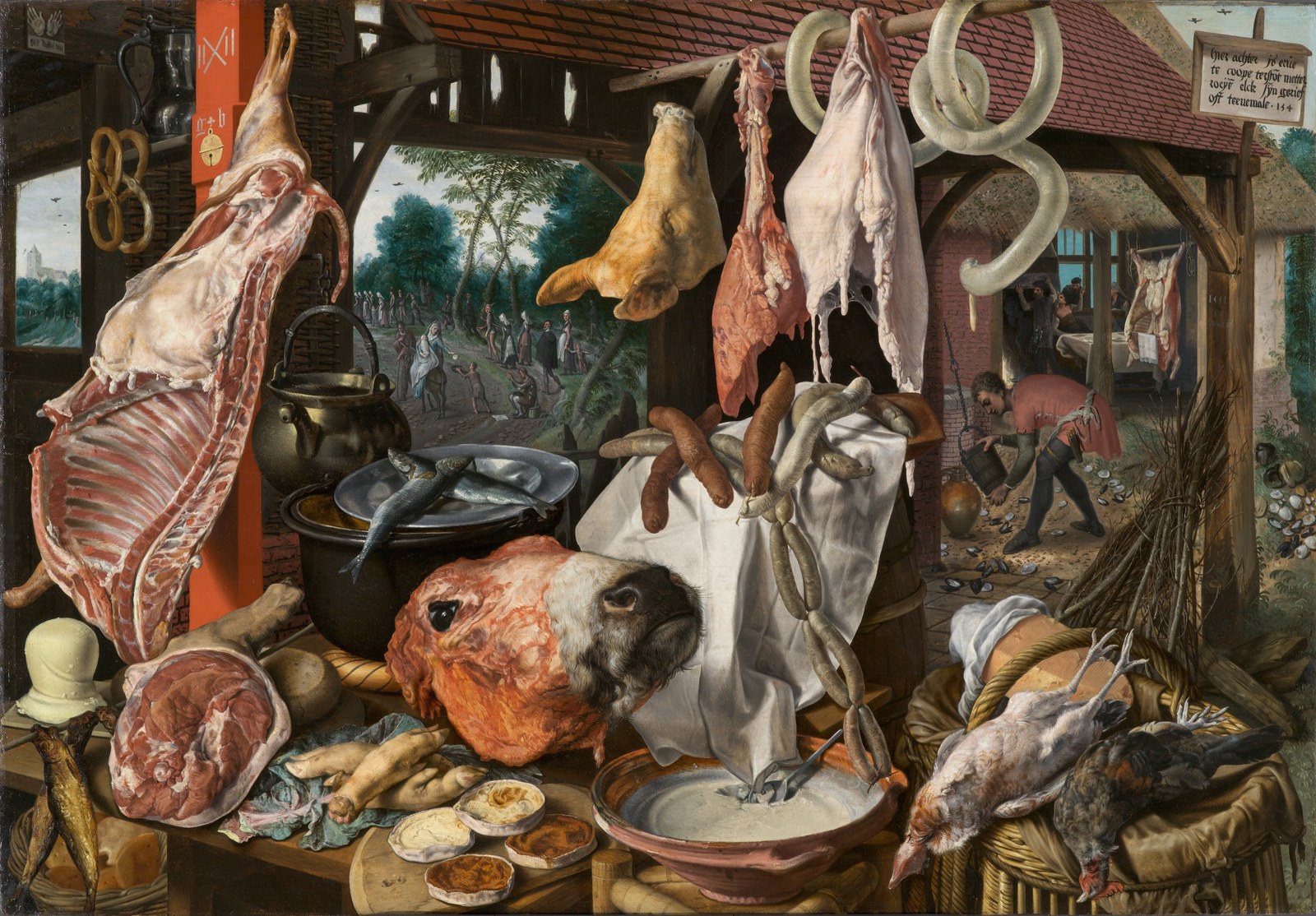
A Meat Stall with the Holy Family Giving Alms (The Butcher’s Stall). Image: Pieter Aertsen · Public domain · Wikimedia Commons, accessed 2026-08-04
The Northern Renaissance describes the parallel flowering of Renaissance-era art in the Low Countries and German-speaking lands between roughly 1430 and 1580, a tradition that shared the Italian Renaissance's interest in naturalism and individual observation but developed its own distinct visual language, largely independent of Italian perspective theory in its earliest phase.
Its foundational achievement was technical: Jan van Eyck and his contemporaries in Bruges perfected oil paint as a medium, layering thin, translucent glazes to achieve a jewel-like intensity of color and an almost microscopic level of surface detail — the individual hairs of a fur collar, the reflected room in a convex mirror, the grain of polished wood. Where Italian painters pursued mathematical perspective and idealized anatomy, Northern painters pursued exhaustive, loving description of the observed world, often embedding religious symbolism within ordinary domestic objects, a technique art historians call disguised symbolism.
This was not a rebellion against Italian art so much as a separate solution to a shared problem — how to make painting describe reality more convincingly — arrived at through different technical and cultural means. Hieronymus Bosch took the tradition's appetite for detail into fantastical, moralizing territory, populating panels like the Garden of Earthly Delights with hybrid creatures and surreal punishments. Albrecht Dürer, working in Nuremberg, fused Northern precision with direct study of Italian theory, gained through his own travels to Venice, producing prints and paintings of unmatched technical control. Pieter Bruegel the Elder, later in the period, turned this tradition's observational intensity toward peasant life and landscape, largely leaving religious subject matter behind.
The Northern Renaissance matters because it proved that Renaissance-level ambition and sophistication did not require Italian formulas: its practitioners achieved comparable naturalism through radically different means, and its innovations — oil glazing technique, the independent landscape and genre scene, the moralizing print — fed back into and permanently altered painting across Europe, Italy included.
What defines Northern Renaissance
Oil glazing technique
Painters built up color in thin, translucent layers of oil paint, achieving a luminous depth and precision of detail — reflections, textures, fabric — that egg tempera could not match.
Disguised symbolism
Ordinary household objects, animals, and architectural details often carried hidden religious or moral meaning, rewarding close, patient looking rather than announcing their significance outright.
Obsessive naturalistic detail
Surfaces were rendered with near-microscopic attention: individual threads, reflected light, and textures were painted with a precision that invites close inspection rather than distant viewing.
Printmaking and mass reproduction
Woodcuts and engravings, particularly by Dürer, spread complex imagery and Renaissance ideas across Europe far more widely and cheaply than unique panel paintings could.
Genre and landscape as independent subjects
Later Northern Renaissance painters, especially Bruegel, treated peasant life, seasonal labor, and landscape as worthy subjects in their own right, not merely as background to religious narrative.
Fantastical and moralizing imagery
Bosch and related painters populated their panels with invented hybrid creatures and elaborate visual allegories warning against sin and folly, a strain of the tradition distinct from van Eyck's calm realism.
History
The Northern Renaissance emerged in the Burgundian Netherlands in the early 1400s, centered on the wealthy trading cities of Bruges and Ghent. Jan van Eyck, court painter to the Duke of Burgundy, completed the Ghent Altarpiece in 1432 (begun by his brother Hubert) and the Arnolfini Portrait in 1434, works whose oil-glazed precision set the technical standard for the following century and a half.
Through the mid-1400s, this Netherlandish tradition of detailed, symbolically dense panel painting spread through trade and workshop networks into German-speaking lands. Hieronymus Bosch, working in 's-Hertogenbosch from the late 1400s into the early 1500s, pushed the tradition's descriptive intensity into fantastical, densely allegorical territory, most famously in the Garden of Earthly Delights.
In Germany, Albrecht Dürer became the movement's most technically ambitious figure, traveling to Venice around 1494 and again in 1505 and bringing back direct knowledge of Italian perspective and proportion theory, which he fused with Northern precision in paintings, engravings, and woodcuts distributed across Europe. His prints, including the Apocalypse series of 1498, made him one of the first artists whose reputation traveled through reproduction rather than unique commissioned works alone.
The Protestant Reformation, beginning in 1517, reshaped the movement's later decades: Reformed iconoclasm reduced demand for religious imagery in much of the north, pushing artists toward portraiture, genre scenes, and landscape. Pieter Bruegel the Elder, active in Antwerp and Brussels from the 1550s until his death in 1569, exemplifies this shift, turning the tradition's descriptive precision toward peasant festivals, proverbs, and seasonal landscapes rather than altarpieces. By the late 1500s, the Northern Renaissance's distinct regional character had begun dissolving into the broader currents of Northern Mannerism and, eventually, the Dutch Golden Age.
Key works
| Work | Artist | Year | Why it matters |
|---|---|---|---|
| The Arnolfini Portrait | Jan van Eyck | 1434 | A double portrait celebrated for its minute detail, including a convex mirror reflecting the room, and its layered symbolic meaning. |
| Ghent Altarpiece | Jan van Eyck | 1432 | A large multi-panel altarpiece whose technical mastery of oil glazing set the standard for Netherlandish painting for generations. |
| The Garden of Earthly Delights | Hieronymus Bosch | 1500 | A three-panel work populated by fantastical hybrid creatures, prized for its inventive, moralizing vision of paradise, sin, and punishment. |
| The Hunters in the Snow | Pieter Bruegel the Elder | 1565 | A landscape from a seasonal cycle, admired for its atmospheric depth and its treatment of ordinary rural life as a subject in its own right. |
| Melencolia I | Albrecht Dürer | 1514 | An engraving dense with symbolic objects, celebrated for its technical virtuosity and its meditation on creative and intellectual frustration. |
How to make art in this style
Painting in the Northern Renaissance Style Today
Palette: Work with deep, saturated jewel tones — forest green, oxblood red, ultramarine blue — built up through translucent layering rather than applied flat. Northern Renaissance color gets its intensity from glazing, thin coats of pigment suspended in oil laid over one another, not from bright pigment straight from the tube.
Composition: Fill the picture with closely observed detail rather than empty space — textiles, household objects, distant townscapes glimpsed through a window. Consider giving ordinary objects quiet symbolic weight: a single candle, a pair of discarded shoes, a dog at a figure's feet can carry meaning beyond their literal presence. Interiors work especially well, staged with enough depth to reward slow looking.
Technique: Build form through many thin, translucent glazes rather than opaque, direct painting, letting light appear to come from within the layered color itself. Render surfaces — fur, metal, glass, polished wood — with painstaking, almost microscopic precision; the tradition's power comes from the gap between minute realism and the strangeness or symbolism of what's depicted. If working in a graphic or print-based mode, dense linear hatching in the manner of engraving is equally authentic to the tradition.
Subjects: Portraiture, domestic interiors, religious narrative dense with symbolic objects, and — later in the period — peasant life, seasonal landscape, and moralizing allegory are all appropriate. Faces should be specific and unidealized rather than classically beautiful, with real, individual character.
Legacy
The Northern Renaissance's technical legacy is enormous: oil glazing, pioneered and perfected by van Eyck and his contemporaries, became the dominant painting medium across Europe for the next five centuries, effectively displacing egg tempera. Its habit of embedding meaning in closely observed domestic detail shaped the later development of genre painting, still life, and portraiture, especially in the Dutch Golden Age that followed directly from it in the 1600s.
Dürer's prints demonstrated that reproducible images could carry an artist's reputation as far as unique paintings, anticipating the role prints and, later, photography would play in circulating art. Bosch's fantastical imagery has had an unusually long afterlife, cited repeatedly by Surrealists in the twentieth century as an ancestor of their own dreamlike, hybrid invention. Bruegel's turn toward peasant life and landscape as serious subjects, rather than background incident, opened a path later followed by Dutch genre and landscape painters.
Together, these artists proved that the Renaissance's ambitions for naturalism and meaning could be pursued through minute observation and symbolic density just as powerfully as through Italian perspective and idealized form.
Frequently asked questions
What is the Northern Renaissance?
The Northern Renaissance refers to the Renaissance-era art of the Low Countries and German-speaking lands, roughly 1430 to 1580, marked by mastery of oil paint, minute realistic detail, and symbolic depth, developed largely independent of Italian perspective theory in its early phase.
Northern Renaissance vs Italian Renaissance: what's the difference?
Italian Renaissance art emphasized mathematical perspective, idealized classical anatomy, and monumental composition. The Northern Renaissance pursued a different route to realism: exhaustive surface detail, oil glazing technique, and symbolic meaning embedded in ordinary objects, rather than classical idealization.
Who perfected oil painting?
Jan van Eyck is traditionally credited with perfecting oil paint as a medium in the early 1400s, using thin translucent glazes to achieve unprecedented luminosity and detail, though he built on techniques already in limited use.
Who were the major Northern Renaissance artists?
Key figures include Jan van Eyck, Hieronymus Bosch, Albrecht Dürer, and Pieter Bruegel the Elder, each working in a different part of the Netherlands or Germany and pursuing a distinct strand of the tradition.
What is 'disguised symbolism'?
Disguised symbolism is a term describing the Northern Renaissance habit of embedding religious or moral meaning within seemingly ordinary objects and settings — a candle, a mirror, a pair of shoes — so that meaning must be read rather than announced.