 Art
Art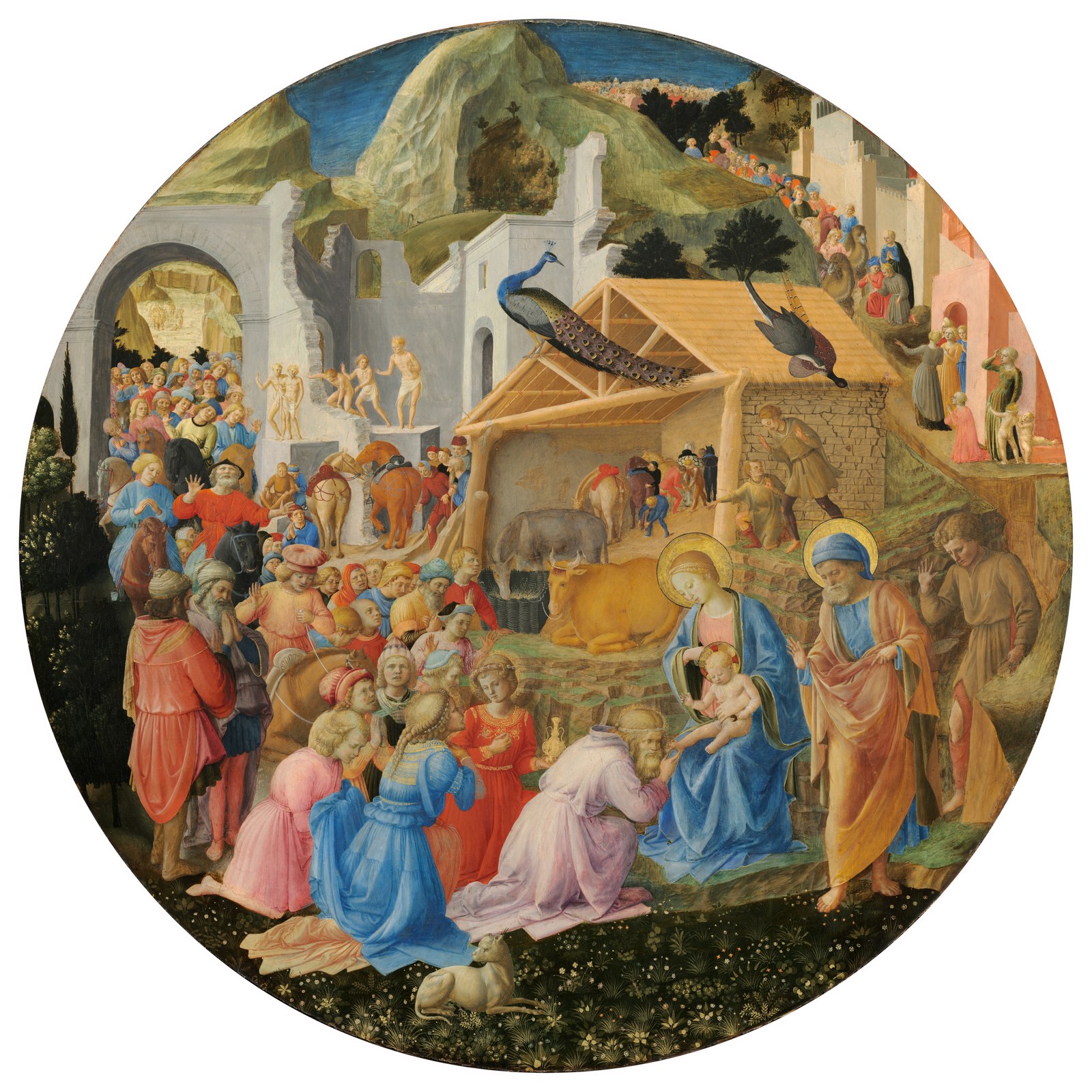
The Adoration of the Magi. Image: Fra Angelico and Fra Filippo Lippi (1395 - 1455) – painter (Italian) Born in Italy, Mugello, Vicchio. Died in Italy, Rome. Details on Google Art Project · Public domain · Wikimedia Commons, accessed 2026-08-04
The Early Renaissance, or Quattrocento (Italian for the 1400s), was the period in which Florence became the laboratory for a new, rationally structured, classically inspired art. Building on Giotto's Trecento naturalism, painters and sculptors of the 1400s systematized the representation of space, anatomy, and light, while architects and patrons revived the forms of ancient Rome.
The single most consequential technical breakthrough was linear perspective: the architect Filippo Brunelleschi demonstrated around 1415 that a scene could be constructed on a flat surface using a mathematically consistent vanishing point, and the painter Masaccio was the first to apply this rigorously in a painting, the Holy Trinity fresco of around 1427, where architecture recedes with startling, illusionistic conviction. Alongside this new spatial logic came a renewed study of the human body — Donatello's bronze David, the first freestanding nude since antiquity, treats flesh and stance with an anatomical confidence unseen since Roman sculpture.
Quattrocento art rebelled against the decorative, flattened elegance of International Gothic style, which had dominated much of Europe through the late 1300s and early 1400s. In its place, Florentine artists pursued individualized, psychologically convincing figures, rational architectural settings, and a revived interest in classical mythology and philosophy alongside traditional religious subjects — Botticelli's Birth of Venus and Primavera are the clearest examples of this classical turn, painted for the Medici circle in the 1480s.
This period matters because it established the intellectual framework — proportion, perspective, anatomical study, and classical reference — that the High Renaissance would refine and the rest of European art would inherit for centuries. It was made possible by a specific set of conditions: wealthy merchant and banking patrons, above all the Medici family, competitive guild commissions, humanist scholars translating and circulating classical texts, and a dense concentration of ambitious workshops in a single city. Painters like Fra Angelico and Piero della Francesca extended this new vocabulary into serene devotional and mathematically precise work respectively, showing the range the Quattrocento's shared toolkit could support, from mystical stillness to rigorous geometric clarity.
What defines Early Renaissance
Linear perspective
Painters constructed space using a single, mathematically consistent vanishing point, first rigorously demonstrated in Masaccio's Holy Trinity fresco, making pictures read as convincing three-dimensional rooms rather than flat, patterned surfaces.
Classical antiquity revived
Artists and patrons looked back to ancient Roman and Greek sculpture, architecture, and mythology for inspiration, reviving contrapposto stances, classical columns and arches, and pagan subject matter alongside Christian themes.
Individualized, humanist figures
Faces and bodies became specific and psychologically present rather than generic types, reflecting a broader humanist interest in the individual person as a subject worthy of careful observation.
Anatomical and proportional study
Sculptors and painters studied the human body closely, working out proportion and musculature with new precision, as seen in Donatello's bronze David and later formalized in written treatises on proportion.
Egg tempera giving way to oil
Most Quattrocento painting still used egg tempera on wood panel, prized for its precise, luminous detail, though oil paint began entering Italy from the north late in the period.
Rational architectural settings
Interiors and townscapes were rendered as coherent, geometrically ordered spaces, often echoing the new classicizing architecture being built in Florence at the same time.
History
The Early Renaissance began in Florence in the early 1400s, propelled by a cluster of individuals working in close dialogue: the architect Filippo Brunelleschi, who formulated the rules of linear perspective around 1415 while studying ancient Roman ruins; the sculptor Donatello, who revived classical anatomical naturalism in works like his bronze David; and the painter Masaccio, who died young in 1428 but left, in his Brancacci Chapel frescoes and the Holy Trinity, the first fully perspectival paintings in Western art.
This new vocabulary spread quickly through Florence's competitive workshop culture, encouraged by patrons eager to demonstrate civic and personal prestige — most importantly the Medici family, who rose to dominate Florentine politics and patronage across the middle of the century. Fra Angelico brought the new naturalism to devotional fresco cycles for the Dominican convent of San Marco in the 1440s; Piero della Francesca, working partly outside Florence in Arezzo and Urbino, pushed perspective and geometric structure to a rigorous, almost mathematical extreme.
By the second half of the century, under Medici patronage, Florentine art turned increasingly toward classical mythology and courtly refinement, epitomized by Sandro Botticelli's Birth of Venus and Primavera, painted in the 1480s for Lorenzo di Pierfrancesco de' Medici. Leon Battista Alberti's treatises on painting and architecture, written mid-century, gave the movement's practices theoretical grounding, framing painting as a rational, humanist discipline rather than a craft.
The Quattrocento gave way to the High Renaissance around 1490–1500, as the center of gravity shifted partly to Rome and as artists including the young Leonardo da Vinci, trained in Florentine workshops of this era, began synthesizing its lessons on a grander, more unified scale. The Early Renaissance is remembered as the formative period in which the tools of Western representational painting — perspective, proportion, anatomical observation — were established.
Key works
| Work | Artist | Year | Why it matters |
|---|---|---|---|
| Holy Trinity | Masaccio | 1427 | The first painting to apply consistent linear perspective with full rigor, creating a convincing illusion of architectural space on a flat wall. |
| The Tribute Money | Masaccio | 1425 | A fresco cycle including The Tribute Money, celebrated for its naturalistic figures and unified light source, deeply studied by later Florentine painters. |
| David | Donatello | 1440 | A bronze nude, the first freestanding nude statue since antiquity, marking a decisive revival of classical sculptural confidence. |
| The Birth of Venus | Sandro Botticelli | 1485 | A mythological subject rendered with linear elegance, exemplifying the Medici court's turn toward classical antiquity. |
| Annunciation | Fra Angelico | 1440 | A serene fresco at the Convent of San Marco combining devotional stillness with newly rigorous architectural perspective. |
| Flagellation of Christ | Piero della Francesca | 1460 | A small panel renowned for its enigmatic, mathematically precise use of perspective and architectural space. |
How to make art in this style
Painting in the Early Renaissance Style Today
Palette: Favor the luminous, slightly cool clarity of egg tempera — soft pinks, sage greens, dusty blues, warm ochres, and gold accents, all kept relatively light in value. Colors should feel clean and jewel-like rather than heavily blended or shadowed.
Composition: Build your scene around a single, consistent vanishing point. Use architectural elements — arches, coffered ceilings, receding pavement tiles — to make the perspective construction visible and legible; Quattrocento painters often made their mastery of space part of the picture's subject. Arrange figures with clear, measured spacing rather than dramatic overlap, giving each one room to be read individually.
Technique: Work with fine, controlled linework and smooth, gradual tonal transitions rather than loose brushwork. Traditionally this meant egg tempera on a gessoed panel, applied in thin, careful hatched layers; the result is precise, matte, and detailed rather than richly textured. Study anatomy and drapery directly — Quattrocento confidence in the body came from close observation, not shorthand.
Subjects: Religious narrative remains the core subject — Annunciations, Madonnas, saints, biblical scenes — but classical mythology, portraiture, and idealized civic architecture are equally appropriate. Give figures calm, contained poses and individualized, thoughtful expressions rather than heightened drama, which belongs to later periods. A sense of rational order, in both space and gesture, is the throughline of the whole style.
Legacy
The Early Renaissance's legacy is foundational rather than stylistic: it gave later European art its basic technical grammar. Linear perspective, anatomical study, and classical reference — pioneered and systematized in Quattrocento Florence — remained the default assumptions of Western representational art for the next four centuries, questioned seriously only with the arrival of modernism.
Its immediate heirs, Leonardo da Vinci, Michelangelo, and Raphael, trained in workshops shaped by Quattrocento methods and carried its lessons to greater unity and monumentality in the High Renaissance. Its humanist framing of the individual — the conviction that a face, a body, a specific person deserved careful, dignified observation — shaped the entire tradition of Western portraiture that followed.
Beyond painting, the Quattrocento's revival of classical proportion and architecture influenced European building design for centuries, and its treatises on perspective and proportion, particularly Alberti's, became standard art-school teaching well into the modern era. Today, the period's clean geometric spaces, luminous tempera color, and classically inspired figures remain a recognizable visual shorthand for Renaissance Florence itself, referenced constantly in film, design, and popular imagery of the era.
Frequently asked questions
What is the Early Renaissance?
The Early Renaissance, or Quattrocento, was the period of Italian art from roughly 1400 to 1490, centered on Florence, when linear perspective, classical revival, and humanist naturalism transformed painting and sculpture. It set the technical foundation the High Renaissance later built on.
What does 'Quattrocento' mean?
Quattrocento is Italian for '400s,' referring to the 1400s (fifteenth century), the period covering the Early Renaissance's major developments in Florence and elsewhere in Italy.
Early Renaissance vs High Renaissance: what's the difference?
The Early Renaissance established perspective, anatomical study, and classical revival, often with a slightly linear, detailed quality. The High Renaissance, roughly 1490 to 1527, synthesized those tools into more unified, monumental, and idealized compositions in the work of Leonardo, Michelangelo, and Raphael.
Who invented linear perspective?
The architect Filippo Brunelleschi is credited with formulating the mathematical rules of linear perspective around 1415, which the painter Masaccio was the first to apply rigorously in a painting.
Who were the key Early Renaissance artists?
Leading figures included the painter Masaccio, the sculptor Donatello, the painter and friar Fra Angelico, the mathematically precise painter Piero della Francesca, and Sandro Botticelli, who worked later in the period for the Medici court.