 Art
Art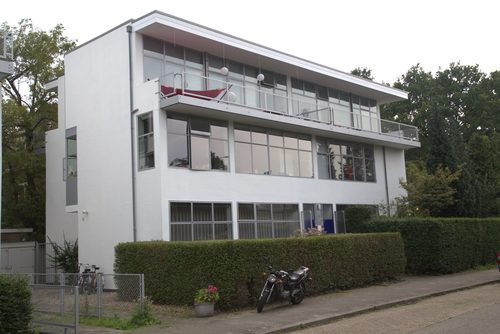
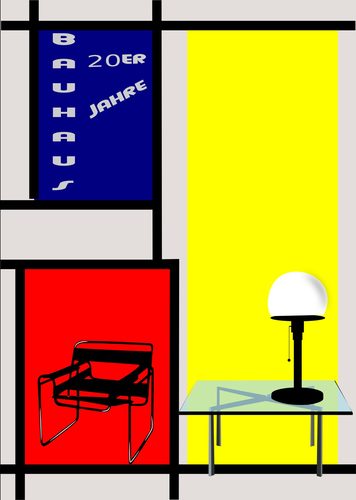
De Stijl was a small Dutch painting and design movement built on a strict visual language, while the Bauhaus was a German art and design school that taught many visual languages under one roof. Theo van Doesburg and Piet Mondrian founded De Stijl in the Netherlands in 1917, reducing art to horizontal and vertical lines, flat rectangular planes, and a limited palette of primary colors plus black, white, and gray, believing this austere grammar expressed universal harmony. Walter Gropius founded the Bauhaus two years later, in 1919, in Weimar, Germany, not as a single style but as a school where painting, architecture, furniture, textiles, and typography were taught together, aiming to unite fine art and craft. Van Doesburg himself taught De Stijl ideas to Bauhaus students in Weimar and pushed the school's early Expressionist leanings toward his own geometric clarity, so De Stijl's ideas fed directly into the school even though the two remained distinct: one a tight aesthetic doctrine, the other an institution.
De Stijl vs. Bauhaus at a glance
| De Stijl | Bauhaus | |
|---|---|---|
| Years | 1917–1931 | 1919–1933 |
| Origin | Netherlands | Weimar & Dessau, Germany |
| Nature | A specific painting and design style with strict rules about color, line, and form. | An art and design school teaching many disciplines, not one single fixed visual style. |
| Palette | Primary colors plus black, white, and gray only, used in flat, unmixed blocks. | No fixed palette; styles ranged from bold color to industrial black, white, and metal tones. |
| Form language | Strict horizontal and vertical lines and rectangular planes, rarely a diagonal or curve. | More varied: geometric in furniture and typography, but open to different forms across departments. |
| Scope | Mostly painting, furniture, and architecture, produced by a small, tightly aligned circle of artists. | Painting, architecture, textiles, typography, theater, and product design, taught to generations of students. |
| Key figures | Theo van Doesburg and Piet Mondrian led the movement's core ideas. | Walter Gropius founded it; Wassily Kandinsky, Paul Klee, and Laszlo Moholy-Nagy taught there. |
| Format | A published manifesto and journal defining a shared aesthetic among independent artists. | A physical school with workshops, faculty, and enrolled students producing varied work. |
How to tell them apart
If a painting or building uses only straight horizontal and vertical lines, flat red, yellow, and blue blocks, and white or black ground, with no diagonals or curves, you're looking at De Stijl; Mondrian's grid paintings are the clearest example. The Bauhaus has no single look: it might be a tubular steel chair, a sans-serif typeface, a geometric abstract painting, or a glass-walled building with a flat roof and asymmetrical facade, since it was a school teaching many approaches rather than one aesthetic. Functional, unornamented industrial design across several different media is the strongest tell for Bauhaus work, while red, yellow, blue, black, and white rectangles alone signal De Stijl.
What they share
Both movements pursued universal, rational design principles meant to apply across painting, furniture, and architecture rather than staying confined to canvas. Theo van Doesburg's years in Weimar teaching Bauhaus students directly connected the two, pushing the school's early years toward geometric abstraction and away from its initial Expressionist mood. Both also believed good design could improve everyday life and rejected purely decorative ornament in favor of clean, functional form.
Try both
Settle it yourself — generate the same subject in each style and compare the results.
Frequently asked questions
Is De Stijl the same as the Bauhaus?
No. De Stijl was a small Dutch movement built around a strict grid of primary colors and straight lines, while the Bauhaus was a German school teaching many art and design disciplines. They influenced each other, but De Stijl is a style and the Bauhaus is an institution.
Which came first, De Stijl or the Bauhaus?
De Stijl came first, founded in the Netherlands in 1917. The Bauhaus followed two years later, founded in Weimar, Germany in 1919.
Did De Stijl influence the Bauhaus?
Yes, directly. Theo van Doesburg settled in Weimar in the early 1920s, taught De Stijl ideas to Bauhaus students, and pushed the school's teaching away from Expressionism toward the geometric, primary-color clarity associated with De Stijl.