 Art
Art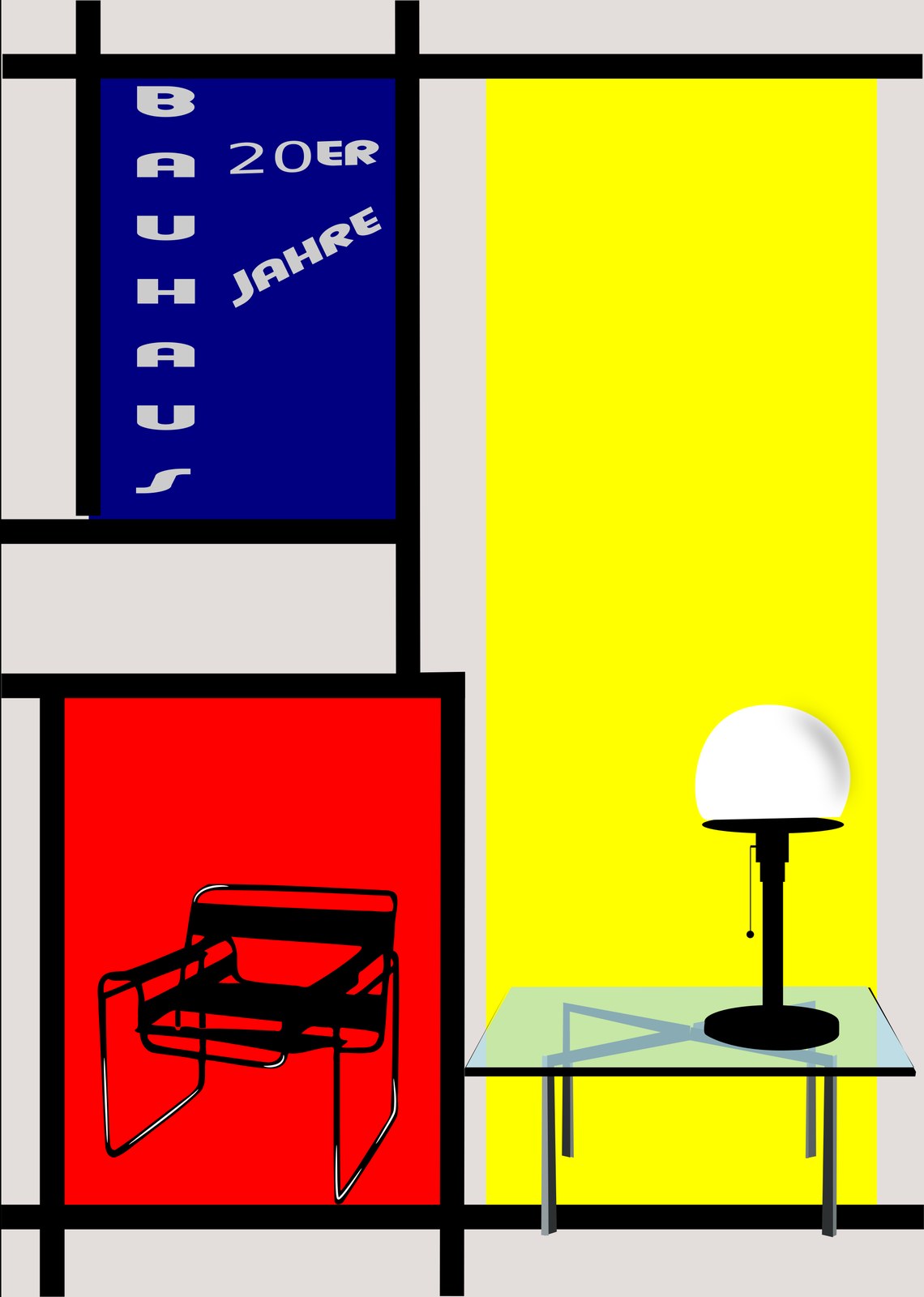
20er Bauhaus. Image: U971331 · CC BY 4.0 · Wikimedia Commons, accessed 2026-08-04
The Bauhaus was not a painting movement but a school — founded in Weimar, Germany, in 1919 by architect Walter Gropius, merging the city's Academy of Fine Art with its School of Arts and Crafts. Its founding manifesto called for uniting all the arts under the roof of a single "building" (Bau), dissolving the old hierarchy that separated fine artists from craftsmen. Every student began with a foundational course (Vorkurs), first taught by Johannes Itten, that trained the eye in basic form, color theory, and material properties before students moved into specialized workshops — weaving, metalwork, furniture, typography, ceramics, and eventually architecture.
Early Bauhaus work carried an expressionist, almost mystical streak under Itten. After 1923, under pressure to prove the school's practical value, Gropius pushed it toward his slogan "Art and Technology: A New Unity," and the aesthetic sharpened into the clean, geometric functionalism now associated with the name. László Moholy-Nagy replaced Itten and brought a machine-age sensibility; painters Wassily Kandinsky and Paul Klee taught rigorous courses in color and form that shaped generations of designers. In 1925 the school relocated to Dessau, moving in 1926 into a new glass-and-steel campus building designed by Gropius himself — an emblem of Bauhaus ideals built as architecture.
The Bauhaus rebelled against nineteenth-century ornament, historicist revival styles, and the divide between "high" art and applied craft. It insisted that a well-designed chair, typeface, or lamp mattered as much as a painting, and that good design should be reproducible for everyone, not reserved for the wealthy. Politically vulnerable from the start, the school was forced out of Dessau in 1932 and closed entirely in Berlin in 1933 under Nazi pressure, which viewed its modernism as culturally suspect.
Its closure scattered its masters worldwide — Gropius and Marcel Breuer to Harvard, Mies van der Rohe to Chicago's Illinois Institute of Technology, Moholy-Nagy to found Chicago's New Bauhaus — carrying its teaching methods into architecture and design schools everywhere. Few movements have shaped the everyday look of the modern world as thoroughly: sans-serif type, tubular steel furniture, and unornamented glass-and-steel buildings all trace back to this fourteen-year experiment.
What defines Bauhaus
Geometric universal forms
Kandinsky and Itten taught that the circle, square, and triangle were a universal visual language, each linked in theory to a primary color (blue, red, yellow). This vocabulary underpinned painting, textiles, and product design alike.
Functionalism over ornament
Surfaces were left undecorated and structure was often exposed rather than hidden, following the belief that a well-designed object's form should arise directly from its purpose.
Industrial materials
Tubular steel, glass, and concrete replaced traditional wood and stone, allowing forms — especially in furniture — that were light, mass-producible, and visibly modern.
Workshop-based teaching
Students trained in hands-on craft workshops alongside fine-art "masters," collapsing the old separation between artist and artisan and treating design as a rigorous, teachable discipline.
Reformed typography
Bauhaus designers, notably Herbert Bayer, stripped typefaces down to lowercase sans-serif letterforms and organized text on strong asymmetric grids, rejecting ornate historical type.
Primary color systems
Red, yellow, blue, black, and white dominated Bauhaus painting, textiles, and graphics, used in flat, unmodulated fields rather than blended or naturalistic tones.
History
Walter Gropius founded the Bauhaus in Weimar in 1919 by merging two existing schools, publishing a manifesto illustrated with Lyonel Feininger's woodcut of a "cathedral of socialism" that expressed his utopian hope of reuniting art and craft. The school's first years, guided by Johannes Itten's foundational course, had a spiritual, expressionist character. That shifted after 1923, when Gropius staged the exhibition "Art and Technology: A New Unity" to answer critics who doubted the school's practical relevance, steering the Bauhaus toward industrial design and standardized production. Itten resigned in 1923 and Moholy-Nagy took over the foundational course, teaching it with Josef Albers and sharpening its machine-age focus.
In 1925, facing political hostility in Weimar, the school moved to Dessau into a purpose-built campus designed by Gropius — glass curtain walls, flat roofs, and asymmetric massing that became an architectural manifesto in its own right. Leadership changed again in 1928 when Hannes Meyer succeeded Gropius as director, pushing the school toward socially minded architecture and mass housing, and again in 1930 when Mies van der Rohe took over and narrowed the curriculum toward architecture.
Nazi political pressure forced the Bauhaus out of Dessau in 1932; it relocated to Berlin as a private institution before Mies closed it under Gestapo pressure in 1933. The regime denounced its modernism as un-German. Its dispersed masters carried Bauhaus methods abroad — Gropius and Breuer to Harvard's Graduate School of Design, Mies to Chicago, Moholy-Nagy founding Chicago's New Bauhaus — embedding its foundational-course pedagogy and functionalist aesthetic into architecture and design education across the United States and, later, the world.
Key works
| Work | Artist | Year | Why it matters |
|---|---|---|---|
| Bauhaus Building, Dessau | Walter Gropius | 1926 | The school's purpose-built campus, with its glass curtain walls and asymmetric plan, made functionalist architecture into a manifesto. |
| Wassily Chair | Marcel Breuer | 1925 | A tubular-steel chair inspired by bicycle handlebars that became one of the enduring icons of modern furniture design. |
| Composition VIII | Wassily Kandinsky | 1923 | Painted while teaching at the Bauhaus, it distills his geometric abstract vocabulary of circles, lines, and triangles. |
| Pedagogical Sketchbook | Paul Klee | 1925 | A teaching text distilling Klee's Bauhaus lectures on the building blocks of visual form. |
| Universal typeface | Herbert Bayer | 1925 | A lowercase, geometric sans-serif designed to simplify German printing and embody Bauhaus typographic reform. |
How to make art in this style
Palette: Work with the primary triad — red, yellow, blue — plus black, white, and gray. Apply colors as flat, unmodulated fields rather than blended tones; avoid pastels or naturalistic mixing.
Composition: Build on a strong underlying grid, favoring asymmetric balance over centered symmetry. Follow the Bauhaus color-form theory as a starting discipline — Kandinsky associated the circle with blue, the square with red, and the triangle with yellow — and use these basic shapes as your primary compositional units rather than illustrative detail.
Technique: Eliminate visible brushwork and decorative flourish. Keep edges hard and clean, whether in paint, collage, or digital media. If working in a design or product context, let structure remain visible rather than concealed behind ornament — a joint, a seam, or a support should read honestly rather than being disguised.
Subjects: Favor abstract geometric studies, architectural and product forms, and typography over figurative or narrative subject matter. If designing an object — furniture, a poster, a typeface — think in terms of function first: what does this object need to do, and what is the simplest, most legible form that does it?
Typography: If lettering is involved, use a geometric sans-serif, prefer lowercase, and organize text on a strict grid with generous white space. Bold rules, circles, and color blocks can substitute for illustration.
Above all, treat the work as a problem of structure and function rather than expression — the Bauhaus approach subordinates personal gesture to legible, reproducible order.
Legacy
The Bauhaus set the template for International Style architecture, whose unornamented glass-and-steel forms went on to dominate postwar skylines worldwide. Its foundational course — teaching form, color, and material before specialization — became the standard model for design schools everywhere, from graphic design to industrial design programs. Herbert Bayer's typographic reforms fed directly into the Swiss Style of graphic design that still shapes corporate branding and signage today.
Tubular-steel furniture, once radical, is now a design-store staple; Marcel Breuer's Wassily chair remains in production a century after its creation. The Bauhaus idea that ordinary objects — a lamp, a chair, a poster — deserve the same design rigor as a painting reshaped how industrial societies think about mass production, giving rise to modern industrial design as a discipline. Its emigrant masters' work at Harvard and IIT embedded Bauhaus thinking directly into American architectural education, and by extension into the corporate modernism of postwar skyscrapers.
Today, the clean sans-serif type, primary-color geometric graphics, and minimalist functional objects that define much of contemporary branding and interior design descend, often unknowingly, from a fourteen-year German school that insisted craft and art were never meant to be separated.
Frequently asked questions
What is Bauhaus art?
Bauhaus refers to the German school of art, design, and architecture (1919–1933) rather than a single painting style. It taught that fine art, craft, and industrial design should be unified, favoring geometric abstraction, functional design, and unornamented form.
Was the Bauhaus a movement or a school?
It was formally a school, founded by Walter Gropius in Weimar in 1919. Its teaching methods and aesthetic became so influential and widely imitated that it is often discussed as a movement in its own right.
Who founded the Bauhaus?
Architect Walter Gropius founded it in 1919 by merging Weimar's Academy of Fine Art with its School of Arts and Crafts. He directed it until 1928, when Hannes Meyer and later Mies van der Rohe succeeded him.
Why did the Bauhaus close?
The school closed in 1933 after sustained pressure from the Nazi regime, which viewed its modernist, internationalist aesthetic as politically and culturally suspect. It had already been forced to relocate from Weimar to Dessau to Berlin under earlier political pressure.
How is Bauhaus different from De Stijl?
Both favored geometric abstraction and primary colors, but De Stijl was a Dutch fine-art and design movement centered on painting and architecture, while the Bauhaus was a school that integrated craft workshops, industrial production, and formal art teaching under one institution.
What is Bauhaus color theory?
Taught primarily by Kandinsky and Itten, it linked the three primary colors to three basic geometric shapes — blue to the circle, red to the square, yellow to the triangle — as a foundational exercise in visual perception.