 Art
Art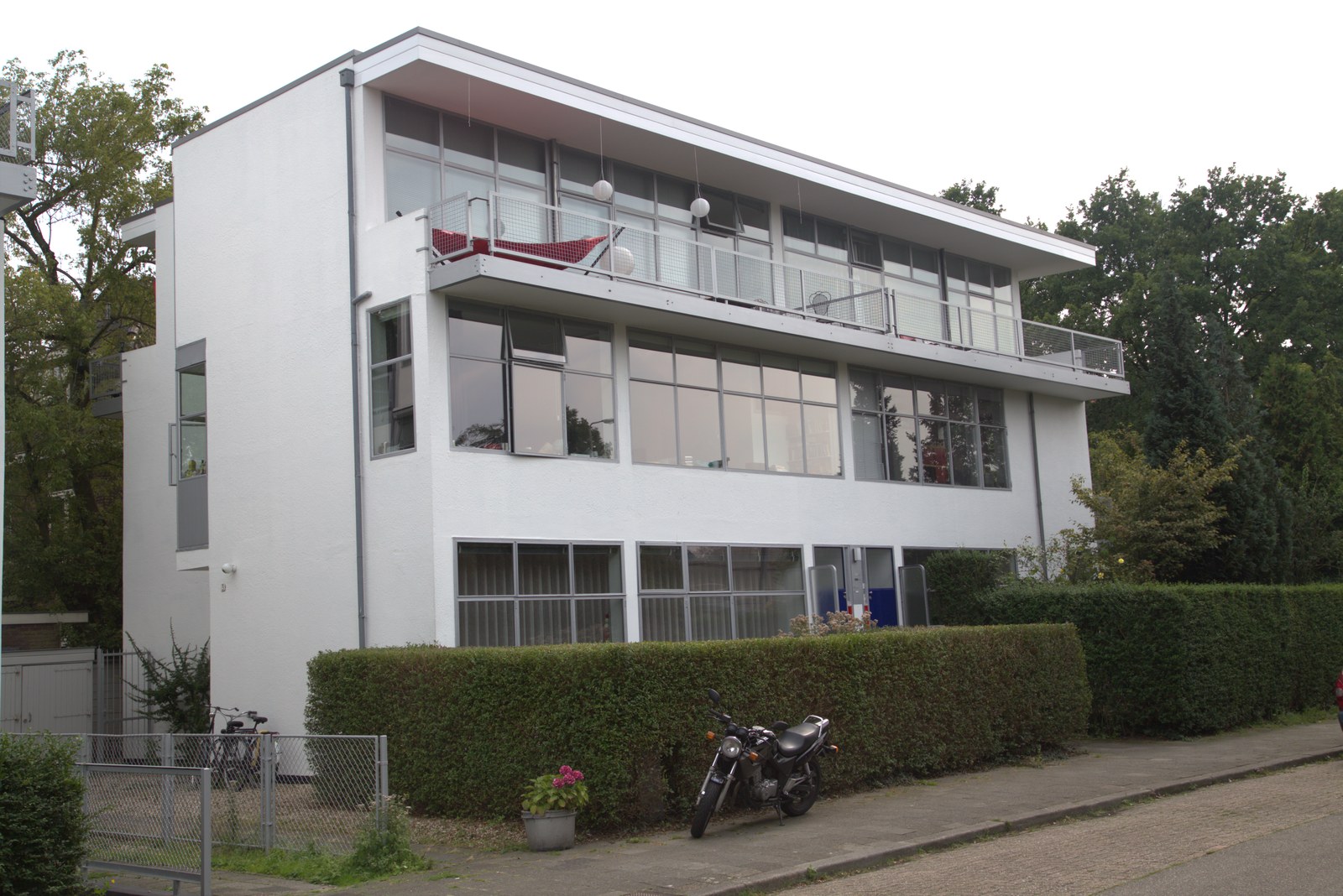
JB.Utrecht.Erasmuslaan.3. Image: John Boers · CC BY-SA 4.0 · Wikimedia Commons, accessed 2026-08-04
De Stijl (Dutch for "The Style"), also known as Neoplasticism, was founded in the Netherlands in 1917 around a journal of the same name, edited by the painter and designer Theo van Doesburg. Its central figure, Piet Mondrian, developed the movement's most rigorous and recognizable visual language: canvases built entirely from black horizontal and vertical lines dividing the surface into rectangles filled, or left unfilled, with the three primary colors — red, yellow, and blue — alongside black, white, and grey. No other colors, no curves, no diagonals: De Stijl artists believed that reducing painting to these fundamental elements revealed a universal harmony underlying all visible reality.
The movement's core belief, articulated by Mondrian under the term "Neoplasticism," was that pure abstraction could achieve a spiritual and aesthetic balance impossible in representational art, which remained tied to the particularities of individual objects and momentary appearances. By stripping painting to horizontal-vertical structure and primary color, De Stijl artists sought something closer to a universal visual grammar — orderly, impersonal, and, they believed, applicable to design and architecture as much as to painting.
De Stijl rebelled against both academic naturalism and what its members saw as the residual subjectivity and decorative excess of earlier modern movements, including Cubism, from which Mondrian's own style had evolved. The movement extended its principles well beyond painting: Gerrit Rietveld applied De Stijl's grid logic to furniture, most famously his Red and Blue Chair, and to architecture in the Rietveld Schröder House, while Theo van Doesburg pursued related ideas in typography, interior design, and even, controversially, in diagonal compositions that led to his split from Mondrian in the mid-1920s.
De Stijl matters because it pushed pure geometric abstraction to one of its most disciplined and enduring conclusions, and because it refused to stay confined to painting — the movement's grid-and-primary-color logic shaped architecture, furniture, typography, and graphic design throughout the twentieth century and remains one of the most immediately recognizable visual languages in all of modern art, still widely referenced in branding, interior design, and popular visual culture today.
What defines De Stijl
Horizontal and vertical lines only
Compositions are built exclusively from straight horizontal and vertical black lines, with no curves or diagonals permitted under the movement's strict formal rules. This orthogonal grid became the movement's defining visual signature.
Primary color plus neutrals
The palette is limited to the three primary colors — red, yellow, and blue — combined with black, white, and grey. No secondary or tertiary colors, gradients, or shading are used.
Flat, unmodulated rectangles
The grid divides the canvas into rectangles of varying size, each filled with flat, even color or left white, with no illusion of depth, texture, or brushwork visible on the surface.
Asymmetrical balance
Despite the strict geometric vocabulary, compositions avoid perfect symmetry, instead achieving a dynamic equilibrium through the careful, deliberate placement and proportion of unequal rectangles and lines.
Extension beyond painting
De Stijl principles were applied directly to furniture, architecture, and interior design, most famously in Gerrit Rietveld's Red and Blue Chair and Schröder House, treating the grid as a total design philosophy rather than a painting style alone.
Universal, impersonal aesthetic
The movement deliberately avoided any trace of individual gesture or emotional expression, aiming instead for an impersonal, universal visual order believed to reflect underlying cosmic harmony.
History
De Stijl formed in the Netherlands in 1917, when Theo van Doesburg founded a journal of the same name to promote a new, radically reduced abstract style, bringing together painters including Piet Mondrian, Bart van der Leck, and later the architect and furniture designer Gerrit Rietveld. The Netherlands' neutrality during World War I allowed the group to develop its ideas relatively undisturbed while much of Europe was consumed by the war, and van der Leck's early experiments with flat planes of primary color directly shaped Mondrian's move toward his mature grid style.
Mondrian, who had already been developing an increasingly abstract, grid-based painting language in Paris before the war, became the movement's most rigorous theorist, publishing his ideas under the term "Neoplasticism" and refining his black-line, primary-color grid compositions through the late 1910s and 1920s into the tightly disciplined style now most associated with the movement. Van Doesburg, meanwhile, pushed De Stijl's principles outward into typography, interior design, and international outreach, forging contacts with the Bauhaus in Germany and helping spread De Stijl's influence across European modernist design circles during the early-to-mid 1920s.
A significant rupture occurred in 1924–25, when van Doesburg introduced diagonal lines into his own compositions, a development he termed "Elementarism." Mondrian, committed to strict horizontal-vertical purity, considered this a betrayal of the movement's core principles and broke publicly with van Doesburg, effectively splitting the movement's leadership. Rietveld continued to apply De Stijl principles to architecture and design throughout the 1920s, most famously in the 1924 Rietveld Schröder House in Utrecht.
Theo van Doesburg's death in 1931 is generally taken as the effective end of De Stijl as an organized group, though Mondrian continued developing his personal grid style — later loosening its strict black lines in his final New York-period paintings — until his own death in 1944. The movement's ideas, however, had already spread well beyond its small founding circle by the time it formally dissolved.
Key works
| Work | Artist | Year | Why it matters |
|---|---|---|---|
| Composition with Red, Blue and Yellow | Piet Mondrian | 1930 | One of the most iconic and widely reproduced examples of Mondrian's mature grid style, distilling the movement's core vocabulary into a single canvas. |
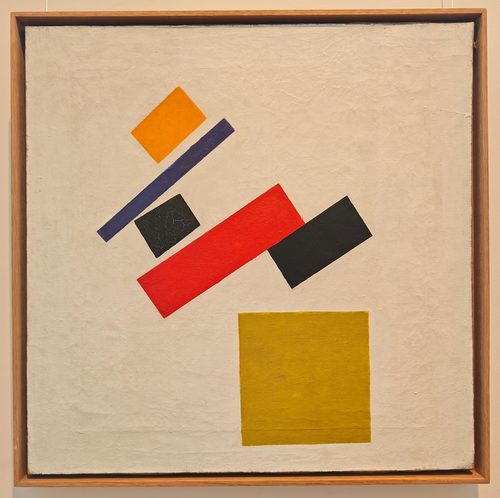
| Composition VIII (The Cow) | Theo van Doesburg | 1918 | Demonstrates van Doesburg's process of abstracting a recognizable subject into flat planes of color, an early De Stijl painting method shared with van der Leck. |
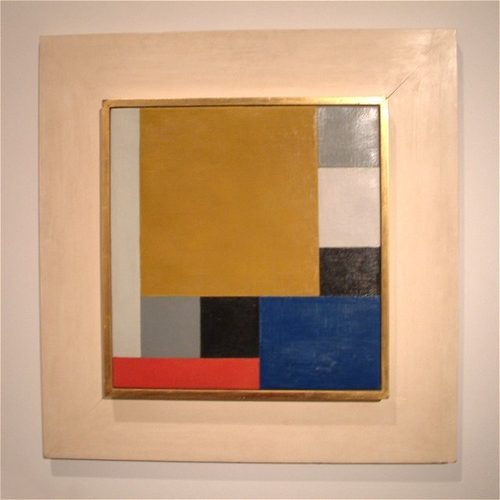
| Counter-Composition V | Theo van Doesburg | 1924 | Represents van Doesburg's later introduction of diagonal lines, the "Elementarist" development that led to his split from Mondrian. |
How to make art in this style
Working in a De Stijl style
Palette: Restrict color strictly to the three primary colors — pure red, yellow, and blue — plus black, white, and grey. Apply each color flat and unmixed; there should be no shading, blending, gradients, or secondary colors anywhere in the composition.
Composition: Build the entire image from a grid of horizontal and vertical black lines only — no diagonals, no curves. Divide the canvas into rectangles of deliberately unequal size and proportion, filling some with color and leaving others white, and adjust the placement until the arrangement feels balanced without being symmetrical; De Stijl compositions achieve equilibrium through carefully judged asymmetry, not mirrored halves.
Technique: Paint each rectangle as a flat, even plane of color with crisp, ruled edges — precision matters, since the visual power of the style depends on the clean geometry of the grid rather than any expressive brushwork. If working digitally or with tape and paper, this discipline is easier to maintain than freehand.
Subjects: There is no representational subject matter — De Stijl painting is entirely non-objective. When applying the style to furniture, architecture, or design objects, let the grid and primary-color logic govern the structure itself (as Rietveld did with chair frames and wall planes) rather than treating color as surface decoration applied afterward.
Practical tip: Start by drawing the black grid lines alone and evaluate the balance of the empty rectangles before adding any color — a well-proportioned grid should feel dynamically stable even without color, and the color placement should reinforce, not rescue, that balance.
Legacy
De Stijl's grid-and-primary-color language became one of the most influential and widely recognized visual vocabularies in modern design. Its ideas circulated directly into the Bauhaus through van Doesburg's contacts, reinforcing the growing international modernist consensus that architecture, furniture, and graphic design should share a unified, geometric, functionalist visual logic — a principle now foundational to modern architecture and industrial design worldwide.
Mondrian's grid compositions in particular have become one of the most reproduced and referenced images in modern art, appearing across fashion, advertising, product design, and popular culture for decades, from Yves Saint Laurent's famous 1965 "Mondrian" dresses to countless later homages in graphic design and branding. Rietveld's furniture and architecture remain touchstones in design education for demonstrating how a painterly grid logic can be translated into functional three-dimensional objects and spaces.
De Stijl's insistence on a shared, universal visual grammar across painting, furniture, and architecture helped establish the broader twentieth-century modernist principle that form should be reduced to its essential structural elements. Today, the movement's clean grid of black lines and primary color blocks remains instantly recognizable and continues to be quoted, often explicitly, in web and interface design, packaging, and minimalist branding wherever a designer wants to signal order, clarity, and modernist rigor.
Frequently asked questions
What is De Stijl?
De Stijl is a Dutch art movement founded in 1917 that reduced painting, architecture, and design to horizontal and vertical black lines, flat rectangles, and the three primary colors plus black, white, and grey, in pursuit of a universal visual harmony.
Who founded De Stijl?
De Stijl was founded by Theo van Doesburg, who launched the movement's journal in 1917, working closely with painter Piet Mondrian, whose grid-based Neoplastic paintings became the movement's defining visual style.
What is Neoplasticism?
Neoplasticism is the term Piet Mondrian used for his own theory and practice within De Stijl, describing his strict reduction of painting to horizontal-vertical black lines and primary-color rectangles as a new, universal plastic art.
Why did Mondrian and van Doesburg split?
In the mid-1920s van Doesburg began introducing diagonal lines into his compositions under the term "Elementarism," which Mondrian considered a betrayal of De Stijl's strict horizontal-vertical principles, leading to a public break between the two.
How did De Stijl influence architecture?
Gerrit Rietveld applied De Stijl's grid and primary-color principles directly to furniture and architecture, most famously in his Red and Blue Chair and the Rietveld Schröder House, and the movement's ideas fed into the broader International Style of modern architecture.