 Art
Art
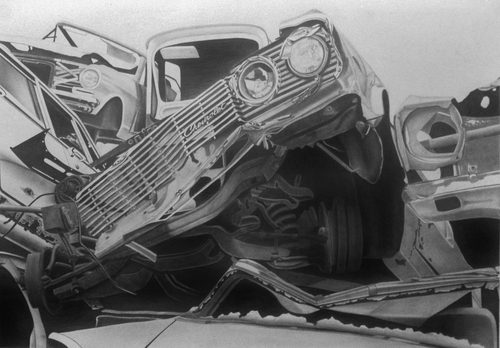
Realism is a 19th-century movement about painting ordinary life honestly, while Photorealism is a 20th-century movement about painting with the mechanical precision of a camera. Realism began in France around 1840, led by Gustave Courbet, as a direct challenge to Romanticism's heroics and myth — instead, painters depicted peasants, laborers, and everyday scenes without idealizing them, insisting art should reflect the visible, social world. Photorealism arrived over a century later, from 1968, when American painters began working directly from photographs, using grids, airbrushes, and projectors to reproduce photographic detail — reflections, focus blur, and all — with obsessive exactness. The two share a name and a claim to truthfulness, but they answer different questions: Realism asks what is worth depicting honestly; Photorealism asks how mechanically exact a painted image can become.
Realism vs. Photorealism at a glance
| Realism | Photorealism | |
|---|---|---|
| Years | 1840–1880 | 1968–1985 |
| Origin | France | United States |
| Core aim | Depict ordinary life and working people honestly, without flattering idealization or classical myth. | Reproduce a photograph's mechanical precision — reflections, blur, grain — as exactly as possible in paint. |
| Subject matter | Peasants, laborers, and everyday rural or urban scenes chosen for their social truth. | Cars, diners, storefronts, and other banal contemporary subjects chosen for their photographic qualities. |
| Technique | Direct observation and visible brushwork, painted from life or memory rather than a photograph. | Grids, projectors, and airbrushes used to transfer a photograph's exact detail onto canvas. |
| Attitude | Socially engaged, sometimes political, elevating overlooked working-class subjects to the scale of history painting. | Detached and technical, more interested in optical precision than social commentary. |
| Surface | Visible texture and brushstroke; paint handling remains part of the image's meaning. | Smooth, near-photographic finish that hides brushwork almost entirely. |
| Origins | Paris art world, reacting against Romantic and academic painting traditions of the 1840s. | American painters reacting against Abstract Expressionism's gesture and emotion in the late 1960s. |
How to tell them apart
If the painting shows unglamorous rural or working-class life with visible brushwork and a sense of social observation, you're looking at Realism. If the image is eerily sharp, mimics a camera's depth of field, and includes photographic quirks like lens flare or reflections in chrome and glass, that's Photorealism. Realism paintings look hand-made even when precise; Photorealist paintings are engineered to look mechanically reproduced. Subject is another tell: Courbet-era Realism favors peasants and stonebreakers, while Photorealism favors motorcycles, diner counters, and storefront windows.
What they share
Both movements reject fantasy, myth, and idealization in favor of the world as it actually looks, and both positioned themselves against the dominant style of their moment — Realism against Romanticism, Photorealism against Abstract Expressionism. Each also expanded what counted as a worthy subject for serious painting, whether a stonebreaker's labor or a parked car's chrome bumper.
Try both
Settle it yourself — generate the same subject in each style and compare the results.
Frequently asked questions
Is Photorealism a type of Realism?
Only in name. They share a commitment to truthful depiction, but Realism is about honest subject matter while Photorealism is about mechanically precise technique derived from photographs.
Which came first, Realism or Photorealism?
Realism, which began in France around 1840. Photorealism emerged in the United States more than a century later, starting around 1968.
Do Photorealist painters copy photographs exactly?
Many work directly from photographs using grids or projectors to transfer detail with extreme accuracy, aiming to match the photograph's optical qualities rather than interpret the scene freely.