 Art
Art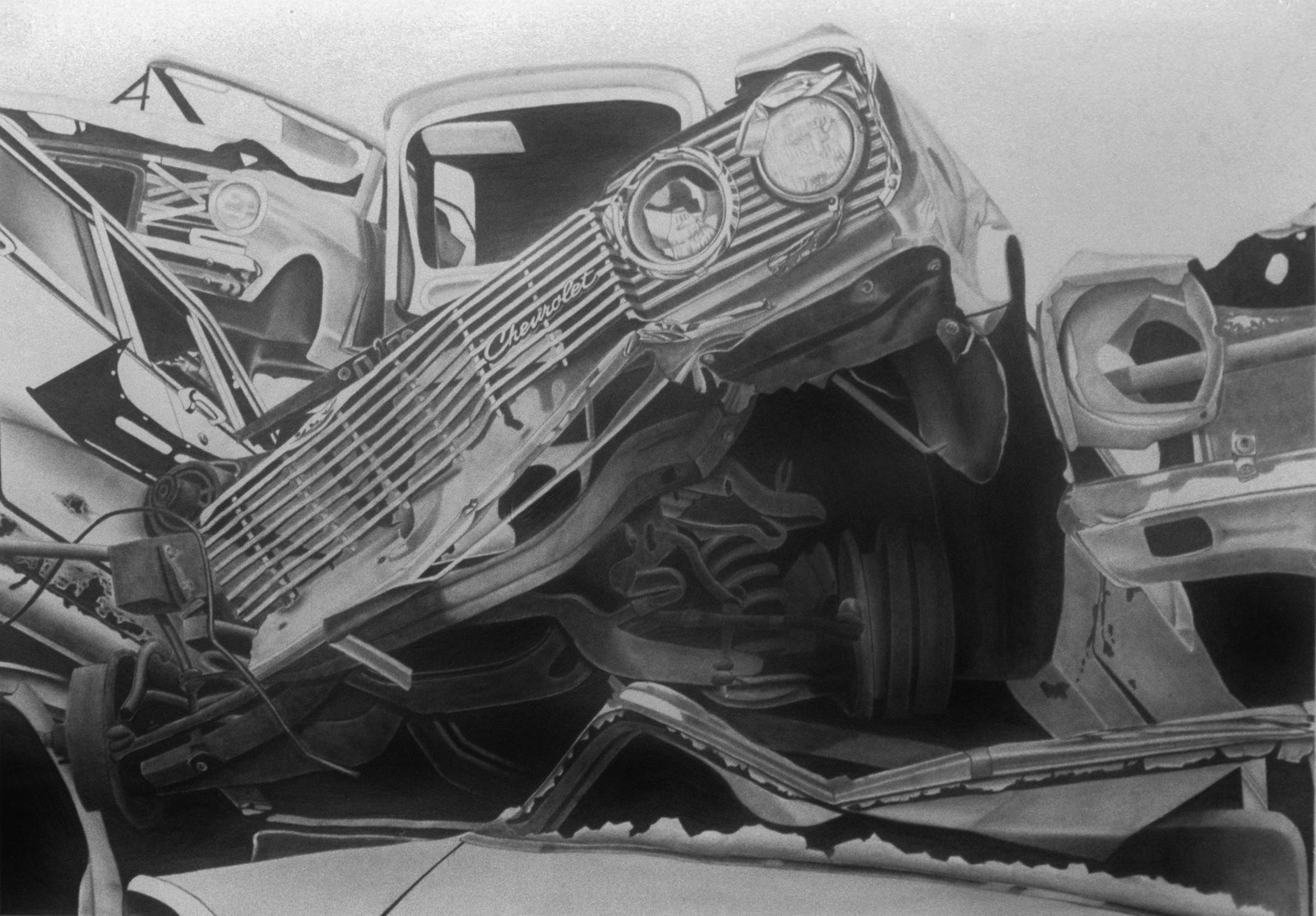
American Landscape. Image: Jan.anders.nelson, Artist · CC BY 4.0 · Wikimedia Commons, accessed 2026-08-04
Photorealism—also called Superrealism, and known in Europe by the 1973 label Hyperréalisme—emerged in the United States around 1968 among painters who used photographs, rather than direct observation, as their source material and aimed to reproduce that photographic image with obsessive, near-mechanical precision. The results looked almost like glossy color photographs: chrome bumpers with mirror-sharp reflections, diner counters lit by fluorescent tubes, storefront windows layered with reflected street scenes, and monumental close-up portraits rendered pore by pore.
The technique was as important as the subject. Painters projected slides directly onto canvas or transferred a grid from a photograph square by square, then built up the image in thin, controlled layers, often with an airbrush to achieve seamless gradients and glassy surfaces impossible to get with a loaded brush. Chuck Close painted immense grid-based portrait heads from passport-style photographs; Richard Estes captured the layered reflections of New York storefronts and diners; Audrey Flack used airbrush extensively for glossy, jewel-like still lifes; Robert Bechtle painted parked cars and tract houses in flat California sunlight.
Photorealism rebelled against two dominant postwar tendencies at once. It rejected Abstract Expressionism's emphasis on visible brushwork, gesture, and the artist's inner emotion, offering instead a cool, impersonal surface with almost no trace of the hand. It also rejected Minimalism and Conceptual art's turn away from representational imagery and traditional painterly skill, reasserting virtuoso, labor-intensive technique and recognizable, often banal, subject matter—cars, diners, motorcycles, storefronts—drawn from commercial and everyday American life.
Photorealism shared Pop Art's interest in mass-produced, commercial imagery but dropped Pop's irony and cartoon flatness in favor of straightforward, almost forensic technical mastery. It matters because it kept representational painting technically ambitious and critically serious at a moment when much of the art world had turned toward abstraction, idea-based work, or entirely non-painted media, and because it directly engages the ongoing, still-unresolved relationship between photography and painting that continues to shape figurative art today.
What defines Photorealism
Photographic Source Images
Paintings were based directly on photographs—often taken by the artist specifically for the purpose—rather than on live observation, and closely reproduced the camera's framing, depth of field, and even lens distortions.
Airbrush and Seamless Surface
Many artists used airbrush technique to achieve smooth, gradual color transitions and glassy, reflective surfaces without visible brushstrokes, mimicking a photograph's continuous tonal range.
Grid Transfer and Projection
Images were frequently enlarged onto canvas using projected slides or a scaled-up grid, allowing painters to reproduce a photograph's exact proportions and details with mechanical accuracy.
Reflective and Chrome Surfaces
Subjects like car bodies, diner counters, and storefront glass gave painters a chance to render complex reflections and specular highlights, showcasing extreme technical control.
Everyday American Subject Matter
Cars, motorcycles, diners, storefronts, and suburban houses—ordinary, often overlooked scenes of commercial and domestic American life—recur throughout the movement, rendered with an almost documentary neutrality.
Absence of Visible Brushwork
Unlike the expressive gesture of Abstract Expressionism, Photorealist surfaces suppress the artist's hand almost entirely, aiming for a cool, impersonal finish closer to a photographic print than a traditional painting.
History
Photorealism emerged in the United States in the late 1960s, developing among painters working largely independently of one another in New York, Los Angeles, and the Bay Area before critics and dealers grouped them under a shared label around 1969–70. The term is generally credited to dealer Louis K. Meisel, who represented several of the movement's key figures and helped codify criteria for what counted as Photorealist work, including the use of a camera and mechanical means to transfer the image.
Chuck Close's monumental grid-based portrait heads, beginning with "Big Self-Portrait" (1968), and Richard Estes's meticulously observed New York storefronts brought early critical attention to the emerging tendency. Robert Bechtle painted parked cars and suburban houses in flat California light, while Ralph Goings focused on diners, pickup trucks, and roadside Americana. Audrey Flack, one of the few prominent women in the movement, used airbrush extensively for glossy still-life compositions often addressing vanitas themes and personal content beneath their technical polish.
The movement gained institutional visibility through group exhibitions in the early 1970s, including shows in the United States and Europe that presented Photorealism as a coherent, market-ready category distinct from both Pop Art and the reigning abstraction of the period. Photorealist paintings sold well throughout the 1970s, appealing to collectors drawn to their evident technical labor and legible, often nostalgic American subject matter.
By the mid-1980s, the original wave of Photorealist painters had largely settled into mature, recognizable individual styles rather than a unified movement, and some, Chuck Close most notably, moved on to related but distinct approaches, including his later, more abstracted grid-based portraiture. Photorealism nonetheless never fully disappeared; a second generation of Hyperrealist painters continued and intensified its technical ambitions from the 1990s onward, working with even more advanced photographic and digital source material.
Key works
| Work | Artist | Year | Why it matters |
|---|---|---|---|
| Big Self-Portrait | Chuck Close | 1968 | A monumental, nearly nine-foot-tall painted head based on a passport-style photograph, one of the works that established Photorealism's grid-based, large-scale portrait technique. |
| Double Self-Portrait | Richard Estes | 1976 | A storefront window rendered with layered, precisely observed reflections of the artist and the street behind him, showcasing the movement's fascination with reflective urban surfaces. |
| Marilyn (Vanitas) | Audrey Flack | 1977 | An airbrushed still life of cosmetics, jewelry, and a photograph arranged as a vanitas composition, blending Photorealist technique with symbolic, personal content. |
How to make art in this style
Painting in the Photorealist Style
Start with a strong source photograph rather than working from life; Photorealism depends on a fixed, single-moment image with the specific framing, depth of field, and lighting only a camera produces. Favor high-contrast, sharply focused photographs with interesting reflective surfaces—glass, chrome, water—since these give the technique somewhere to show off.
Transfer the image accurately before painting a single stroke. Use a projector to trace the photograph's outlines directly onto canvas, or scale it up using a numbered grid, so proportions and placement match the source exactly rather than relying on freehand estimation.
Build the painting in thin, controlled layers rather than loaded, gestural strokes. An airbrush is the traditional tool for smooth gradients and glassy highlights, though a fine brush with heavily thinned paint and careful blending can achieve a similar effect. Work section by section, sometimes masking off areas, to keep edges crisp and transitions seamless.
Suppress visible brushwork throughout. Avoid textured, expressive marks; the surface should read as smooth and continuous, closer to a photographic print than a traditional painted canvas. Pay particular attention to reflections, specular highlights, and depth of field, since rendering these photographic effects convincingly is what signals the style most clearly.
Choose everyday, often overlooked subjects—cars, diners, storefronts, household objects—rather than dramatic or exotic scenes; Photorealism's power comes from technical intensity applied to ordinary imagery, not from unusual subject matter. Work slowly and expect the process to take considerably longer than a gestural or expressive painting of the same size.
Legacy
Photorealism kept technically demanding, representational painting relevant and critically taken seriously at a moment when much of the art world had turned toward abstraction, minimal object-making, or conceptual practices that abandoned traditional painterly skill altogether. Its close study of photographic vision—framing, depth of field, reflection, and flattened perspective—helped establish photography's relationship to painting as an ongoing, serious subject rather than a threat to be ignored.
The movement's technical ambitions were extended by a later generation of Hyperrealist and Superrealist painters from the 1990s onward, who pushed photographic precision even further using improved photographic and digital reference material, particularly in figurative and portrait painting. Photorealism's methods—projection, grid transfer, airbrush—remain standard technical tools taught in ateliers and painting programs today.
Beyond painting itself, Photorealism's aesthetic of glossy, hyper-detailed surfaces anticipated the broader visual culture's later fascination with photographic and digitally rendered hyperreal imagery, from commercial illustration to CGI. For painters interested in representational precision, commercial and everyday American subject matter, or the technical challenge of translating a photograph convincingly into paint, Photorealism remains the essential historical reference point.
Frequently asked questions
What is Photorealism?
Photorealism is a painting movement that began in the United States around 1968, in which artists used photographs as source material and reproduced them with extreme, camera-like precision, often using projectors, grids, and airbrush technique.
Who coined the term Photorealism?
Art dealer Louis K. Meisel is generally credited with coining the term around 1969–70 and helping define the criteria distinguishing Photorealist work from other realist painting.
How is Photorealism different from Pop Art?
Both movements drew on commercial and everyday American imagery, but Pop Art used bold, flat, cartoon-like graphic style, often with ironic or critical commentary. Photorealism instead pursued exacting, camera-like technical precision without Pop's irony, aiming to reproduce a photograph's detail rather than stylize it.
Do Photorealist paintings look exactly like photographs?
They are designed to closely resemble photographs at a glance, reproducing framing, reflections, and depth of field with great precision, though up close the painted surface and the artist's compositional choices, such as cropping or scale, remain distinct from an actual photograph.
Is Photorealism still practiced today?
Yes. A later generation of Hyperrealist and Superrealist painters has continued and extended Photorealist technique since the 1990s, often working with more advanced photographic and digital reference material, particularly in portraiture and figurative painting.