 Art
Art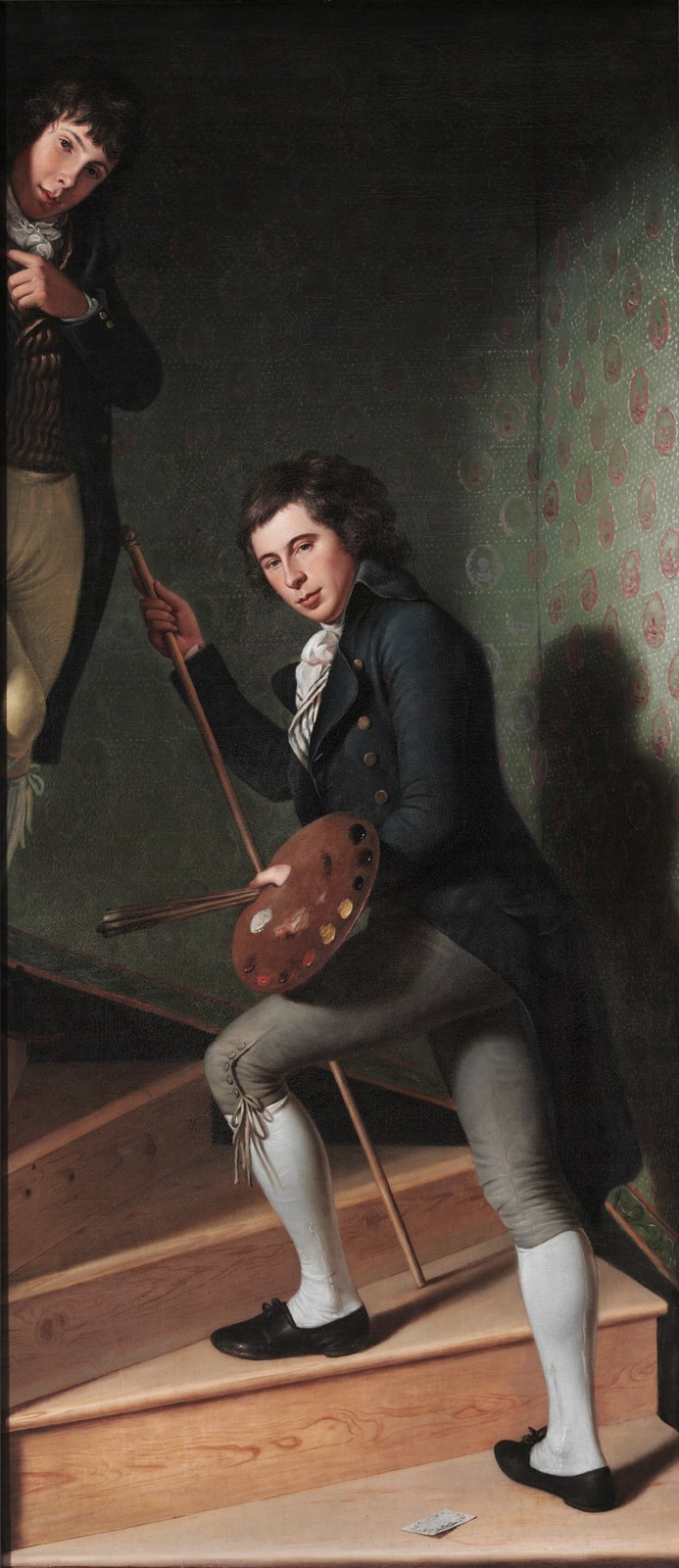
Staircase Group (Portrait of Raphaelle Peale and Titian Ramsay Peale I). Image: Charles Willson Peale · Public domain · Wikimedia Commons, accessed 2026-08-04
Realism emerged in France in the 1840s as a direct challenge to the academic and Romantic painting that dominated the era's official Salon. Where academic art favored idealized history, mythology, and religious subjects, and Romanticism favored dramatic emotion and exotic imagination, Realist painters insisted that art's proper subject was the observable, often unglamorous, present: laborers breaking stone, peasants at a funeral, city streets, ordinary bodies unposed and unidealized.
Gustave Courbet, the movement's most forceful and self-consciously provocative figure, declared that he could not paint an angel because he had never seen one—a blunt statement of Realism's core premise that painting should represent only what could be directly observed. His large-scale canvases of rural laborers and provincial funerals, painted with the scale and seriousness previously reserved for history painting, scandalized Salon audiences who found such subjects unworthy of grand treatment. Jean-François Millet, working in parallel from Barbizon, brought a similar unsentimental dignity to scenes of peasant labor. Honoré Daumier turned his sharp observational eye toward Parisian urban life and social satire, often in the mass medium of lithography.
Realism rebelled explicitly against both academic idealization and Romantic escapism. It refused to flatter its subjects, refused mythological or exotic pretext, and insisted that contemporary, often working-class, life was worthy of the same serious, large-scale treatment previously reserved for kings, gods, and saints. This was as much a political statement as an aesthetic one, arriving in the charged years around the 1848 revolutions across Europe, when questions of class, labor, and social order were urgently contested.
Realism matters because it permanently expanded what counted as legitimate subject matter for serious art, breaking the academic hierarchy that had ranked history painting above genre, portrait, and landscape for centuries. It also established a stance—unsentimental, observational, often confrontational—that would echo through later movements from Social Realism to street photography. Without Realism's insistence on ordinary contemporary life as worthy subject, the modern art tradition's subsequent turn toward everyday and even banal subject matter would have lacked its crucial founding argument.
What defines Realism
Everyday, unidealized subject matter
Laborers, peasants, provincial townspeople, and city dwellers are depicted going about ordinary life and work, without mythological, religious, or historical pretext to justify their inclusion.
Large-scale treatment of humble subjects
Courbet in particular painted rural and working-class scenes at the physical scale traditionally reserved for history painting, a deliberate provocation against academic hierarchy of subject matter.
Unflattering, direct observation of bodies
Figures are rendered with real physical weight, imperfection, and awkwardness rather than idealized proportion, refusing the smooth, classicized bodies of academic painting.
Dark, earthy, tonal palette
Realist paintings often favor a somber range of browns, grays, and muted colors, reinforcing a sense of sober, unglamorous truthfulness over decorative appeal.
Visible, workmanlike brushwork
Paint handling is frequently thick, direct, and unpolished compared to academic finish, sometimes applied with a palette knife, reinforcing the sense of unvarnished directness.
Social and political undertone
Even without explicit political statement, the choice to grant working people serious, monumental treatment carried social implications in a period of intense class tension across Europe.
History
Realism took shape in France through the 1840s, gaining its decisive public identity when Gustave Courbet exhibited A Burial at Ornans and The Stone Breakers at the Paris Salon in the early 1850s. Both works depicted ordinary provincial and working-class subjects at a scale and with a seriousness that shocked critics accustomed to reserving such treatment for noble or sacred subject matter. Courbet doubled down in 1855 by staging his own independent Pavilion of Realism exhibition outside the official Paris World's Fair, after several works were rejected, an act of open defiance that helped define Realism as a self-conscious, oppositional movement rather than merely a style.
The movement developed alongside and overlapped considerably with the Barbizon School, sharing painters, subjects, and a commitment to direct observation, though Realism's ambitions extended beyond landscape into urban and social subject matter more broadly. Jean-François Millet's peasant scenes, while closely associated with Barbizon, are equally central to Realism's project. Honoré Daumier extended Realist observation into satirical lithography and painting of Parisian urban and legal life, using his sharp eye for gesture and physiognomy to comment on contemporary social conditions.
The political backdrop of the 1848 revolutions across Europe, with their upheavals around labor and class, gave Realism's subject choices an inescapable social charge, even when individual works avoided explicit political statement. Rosa Bonheur extended the movement's principles into animal and rural subjects, achieving major international success with meticulously observed depictions of farm animals and rural labor.
By the 1870s and 1880s, Realism's core insight—that contemporary, ordinary life deserved serious artistic treatment—had been absorbed so thoroughly into mainstream practice that it ceased to function as a distinct oppositional movement. Its emphasis on direct, unsentimental observation fed forward into Impressionism's attention to modern life and, later in the century, into Social Realism and documentary photography, both of which inherited Realism's core commitment to depicting the world as it actually appeared.
Key works
| Work | Artist | Year | Why it matters |
|---|---|---|---|
| A Burial at Ornans | Gustave Courbet | 1850 | A monumental depiction of an ordinary provincial funeral, its history-painting scale applied to unglamorous subject matter scandalized the Salon. |
| The Stone Breakers | Gustave Courbet | 1849 | A stark, unsentimental depiction of two laborers at manual work, widely read as a founding statement of Realist principle. |
| The Gleaners | Jean-François Millet | 1857 | A dignified, monumental treatment of peasant women gathering leftover grain, controversial for its implicit sympathy toward rural poverty. |
| The Third-Class Carriage | Honoré Daumier | 1864 | A sober depiction of working-class railway passengers, exemplifying Daumier's unsentimental attention to ordinary urban life. |
| Plowing in the Nivernais | Rosa Bonheur | 1849 | A monumental, precisely observed scene of oxen plowing farmland, exemplifying Realism's serious treatment of rural agricultural labor. |
How to make art in this style
Painting in the Realist Style Today
Palette: Work with a sober, earthy range—browns, grays, muted greens, and dulled flesh tones—avoiding decorative brightness or idealized color. Let tonal contrast, rather than saturated hue, carry the painting's visual weight, reinforcing a mood of sober, unvarnished observation.
Composition: Choose ordinary contemporary subject matter and treat it with unusual seriousness—give a laborer, a market scene, or a provincial gathering the same compositional weight and scale a history painter might give a battle or a saint's martyrdom. Avoid picturesque staging; let figures occupy space as they actually would, without theatrical arrangement.
Brushwork and technique: Use direct, workmanlike paint handling—visible, sometimes thick strokes, occasionally applied with a palette knife for texture—rather than smooth academic finish. Model form through observed light and shadow rather than idealized anatomy; let real physical weight, awkwardness, and imperfection show in figures and faces.
Subjects: Depict labor, poverty, provincial or urban daily life, and ordinary bodies without sentimentalizing or prettifying them. Resist mythological, religious, or exotic pretext for including a figure or scene—the subject's inherent presence and dignity should justify the painting on its own. Consider scale deliberately: painting a humble, everyday subject at a large, ambitious size is itself a Realist statement, a way of insisting the ordinary deserves serious attention.
Legacy
Realism's central legacy is the permanent expansion of what counts as legitimate artistic subject matter. By insisting that ordinary contemporary life—labor, poverty, provincial routine—deserved the same serious treatment as history painting, Courbet and his contemporaries broke the academic hierarchy of genres that had structured Western painting for centuries. Every subsequent movement that treats everyday modern life as worthy subject, from Impressionism to Social Realism to documentary photography, builds on ground Realism cleared first.
The movement's confrontational stance toward official taste and institutions also set a template for artistic self-assertion: Courbet's independent 1855 pavilion, mounted in direct defiance of Salon rejection, anticipated the independent and Salon des Refusés exhibitions that would define avant-garde practice for the rest of the century. Realism demonstrated that an artist could build a serious career and reputation by deliberately provoking, rather than courting, established taste.
Realism's unsentimental, observational ethos also echoes through twentieth-century documentary photography and social-conscience painting, and its insistence on painting what is actually seen rather than what convention dictates remains a touchstone whenever contemporary art claims the mantle of honesty or authenticity. The word "realism" itself, still invoked loosely across art criticism today, traces back directly to this movement's founding insistence that truth to observed life is itself a legitimate artistic value.
Frequently asked questions
What is Realism in art?
Realism is a mid-19th-century French movement that rejected idealized, mythological, and academic subject matter in favor of depicting ordinary contemporary life—laborers, peasants, city streets—with direct, unsentimental honesty. It is most closely associated with Gustave Courbet.
Who started Realism?
Gustave Courbet is generally credited as the movement's central figure, especially after his provocative Salon exhibitions of A Burial at Ornans and The Stone Breakers in the early 1850s. Jean-François Millet and Honoré Daumier are also central figures associated with the movement.
What is the difference between Realism and Romanticism?
Romanticism favored dramatic emotion, exotic subjects, and imaginative or historical themes, often painted with theatrical intensity. Realism rejected that escapism in favor of ordinary, observable contemporary life painted without idealization.
What is the difference between Realism and the Barbizon School?
The two overlapped in personnel and outlook; Barbizon painters focused specifically on landscape and rural scenery observed directly from nature, while Realism encompassed a broader range of subjects, including urban and social themes, with a more explicitly confrontational stance toward academic taste.
Why was Realism controversial?
Realist painters gave ordinary, often working-class subjects the scale and seriousness traditionally reserved for history painting, which many critics and Salon juries considered an affront to established hierarchies of subject matter and taste.