 Art
Art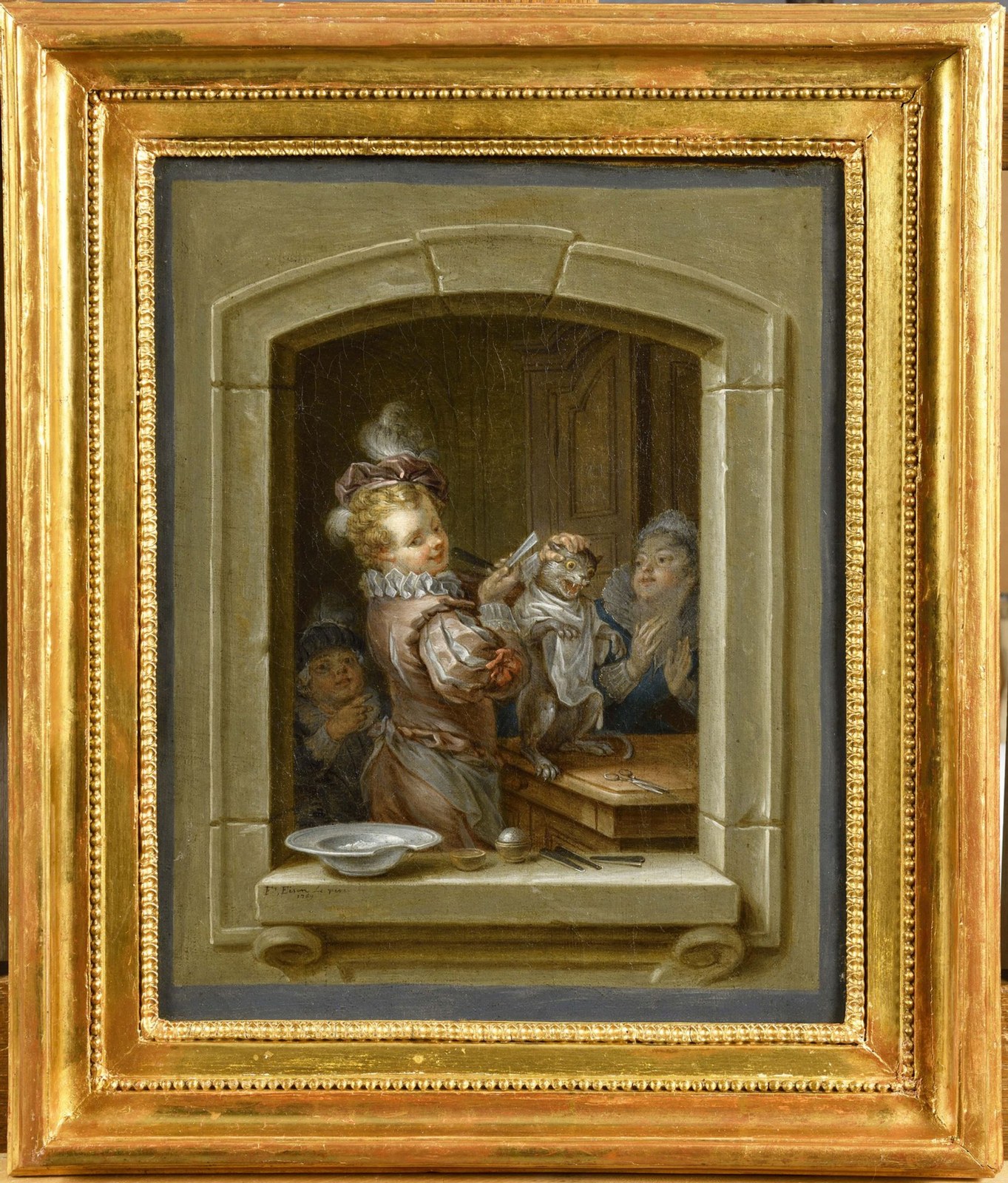
The cat's' toilette. Image: François Eisen · Public domain · Wikimedia Commons, accessed 2026-08-04
Rococo emerged in Paris around 1720, in the decades following the death of Louis XIV, as French aristocratic taste shifted from the grand, formal ceremony of Versailles toward the intimate pleasures of private townhouses, or hôtels. Where Baroque art aimed to overwhelm with religious or royal grandeur, Rococo aimed to charm. The style took its name, coined later and somewhat mockingly, from rocaille, the shell-and-rock ornamental motifs that curled through its interiors, furniture, and picture frames.
Visually, Rococo replaced Baroque's dark, saturated drama with a light, pastel palette of pinks, blues, creams, and golds, and its heavy diagonal compositions with sinuous, asymmetrical curves. Paintings favored intimate, often flirtatious subjects — aristocratic couples in garden settings, mythological lovers, actors and masqueraders, portraits of fashionable women — rendered with a soft, feathery touch rather than sculptural solidity. Jean-Antoine Watteau's fêtes galantes, scenes of elegantly dressed figures at leisure in idyllic parkland, effectively invented the genre's mood: wistful, theatrical, faintly melancholic beneath the charm. Later painters like François Boucher and Jean-Honoré Fragonard pushed the sensibility toward frank sensuality and playful eroticism.
Rococo was inseparable from interior decoration and the applied arts; painting, furniture, porcelain, and architecture were designed together to produce a unified, delicately ornamental environment for aristocratic social life. It was very much a style of and for the elite — a visual language of taste, wit, and leisure that had little interest in the moral seriousness or public grandeur that had defined earlier court art.
The style matters as the last major expression of Ancien Régime aristocratic culture before the French Revolution swept it away, and as a case study in how quickly taste can turn political: within a generation, Rococo's frivolity came to seem morally and socially indefensible, prompting a deliberate return to sobriety in Neoclassicism. Rococo also expanded painting's emotional register toward wit, pleasure, and intimacy, categories that academic history painting had long treated as minor.
What defines Rococo
Pastel, light-filled palette
Rococo abandoned Baroque's dark grounds and saturated color for soft pinks, powder blues, mint greens, and creamy whites, often heightened with gold. The overall effect is airy and decorative rather than dramatic.
Curving, asymmetrical ornament
Borrowed from rocaille shell-and-scroll motifs, Rococo composition favors S-curves and irregular, flowing shapes over Baroque's diagonal thrust or Renaissance symmetry. Picture frames, furniture, and architectural interiors share this restless, decorative curvilinearity.
Intimate, playful subject matter
Rather than religious drama or royal ceremony, Rococo painting depicts flirtation, leisure, theater, and mythological romance, often set in idealized garden landscapes. Scenes carry a knowing, sometimes gently erotic wit rather than moral gravity.
Soft, feathery brushwork
Rococo painters favored a light, caressing touch, with blended edges and delicate modeling that suits silk, powdered wigs, and dappled garden light. Surfaces feel touchable and weightless rather than sculptural.
Integration with decorative arts
Rococo painting developed alongside furniture, porcelain, and interior paneling designed as a unified ensemble. A painting's shape, scale, and mood were frequently dictated by its intended place within a boudoir or salon wall.
Elongated, graceful figures
Figures, particularly women, are rendered with elongated proportions, delicate gestures, and fashionable dress, prioritizing elegance and charm over anatomical weight. This gave Rococo portraiture a distinctly decorative, idealized quality.
History
Rococo developed in Paris in the years following Louis XIV's death in 1715, when the French court's center of gravity shifted temporarily from Versailles back to Paris under the Régence, and aristocratic life reoriented around smaller, more intimate townhouses. The heavy, ceremonial Baroque interiors suited to Versailles's vast state rooms gave way to lighter, more delicately ornamented spaces designed for conversation, flirtation, and private entertainment, and painting followed suit.
Jean-Antoine Watteau, admitted to the French Academy in 1717 under the newly invented category of fête galante, is generally credited with founding Rococo painting, blending theatrical costume, pastoral landscape, and a wistful, ambiguous mood. In the decades after Watteau's early death in 1721, François Boucher emerged as the style's dominant figure at the French court, eventually named First Painter to Louis XV in 1765 and closely associated with the king's mistress, Madame de Pompadour, a major patron. Jean-Honoré Fragonard, trained partly under Boucher, carried Rococo's playful sensuality to its most virtuosic extreme in the 1760s and 1770s.
The style spread beyond France to Central Europe, where it fused with late Baroque religious architecture to produce the exuberant Rococo churches and palaces of Bavaria and Austria, and, in fresco painting, the Venetian Giovanni Battista Tiepolo carried a related decorative grandeur from Venice outward to Würzburg and Madrid.
By the 1760s, Rococo faced growing criticism as frivolous and morally suspect, both from Enlightenment critics like Diderot and from a new generation of artists drawn to the austere civic seriousness of ancient Rome. The French Revolution of 1789 effectively ended the style as a living aristocratic idiom, though its decorative vocabulary persisted in interior design and later revival movements.
Key works
| Work | Artist | Year | Why it matters |
|---|---|---|---|
| Pilgrimage to Cythera | Jean-Antoine Watteau | 1717 | Defined the fête galante genre, blending theater, landscape, and wistful romance. |
| The Swing | Jean-Honoré Fragonard | 1767 | A playful, flirtatious composition epitomizing Rococo's lighthearted aristocratic taste. |
| Madame de Pompadour | François Boucher | 1756 | A lush portrait of Louis XV's influential mistress, showcasing Rococo's decorative elegance and pastel palette. |
| Gilles | Jean-Antoine Watteau | 1718 | A haunting, isolated portrait of a stock theatrical clown that adds melancholy to Rococo's lighter mood. |
How to make art in this style
Working in a Rococo Style
Palette: Favor soft, high-key pastels — blush pink, powder blue, mint, buttery cream — accented with touches of gold or silver. Avoid heavy blacks and browns; even shadows should stay warm and light rather than deep.
Composition: Build the scene around graceful, curving movement rather than strong diagonals or rigid symmetry. Garden settings, draped fabric, and scattered figures work well; let the eye travel in gentle S-curves across the canvas rather than being pulled sharply to one focal point.
Brushwork and technique: Use a light, blended touch with soft edges, particularly for skin, fabric, and foliage. Layer thin, luminous strokes rather than building heavy impasto, and keep detail delicate — a suggestion of lace or powder rather than a hard-edged rendering.
Subjects: Choose scenes of leisure, courtship, theater, or idealized pastoral life rather than solemn or historical themes. Fashionable dress, garden architecture, and playful mythological figures like cupids all suit the mode. A touch of gentle wit or implied narrative — a dropped glove, an exchanged glance — adds character without tipping into overt drama.
Framing and finish: Consider the painting's decorative context; Rococo works were often designed for a specific wall or panel, so an elegant, curvilinear border or an oval or asymmetrical format can reinforce the style's ornamental logic. Keep the overall mood light, intimate, and unhurried rather than monumental.
Legacy
Rococo's reputation swung sharply after the French Revolution, when its aristocratic frivolity became politically toxic, and it was largely dismissed by nineteenth-century critics as decadent. That judgment softened over time, and Rococo's decorative confidence, pastel color, and interest in fashion and leisure have repeatedly resurfaced — in nineteenth-century Aestheticism, in twentieth-century fashion illustration, and in the pastel maximalism of some contemporary design and film production.
Rococo's influence is visible wherever image-makers reach for softness, ornament, and unapologetic prettiness: high-fashion photography, romantic film sets, and luxury branding regularly borrow its palette and curvilinear ornament to signal indulgence and refined leisure. The style's close integration of painting with interior decoration also anticipated later total-design movements, from Art Nouveau to contemporary lifestyle branding, in treating a visual mood as something to be built across an entire environment rather than confined to a single canvas.
Rococo remains a useful shorthand — sometimes admiring, sometimes dismissive — for any art or design that pursues ornamental abundance and sensory pleasure over restraint, a reminder of how contested the line between decorative charm and superficiality has always been in art criticism.
Frequently asked questions
What is Rococo art?
Rococo is an eighteenth-century French style that favors pastel color, curving ornamental forms, and lighthearted subjects of leisure and romance. It developed as a lighter, more intimate reaction to the grandeur of Baroque art.
What's the difference between Rococo and Baroque?
Baroque art is dark, dramatic, and often religious or royal in purpose, while Rococo is pastel-colored, playful, and intimate, favoring private aristocratic pleasure over public grandeur. Rococo essentially softened and miniaturized Baroque's theatrical vocabulary.
Who started Rococo?
Jean-Antoine Watteau is generally credited with founding Rococo painting through his fête galante scenes in the early eighteenth century, with François Boucher and Jean-Honoré Fragonard later developing the style at the French royal court.
Why did Rococo fall out of favor?
By the 1760s, Enlightenment critics condemned Rococo as frivolous and morally shallow, and the French Revolution in 1789 discredited its association with aristocratic excess, prompting a shift toward the austere civic seriousness of Neoclassicism.
Where did Rococo spread beyond France?
Rococo influenced Central European art and architecture, particularly in Bavaria and Austria, where it merged with late Baroque church design, and its decorative vocabulary reached England, Italy, and beyond through prints, furniture, and porcelain.