 Art
Art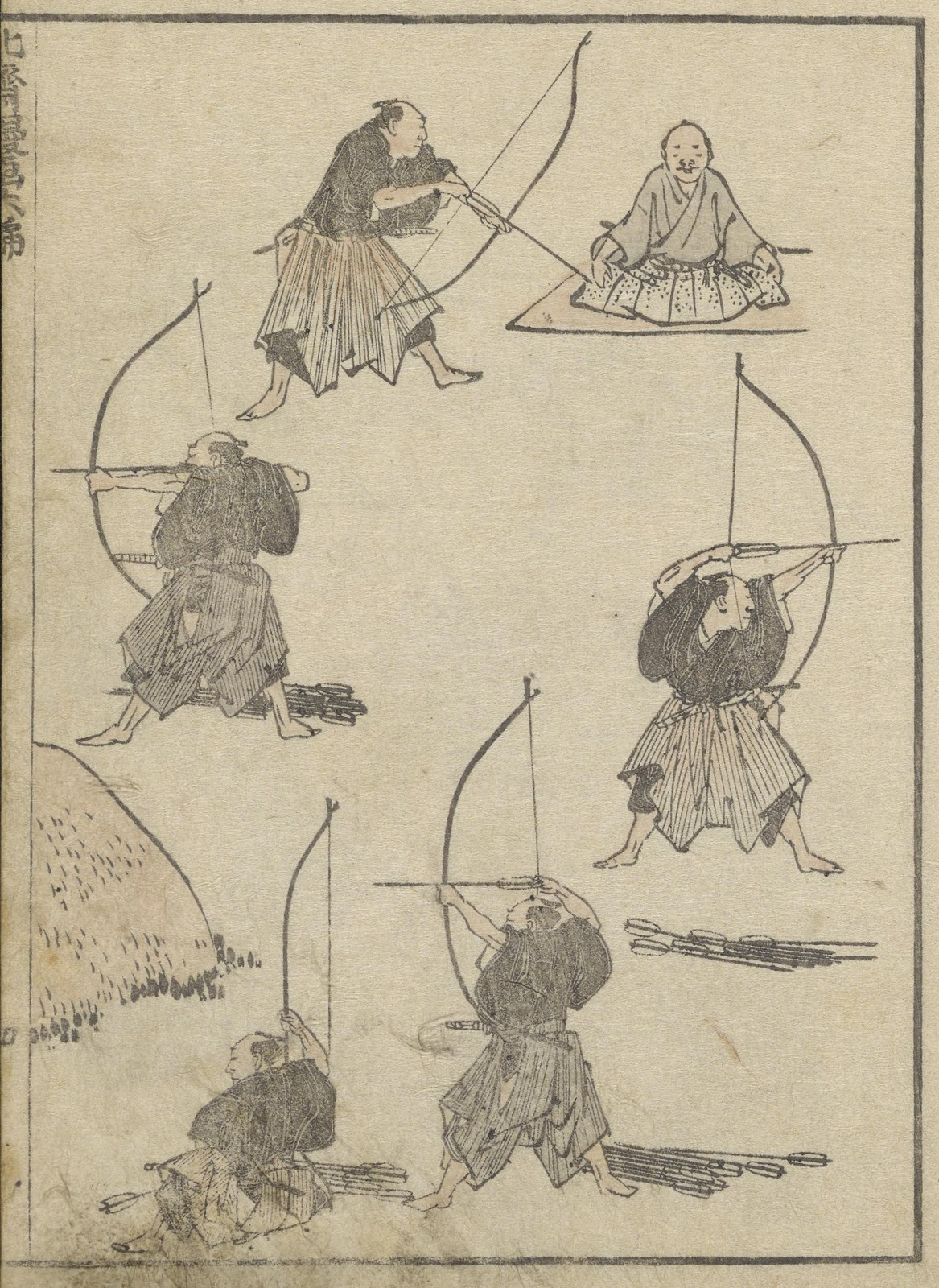
Archers (Kyujutsu) Page 7 by Katsushika Hokusai 1817. Image: Katsushika Hokusai · Public domain · Wikimedia Commons, accessed 2026-08-04
Ukiyo-e is a genre of Japanese art, primarily woodblock prints, though also paintings, that flourished from the 17th through the 19th centuries during the Edo period, centered in the city of Edo, now Tokyo. Ukiyo originally a Buddhist term for the sorrowful transience of earthly life, was reinterpreted in the pleasure-seeking urban culture of Edo as the floating world, a celebration of transient pleasures: theater, courtesans, fashion, and city life. The term took its charge from Edo's licensed pleasure district, Yoshiwara, and the kabuki theater district, both subjects that supplied the genre's earliest and most enduring imagery.
Production followed a collaborative system involving a publisher, a designing artist, a block carver, and a printer, enabling affordable mass production for a growing urban merchant class. Subjects included bijin-ga, pictures of beautiful women, yakusha-e, actor prints tied to kabuki theater, and, from the early 19th century, landscape prints popularized by Hokusai and Hiroshige, alongside warrior prints, historical scenes, and studies of birds and flowers. Shunga, explicit erotic prints, formed another substantial and commercially significant category, produced by many of the same leading designers. Stylistic hallmarks include flat areas of bold color, strong outline, asymmetrical or cropped compositions, decorative pattern, and inventive perspective.
Ukiyo-e broke from courtly and Buddhist painting traditions patronized by aristocracy and temples by depicting the commercial, urban, and often disreputable pleasure quarters, actors, and courtesans, popular culture rather than elite or religious subjects, produced for a mercantile townsperson audience rather than samurai or aristocratic patrons. The genre constituted a major popular visual culture over roughly two centuries, and its export to the West after Japan's ports opened in the 1850s ignited the craze known as Japonisme, profoundly shaping European Impressionist and Post-Impressionist art. Today, ukiyo-e prints remain among the most recognized Japanese artworks worldwide, Hokusai's Great Wave chief among them. The genre's technical vocabulary, flat plane, bold contour, cropped framing, also anticipated formal strategies that Western modernism would later treat as radically new.
What defines Ukiyo-e
Collaborative woodblock production
Each print was the product of a publisher, a designing artist, a block carver, and a printer working in sequence, with separate blocks carved for each color. This division of labor allowed hundreds of affordable impressions from a single design.
Flat color and bold contour
Forms are defined by strong outline and filled with flat, unmodulated color rather than the shading and blending typical of Western painting, giving the prints their immediately recognizable graphic clarity.
Subjects of the floating world
Early ukiyo-e centered on kabuki actors, courtesans, and scenes of urban pleasure, the fashionable, transient entertainments of Edo's commercial districts.
Bold landscape composition
From the early 19th century, landscape prints introduced dramatic cropping, asymmetry, and unusual vantage points, often framing a famous site like Mount Fuji from an unexpected angle.
Decorative pattern and textile detail
Elaborate kimono patterns and textile design are rendered with the same care as figures and landscape, treating surface pattern as a subject in its own right.
Series publication
Many major works were issued as numbered series exploring a single theme or place across dozens of related sheets, such as views of Mount Fuji or stations along a travel route.
History
Ukiyo-e's origins trace to early 17th-century Edo, growing from genre painting depicting urban life; the woodblock print format matured through the 17th and 18th centuries. Early monochrome prints gave way to full-color nishiki-e, or brocade prints, technique developed by the mid-18th century, enabling the rich, multi-block color printing associated with the mature style. The genre's golden age of bijin-ga and yakusha-e ran through the later 18th century with artists such as Kitagawa Utamaro, known for idealized female beauty studies, and Tōshūsai Sharaku, known for bold, psychologically intense actor portraits produced during a brief, intense burst of activity around 1794 to 1795.
A major shift came in the early 19th century when Katsushika Hokusai and later Utagawa Hiroshige turned to landscape as a primary subject, producing series like Hokusai's Thirty-six Views of Mount Fuji, published around 1830 to 1832, and Hiroshige's Fifty-three Stations of the Tokaido, begun in 1833, which capitalized on growing domestic travel culture and remain the genre's most globally famous works. Ukiyo-e production continued through the 19th century, though quality and innovation are often considered to have declined after Hiroshige's death in 1858, amid the political upheaval of the Meiji Restoration of 1868 that opened Japan to Western influence.
Prints exported to Europe from the 1850s and 1860s, some famously used as packing material for porcelain shipments, sparked the Japonisme craze among Impressionist and Post-Impressionist artists. In Japan, photography and Westernization gradually displaced traditional print culture through the late 19th and early 20th centuries, though the tradition continued in modified form through the early 20th-century Shin-hanga, or new prints, revival.
Key works
| Work | Artist | Year | Why it matters |
|---|---|---|---|
| The Great Wave off Kanagawa | Katsushika Hokusai | 1831 | The most globally recognized ukiyo-e image, part of the Thirty-six Views of Mount Fuji series and one of the most reproduced artworks in history. |
| Fine Wind, Clear Morning | Katsushika Hokusai | 1831 | Also known as Red Fuji, this print from the same series celebrates Mount Fuji through flat color and simplified form. |
| The Fifty-three Stations of the Tokaido | Utagawa Hiroshige | 1833 | A landmark landscape series documenting the stops along Japan's principal travel route, fueling and reflecting a domestic travel boom. |
| Three Beauties of the Present Day | Kitagawa Utamaro | 1793 | A celebrated bijin-ga print exemplifying Utamaro's refined, psychologically attentive portrayal of women. |
| One Hundred Famous Views of Edo | Utagawa Hiroshige | 1856 | A late, expansive series capturing the city of Edo across seasons, later a direct source studied by European painters. |
How to make art in this style
Palette. Limit yourself to a handful of flat, saturated hues, indigo blue, warm ochre, vermillion red, and soft green, rather than a full naturalistic range. Let color blocks sit flat and unblended rather than shaded.
Composition. Favor bold asymmetry over centered balance. Crop a subject at the frame's edge, a branch, a wave, a figure's sleeve, to create dynamic tension, and experiment with elevated or oblique vantage points rather than a fixed eye-level view.
Line and shape. Build every form from confident outline first, then fill with flat color. Treat waves, foliage, and fabric as rhythmic, repeating pattern rather than naturalistic texture; pattern is a subject in the ukiyo-e tradition, not just decoration.
Technique. If working in actual relief printmaking, woodblock or linocut, plan a separate block or layer for each color and register them carefully; even in painting or digital work, thinking in discrete color layers helps preserve the style's flatness.
Subjects. A single striking silhouette works better than a busy scene, a mountain peak, a cresting wave, a costumed figure. Consider working in series, depicting the same subject or place across several compositions with varied season, weather, or viewpoint. Season and weather markers, cherry blossoms, snow, autumn maple, are traditional devices for anchoring a composition in a specific, recognizable moment.
Legacy
Ukiyo-e was the direct catalyst for Japonisme and thereby a formative influence on Impressionism, Post-Impressionism, and Art Nouveau's flattened space, cropped compositions, and decorative line. Its compositional daring, asymmetry, bold cropping, high vantage points, reshaped Western approaches to picture-making at a pivotal moment in the emergence of modern art. Vincent van Gogh, Claude Monet, and Mary Cassatt all studied ukiyo-e closely, Van Gogh copying Hiroshige prints outright, Monet collecting them, Cassatt adapting their technique, absorbing lessons in flat color and asymmetry that fed into some of the most consequential formal breakthroughs of the later 19th century.
The tradition continues to influence graphic design, the visual lineage of manga and anime, and global associations with Japanese aesthetics more broadly. Hokusai's Great Wave is among the most reproduced images in art history, appearing everywhere from museum walls to popular culture. Its imagery also survives commercially, printed on everything from textiles to tattoo designs, and the early 20th-century Shin-hanga movement extended the collaborative woodblock process directly out of the ukiyo-e workshop tradition. Contemporary print revivalists and collectors keep the technique alive, and museums worldwide hold major ukiyo-e collections, ensuring the genre's continued visibility centuries after its Edo-period heyday.
Frequently asked questions
What does ukiyo-e mean?
Ukiyo-e translates as pictures of the floating world, a term originally describing Buddhist ideas of life's transience, reinterpreted in Edo-period Japan as a celebration of fleeting urban pleasures like theater and fashion.
Who is the most famous ukiyo-e artist?
Katsushika Hokusai is the most internationally recognized, largely due to his print The Great Wave off Kanagawa, though Utagawa Hiroshige, Kitagawa Utamaro, and Tōshūsai Sharaku are equally central to the tradition.
How were ukiyo-e prints made?
Prints were produced through a collaborative process involving a publisher who financed the project, an artist who designed the image, a carver who cut separate woodblocks for each color, and a printer who applied ink and pressed paper against the blocks in sequence.
Ukiyo-e vs Shin-hanga, what's the difference?
Ukiyo-e is the original Edo-period tradition, produced roughly from the 17th through 19th centuries for a domestic Japanese audience. Shin-hanga, or new prints, was an early 20th-century revival that reused the traditional collaborative woodblock process but incorporated Western ideas of light and perspective, often aimed at Western collectors.
Why is The Great Wave so famous?
Its bold composition, a towering wave dwarfing small boats with a distant Mount Fuji, combines dramatic design with technical mastery of the woodblock medium, and it circulated widely in Europe during the 19th century, making it one of the most reproduced images in art history.