 Art
Art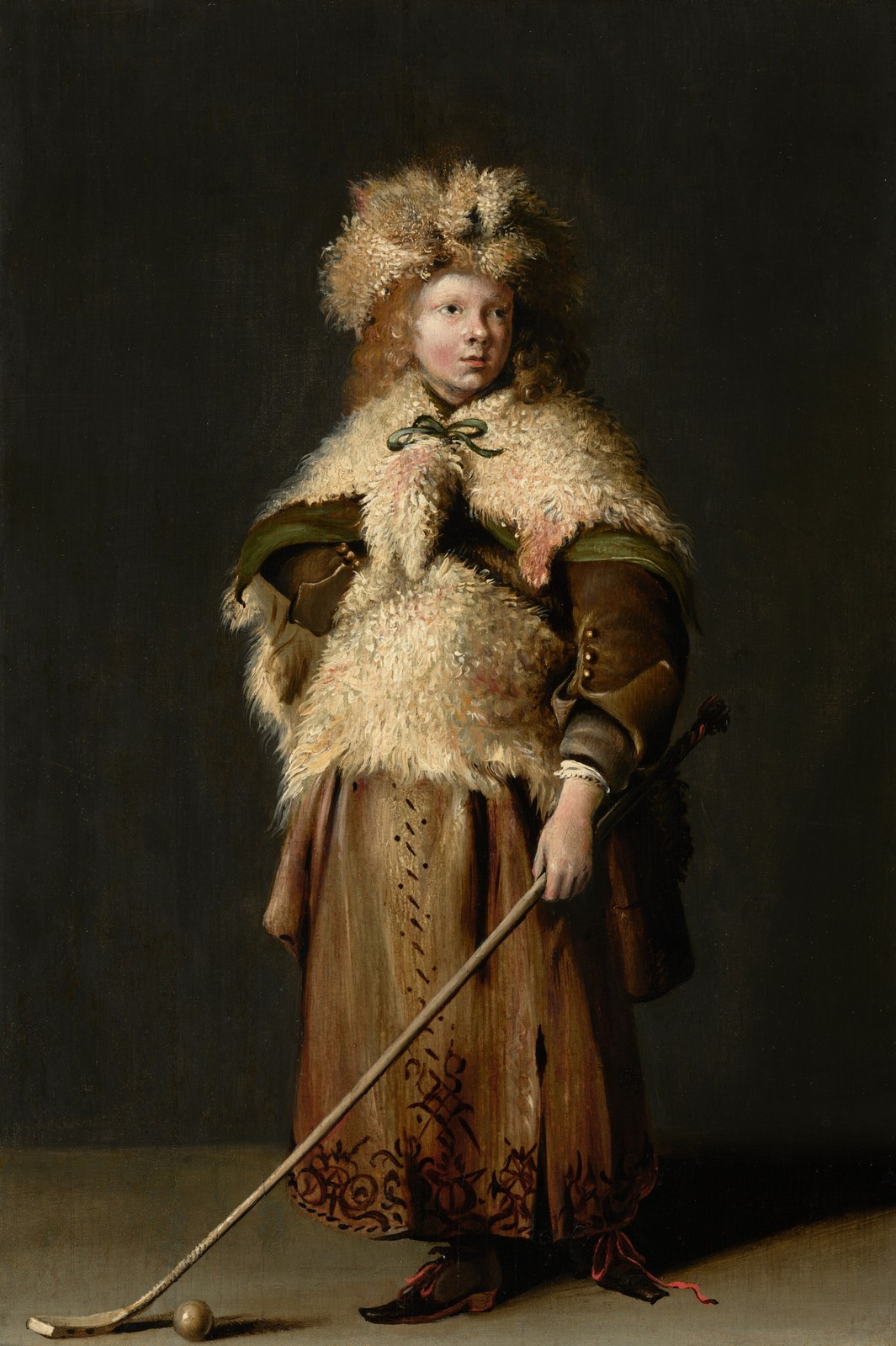
Moses ter Borch Holding a Kolf Stick. Image: Gesina ter Borch / Gerard ter Borch · Public domain · Wikimedia Commons, accessed 2026-08-04
The Dutch Golden Age describes the extraordinary flowering of painting, alongside science, trade, and cartography, that accompanied the Dutch Republic's rise as a maritime and commercial power during the seventeenth century. Having thrown off Spanish Catholic rule, the Protestant Netherlands lacked the church commissions and royal courts that drove art elsewhere in Europe. Instead, a newly wealthy merchant class — guild members, shipowners, civic militia companies — became the primary buyers of art, purchasing paintings much as they purchased furniture, to decorate homes and assert respectability.
This shift in patronage reshaped what Dutch art looked like. Rather than grand religious narratives or mythological allegory, Dutch painters specialized in distinct genres sold on the open market: portraits and group portraits, genre scenes of everyday domestic and tavern life, still lifes of food and flowers, landscapes and seascapes, and church interiors. Painters often worked within a single specialty for an entire career, competing on technical mastery within a narrow field rather than range of subject.
The style is marked by restrained, closely observed naturalism rather than Baroque theatrics. Light typically enters from a single window at the side of a composition, falling softly across a room, a face, or a bowl of fruit, and rendered with such precision that surfaces — pewter, lace, bread crust, glass — seem tangible. Vermeer perfected this quiet, almost meditative interior light; Rembrandt pushed portraiture toward psychological depth through dramatic yet controlled chiaroscuro; Frans Hals captured fleeting expression with rapid, visible brushwork; still-life painters built elaborate meditations on wealth, mortality, and sensory pleasure out of laid tables.
Dutch Golden Age painting matters because it represents the first sustained tradition of secular, market-driven art in European history — painting made not for church or crown but for a broad, image-hungry public. Its unflinching attention to ordinary rooms, faces, and objects established genre painting and still life as major categories, and its observational discipline laid groundwork for later realist and even photographic ways of seeing.
What defines Dutch Golden Age
Everyday genre scenes
Painters depicted taverns, kitchens, music lessons, and domestic interiors rather than religious or mythological subjects. These scenes often carried moralizing undertones about temperance, love, or vanity, encoded in small symbolic details.
Meticulous still life
Tables laid with fruit, flowers, silverware, and food were rendered with near-microscopic precision, often as vanitas compositions reminding the viewer of mortality through wilting blooms or an overturned glass. Surface texture — dew on grapes, the sheen of pewter — was a point of technical pride.
Single-source, naturalistic light
Light typically falls from one window, modeling form gently rather than through dramatic contrast. This calibrated illumination gives Dutch interiors their characteristic stillness and psychological intimacy.
Group and civic portraiture
Militia companies, guild regents, and anatomy classes commissioned large group portraits that required painters to balance individual likeness with unified composition. Rembrandt's innovations in this genre pushed static lineups toward dramatic, narrative arrangement.
Landscape and seascape specialization
Landscape painters captured the flat Dutch countryside, windmills, and dramatic skies with low horizons and expansive cloud formations, while marine painters recorded the ships and harbors central to Dutch commercial identity.
Restrained, tonal color
Compared to Baroque's saturated drama, Dutch Golden Age palettes are often muted and tonal, built from earth colors, grays, and blacks, with color reserved for small, carefully placed accents that draw the eye.
History
The Dutch Golden Age followed the Dutch Republic's independence from Habsburg Spain, formalized in stages through the late sixteenth and early seventeenth centuries and confirmed by the 1648 Peace of Westphalia. Freed from Spanish Catholic authority and organized as a decentralized, Protestant, merchant-run republic, the Netherlands experienced rapid growth in trade, shipping, and colonial commerce through the Dutch East India Company, generating unprecedented urban wealth in cities like Amsterdam, Haarlem, Delft, and Leiden.
Without the church and court patronage that sustained painters elsewhere, Dutch artists adapted to an open, competitive art market, producing smaller, specialized paintings sold through dealers, guild exhibitions, and even lotteries to a broad urban public. Guilds such as Haarlem's Guild of Saint Luke regulated the profession, and cities developed distinct local specialties — Delft associated with quiet interiors and townscapes, Haarlem with tavern scenes and portraiture, Leiden with small, highly finished fine painting.
Rembrandt van Rijn, working first in Leiden and then Amsterdam, became the era's dominant figure, running a large workshop and continually pushing portraiture and biblical narrative toward greater psychological depth, even as his later years brought financial ruin. Johannes Vermeer, working in relative obscurity in Delft and producing few paintings, achieved an unmatched refinement of light and stillness only fully recognized by later centuries. Frans Hals in Haarlem specialized in lively, spontaneous portraiture.
By the century's end, the Republic's economic and political power was waning relative to England and France, and with it the extraordinary art market that had sustained so many specialist painters. Production slowed through the early eighteenth century, and Dutch painting's international reputation dimmed until nineteenth-century critics and collectors, especially in France, rediscovered and canonized Vermeer and the genre painters as forerunners of modern realism.
Key works
| Work | Artist | Year | Why it matters |
|---|---|---|---|
| Girl with a Pearl Earring | Johannes Vermeer | 1665 | A luminous, enigmatic portrait celebrated for its subtle handling of light on fabric and skin. |
| The Night Watch | Rembrandt van Rijn | 1642 | A monumental militia portrait that broke convention with dramatic light and implied motion. |
| The Anatomy Lesson of Dr. Nicolaes Tulp | Rembrandt van Rijn | 1632 | An early group portrait that established Rembrandt's reputation for psychological depth. |
| The Milkmaid | Johannes Vermeer | 1658 | A domestic scene elevated to monumental stillness through calibrated light and color. |
| The Laughing Cavalier | Frans Hals | 1624 | Virtuoso brushwork captures spontaneity and character in a portrait sitter's expression. |
How to make art in this style
Working in a Dutch Golden Age Style
Palette: Build from muted earth tones — umbers, ochres, warm grays, and near-blacks — reserving brighter color (a red ribbon, a blue tablecloth, yellow light) for small, deliberate accents. Avoid the saturated, theatrical color of Baroque painting in favor of tonal harmony.
Composition: Set the scene in a modest interior or still-life arrangement, often anchored by a single window at one side. Keep the composition quiet and stable rather than dynamic; let a small human gesture — pouring, reading, sewing — carry the narrative weight instead of dramatic action.
Light: Use one clear, directional light source and model form gradually across it, avoiding harsh contrast. Study how light behaves on different materials — cloth, metal, glass, skin — since much of the genre's power comes from convincingly rendered texture under consistent illumination.
Brushwork and technique: Build surfaces through fine, controlled layering rather than visible bravura strokes, particularly for still life and interiors; portraiture can allow looser, more energetic handling. Work slowly and observationally, painting from actual objects and controlled studio light rather than invention.
Subjects: Choose ordinary subjects treated with total seriousness — a woman at a window, a laid table, a modest room, a townscape under a wide sky. Consider embedding a quiet symbolic layer, since Dutch genre painting often used everyday objects to suggest transience, virtue, or vice without overt allegory.
Legacy
Dutch Golden Age painting established genre scenes, still life, and landscape as fully legitimate categories of art rather than lesser minor subjects — a hierarchy shift that shaped European painting for centuries. Its observational rigor and interest in ordinary life directly anticipated nineteenth-century Realism, and its handling of light influenced generations of painters, from Chardin to the Impressionists, the latter of whom studied Vermeer's optical precision closely after his nineteenth-century rediscovery.
The rediscovery of Vermeer in the nineteenth century, championed by French critics, transformed a nearly forgotten Delft painter into one of the most beloved artists in the Western canon, and his work continues to shape how photographers and filmmakers think about window light and quiet domestic staging. Rembrandt's psychologically charged portraiture remains a touchstone for figurative painters and portrait photographers alike, admired for its ability to suggest interior life through light and expression alone.
Beyond painting, Dutch Golden Age still-life conventions — the laid table, the wilting flower, the reflective glass — continue to inform photography, food styling, and advertising imagery, where the vanitas tradition's blend of abundance and mortality still carries visual weight.
Frequently asked questions
What is Dutch Golden Age painting?
Dutch Golden Age painting refers to the flourishing of Dutch art during the seventeenth century, when a wealthy merchant class replaced church and royal patrons and painters specialized in genre scenes, portraiture, still life, and landscape sold on the open market.
What makes Dutch Golden Age art different from Baroque?
While it shares the Baroque era's timeframe, Dutch Golden Age painting favors restrained, naturalistic light and everyday domestic subjects over the dramatic religious and mythological grandeur typical of Italian and Flemish Baroque art.
Who are the most famous Dutch Golden Age painters?
Rembrandt van Rijn, Johannes Vermeer, and Frans Hals are the era's best-known painters, alongside still-life specialists and landscape painters who each dominated their own specialized genre.
Why did Dutch painters focus on everyday scenes?
Because the Protestant Dutch Republic lacked Catholic church commissions and a royal court, painters sold work directly to a broad merchant public, who wanted images of their own homes, tables, and towns rather than religious or mythological subjects.
What is a vanitas painting?
A vanitas is a still-life composition using symbols like wilting flowers, skulls, hourglasses, or extinguished candles to remind viewers of mortality and the fleeting nature of earthly pleasure, a popular subgenre within Dutch still-life painting.