 Art
Art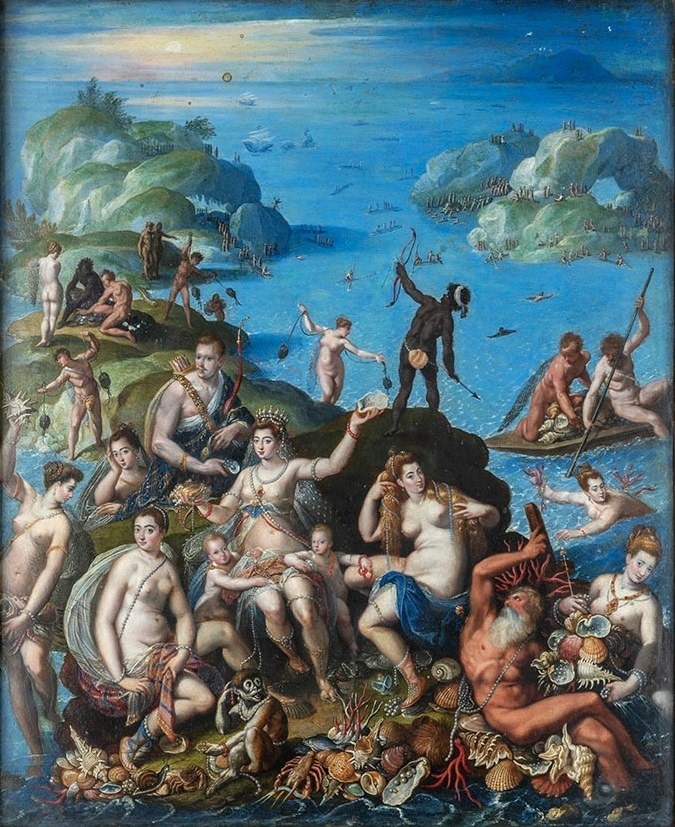
Coral Fishers (Discovery of America).. Image: Jacopo Zucchi · Public domain · Wikimedia Commons, accessed 2026-08-04
Mannerism, sometimes called Late Renaissance, describes the style that dominated much of Italian and, later, Spanish painting from around 1520 to 1600, developing directly out of the High Renaissance but deliberately complicating its calm, balanced harmony. Where Leonardo, Michelangelo, and Raphael had pursued naturalism refined into ideal beauty, Mannerist painters pursued artifice, elegance, and tension for their own sake — bodies stretched into impossibly graceful poses, color pushed into sharp, artificial hues, and space compressed or made ambiguous rather than logically constructed.
The term itself derives from the Italian maniera, meaning "style" or "manner," and originally carried a positive sense: a Mannerist painting displayed a recognizable, sophisticated manner, a self-conscious virtuosity, rather than simply describing the world as it appeared. Figures acquired elongated limbs and small heads, twisted into a spiraling pose Italian critics called the figura serpentinata; color shifted from High Renaissance warmth into acidic, almost synthetic-looking combinations of violet, salmon pink, and sour green; compositions crowded figures into shallow, disorienting spaces or left large portions of the canvas strangely empty.
Mannerism emerged partly from artistic anxiety: a generation of painters trained in the shadow of Leonardo, Michelangelo, and Raphael faced the problem of what to do once naturalistic perfection had apparently already been achieved. Rather than repeat it, painters like Pontormo, Bronzino, and Parmigianino pursued deliberate distortion and refinement instead, and the trauma of the 1527 Sack of Rome, which scattered artists and shook confidence in the High Renaissance's stable, humanist worldview, gave the new style an added emotional charge in its early years.
Mannerism matters because it demonstrates that stylistic evolution in art does not move only toward greater naturalism; sometimes it moves toward greater artifice, self-consciousness, and emotional intensity instead. Its elegant strangeness anticipated aspects of later art, from the emotional distortion of Expressionism to the deliberate artifice prized in fashion and design centuries afterward, and its late Spanish exponent, El Greco, produced some of the most visionary and unclassifiable religious paintings in the Western tradition.
What defines Mannerism
Elongated, distorted figures
Bodies stretched into unnaturally long limbs and slender proportions, with small heads and exaggerated grace, departing deliberately from the anatomical correctness the High Renaissance had pursued.
Figura serpentinata (spiraling pose)
Figures were often posed in a twisting, spiral stance that shows the body from multiple angles at once, prized as a demonstration of the artist's skill and inventiveness.
Acidic, artificial color
Mannerist painters favored sharp, sometimes jarring color combinations — violet, acid green, salmon pink — chosen for expressive or decorative effect rather than naturalistic accuracy.
Ambiguous, compressed space
Compositions often crowded figures into shallow, unclear spatial settings, or left disconcerting empty areas, undermining the coherent perspectival space the High Renaissance had perfected.
Emotional tension and artifice
Faces and gestures carry heightened, sometimes theatrical emotional intensity, and the overall effect prizes conspicuous sophistication and virtuosity over calm, naturalistic ease.
Elite, courtly subject matter
Much Mannerist painting was produced for refined court and aristocratic patrons who prized wit, elegance, and complex allegory, alongside continued religious commissions marked by unusual intensity.
History
Mannerism developed in the 1520s among a younger generation of Italian painters who had trained during or just after the High Renaissance but sought to distinguish themselves from its achieved, seemingly unsurpassable harmony. Jacopo da Pontormo, working in Florence, and his contemporary Parmigianino, working in Parma and Rome, were among the style's earliest major practitioners, producing elongated, emotionally charged religious paintings through the 1520s and 1530s.
The 1527 Sack of Rome, in which mutinous imperial troops devastated the city and scattered its concentration of artists and patrons, is often treated as a symbolic turning point, intensifying an anxious, unstable quality already visible in the earliest Mannerist work. Agnolo Bronzino, Pontormo's pupil, became the leading portraitist of the Medici court in Florence from the 1530s onward, developing a cooler, more polished and enamel-like variant of the style, prized for its icy elegance.
Mannerism spread beyond Italy through the movement of artists and prints: a distinct Northern Mannerist tradition developed at the French court at Fontainebleau from the 1530s, and in Spain, the Greek-born painter Doménikos Theotokópoulos, known as El Greco, absorbed Venetian color and Roman Mannerist figuration during years spent in Italy before settling in Toledo in 1577, where he produced increasingly visionary, elongated, spiritually intense religious paintings until his death in 1614.
By the last decades of the 1500s, a reaction against Mannerism's perceived artificiality was building in Italy, led by the Carracci family in Bologna, who called for a return to naturalism and direct study from life, and by Caravaggio, whose dramatic realism and stark lighting offered an even sharper break. Together these reactions opened the way to the Baroque, and by around 1600 Mannerism had largely given way to the new style, though El Greco continued working in his own distinctive manner in Spain until his death.
Key works
| Work | Artist | Year | Why it matters |
|---|---|---|---|
| Madonna with the Long Neck | Parmigianino | 1535 | An unfinished altarpiece whose elongated Madonna and crowded, ambiguous composition exemplify Mannerist distortion and artifice. |
| Deposition from the Cross | Jacopo da Pontormo | 1528 | A radically colored, spatially disorienting altarpiece considered one of the earliest and most intense expressions of Mannerist style. |
| The Burial of the Count of Orgaz | El Greco | 1588 | A visionary, elongated composition dividing earthly burial from a mystical heavenly realm, among El Greco's most celebrated works. |
How to make art in this style
Creating Art in the Mannerist Style Today
Palette: Choose sharp, slightly artificial color combinations — acid green, violet, salmon or coral pink, sour yellow — that feel deliberately unnatural rather than earthy or naturalistic. Contrast cool and warm hues directly against each other rather than blending them into harmony.
Composition: Elongate figures beyond correct anatomical proportion — longer necks, limbs, and torsos, smaller heads — and pose them in twisting, spiraling stances that reveal the body from several angles at once. Crowd the picture space with figures pressed close together, or, alternatively, leave jarring empty areas that unsettle a viewer's sense of scale and depth. Avoid the calm, triangular stability of High Renaissance composition; aim instead for restless, asymmetrical arrangement.
Technique: Work for a smooth, polished, almost enamel-like paint surface, particularly for portraiture — Mannerist finish tends toward cool precision rather than visible, textured brushwork. Render fabric and drapery with exaggerated, sinuous folds that echo the elongation of the figures beneath them.
Subjects: Religious narrative, allegory, and courtly portraiture all suit the style, treated with heightened emotional intensity, elegant artifice, and sometimes deliberate obscurity of meaning. Faces can carry cool, composed detachment or intense, visionary emotion, but should avoid the calm, naturalistic ease of High Renaissance expression. Above all, prioritize sophistication and inventive display of skill over straightforward, believable representation.
Legacy
Mannerism's reputation has swung sharply over time. For centuries after Vasari's own qualified praise, it was often dismissed as a decadent, overly artificial interlude between the High Renaissance's naturalism and the Baroque's dramatic realism — the word "mannered" still carries a faint negative charge in English. Twentieth-century art historians rehabilitated the style considerably, recognizing its deliberate, sophisticated artifice as a serious and intentional aesthetic choice rather than a failure of nerve.
Its influence surfaces wherever artists choose expressive distortion over naturalism: its elongated figures and emotional intensity have been cited as ancestors of later Expressionist and even Surrealist figuration, and El Greco in particular was rediscovered and championed by early twentieth-century modernists, who found in his elongated, visionary forms a precedent for their own departures from realistic proportion.
Mannerism also permanently established that a self-conscious, virtuosic "manner" could itself be an artistic value, an idea that resurfaces whenever later art movements prize style, artifice, and technical display over straightforward representation of the world.
Frequently asked questions
What is Mannerism?
Mannerism, or Late Renaissance style, was an Italian and later Spanish art movement of roughly 1520 to 1600 that reacted against the High Renaissance's calm naturalism with elongated figures, artificial color, and ambiguous, tension-filled composition.
Where does the name 'Mannerism' come from?
It derives from the Italian word maniera, meaning 'style' or 'manner,' originally used approvingly to describe a painter's distinctive, sophisticated artistic manner rather than any negative sense of artificiality.
Mannerism vs High Renaissance: what's the difference?
The High Renaissance pursued calm, balanced naturalism and idealized proportion. Mannerism deliberately complicated that harmony with elongated bodies, acidic color, crowded or ambiguous space, and heightened emotional or decorative artifice.
Who were the key Mannerist artists?
Jacopo da Pontormo and Parmigianino are usually credited as early pioneers, Bronzino developed a cool courtly variant in Florence, and El Greco carried a highly personal, visionary version of the style to Spain later in the century.
What came after Mannerism?
Mannerism gave way around 1600 to the Baroque, driven partly by the Carracci family's call for a return to naturalism and by Caravaggio's dramatic, realistic use of light and shadow.