 Art
Art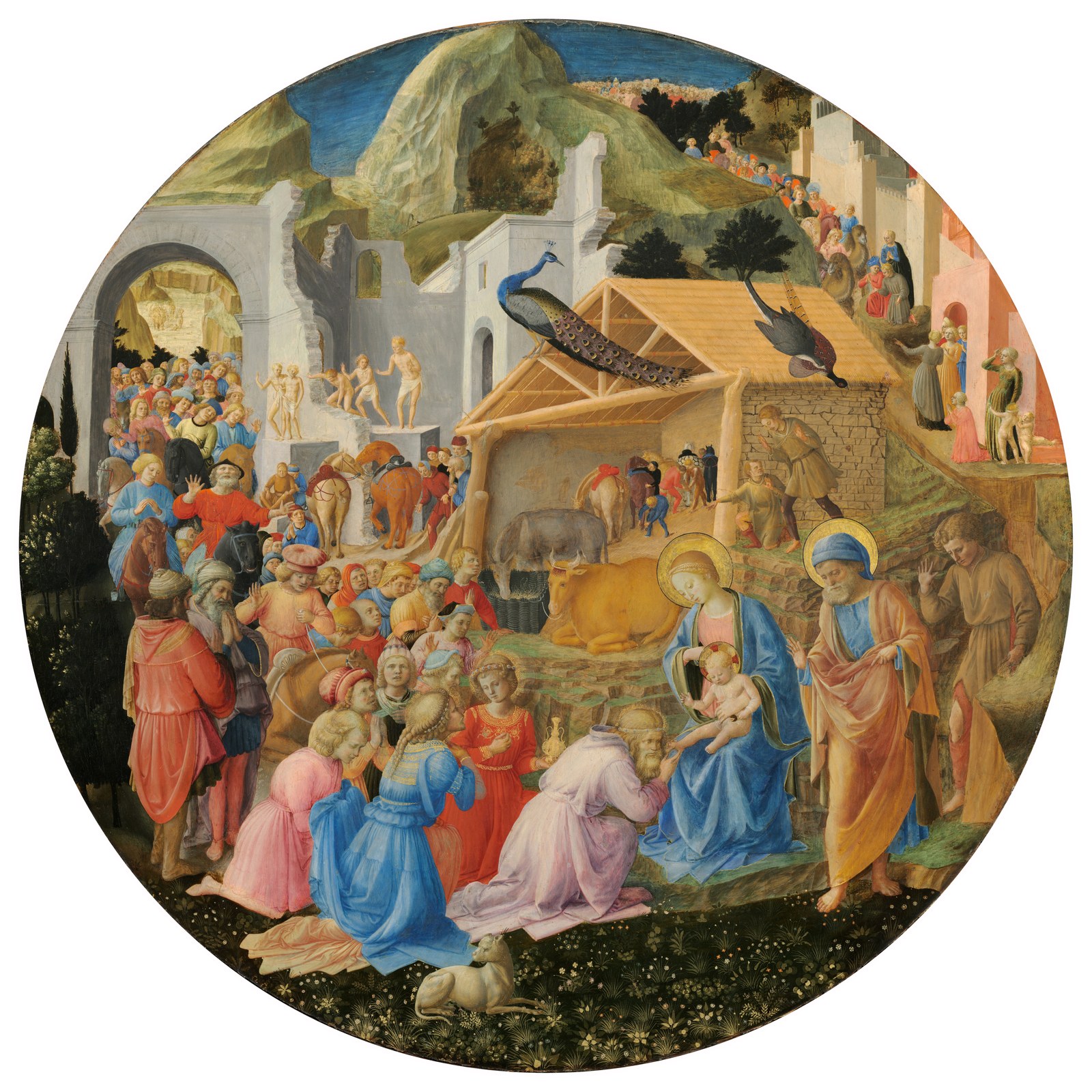
The Adoration of the Magi. Image: Fra Angelico and Fra Filippo Lippi (1395 - 1455) – painter (Italian) Born in Italy, Mugello, Vicchio. Died in Italy, Rome. Details on Google Art Project · Public domain · Wikimedia Commons, accessed 2026-08-04
The High Renaissance names the roughly forty years between 1490 and 1527 when the technical achievements of the Quattrocento — linear perspective, anatomical accuracy, classical proportion — were synthesized by a small number of artists into a style of unprecedented balance, monumentality, and idealized grace. Centered first in Florence and then increasingly in Rome under papal patronage, it is inseparable from three names: Leonardo da Vinci, Michelangelo Buonarroti, and Raphael Sanzio.
Where Quattrocento painting could feel precise but somewhat linear and additive — figures and architecture carefully constructed piece by piece — High Renaissance painting aimed for effortless unity. Leonardo's sfumato technique, a smoky blending of tone that eliminates hard outlines, gave faces like the Mona Lisa's an ambiguous, lifelike softness no earlier painter had achieved. Michelangelo's Sistine Chapel ceiling married Quattrocento anatomical study to a scale and physical grandeur closer to sculpture than painting. Raphael's School of Athens organized dozens of figures into a single, breathing architectural space with a clarity that made complexity look serene.
This was less a rebellion than a culmination: the High Renaissance did not reject the Quattrocento so much as absorb its lessons so completely that the underlying structure — perspective grids, proportional systems, anatomical study — became invisible, dissolved into apparently effortless naturalism. Its real target, if it had one, was the sense that art could and should aspire to an ideal beauty beyond ordinary appearance, refining the merely correct into the sublime.
The period matters because it produced some of the most famous and technically accomplished images in the Western tradition, and because its brief unity — three towering, temperamentally different artists working in close, sometimes rivalrous proximity in the same cities for the same patrons — has rarely been repeated. It ended abruptly: Raphael died in 1520, and the Sack of Rome in 1527, when mutinous imperial troops devastated the city, scattered artists and patrons alike, closing the era and opening the door to the more anxious, stylized art of Mannerism.
What defines High Renaissance
Sfumato and atmospheric blending
Leonardo's technique of softening outlines through subtle gradations of tone, rather than hard contour lines, gave faces and forms a hazy, lifelike ambiguity that became a hallmark of the period's most celebrated paintings.
Idealized, harmonious anatomy
Bodies were rendered with heroic proportion and anatomical precision drawn from close study, but adjusted toward an idealized beauty rather than strict individual likeness, especially in Michelangelo's sculpture and fresco work.
Pyramidal, balanced composition
Figures were frequently arranged in stable, triangular or pyramidal groupings that lend even complex, multi-figure scenes a sense of calm equilibrium and monumental order.
Unified, monumental space
Architectural and landscape settings were constructed with complete perspectival consistency, integrating dozens of figures into a single coherent, breathing space, as in Raphael's large fresco compositions.
Disegno as intellectual foundation
Central Italian artists prized disegno — draftsmanship and conceptual design — as the intellectual core of art, a value later contrasted with the Venetian school's emphasis on color and paint handling.
Papal and princely patronage at grand scale
Major commissions came from popes and rulers seeking monumental public statements, funding works of a physical scale and ambition — ceiling frescoes, wall-sized narrative cycles — that exceeded typical Quattrocento commissions.
History
The High Renaissance grew directly out of the Quattrocento but is generally dated from around 1490 to 1500, when Leonardo da Vinci, trained in Florence, began producing mature work that visibly moved beyond his teachers' more linear style — his Last Supper, painted in Milan between 1495 and 1498, demonstrated a new command of unified composition and psychological subtlety.
The center of gravity shifted decisively to Rome in the early 1500s, driven by the ambitions of Pope Julius II, who commissioned Michelangelo to paint the Sistine Chapel ceiling (completed 1512) and Raphael to fresco the papal apartments, including the School of Athens (completed around 1511). Michelangelo, already renowned as a sculptor after his marble David (completed 1504) in Florence, brought a sculptor's sense of physical mass to painting; Raphael, younger than both Leonardo and Michelangelo, absorbed lessons from each while developing his own gift for clarity and grace.
This concentrated burst of activity — three major artists competing for prestige in the same city for the same small circle of patrons within roughly two decades — is what gives the High Renaissance its unusual intensity and coherence as a period. It was, however, short-lived. Raphael died suddenly in 1520 at thirty-seven. Seven years later, in 1527, mutinous troops of Emperor Charles V sacked Rome, killing thousands and driving artists and patrons out of the city in what contemporaries experienced as a catastrophic rupture.
The Sack of Rome is generally treated as the High Renaissance's effective end point. Its unifying confidence gave way to the more tense, artificial, and emotionally charged style of Mannerism, practiced by a younger generation who had trained under or alongside the High Renaissance masters but could not, or chose not to, simply repeat their achievements.
Key works
| Work | Artist | Year | Why it matters |
|---|---|---|---|
| Mona Lisa | Leonardo da Vinci | 1503 | Renowned for its sfumato technique and ambiguous, lifelike expression, it remains the most widely recognized painting in Western art. |
| The Last Supper | Leonardo da Vinci | 1498 | A mural in Milan celebrated for its psychologically charged staging of the apostles' reactions to Christ's announcement of betrayal. |
| Sistine Chapel Ceiling | Michelangelo | 1512 | A monumental fresco cycle depicting scenes from Genesis, prized for its sculptural anatomy and physical grandeur. |
| David | Michelangelo | 1504 | A colossal marble sculpture whose idealized anatomy and composed tension became a defining image of Renaissance humanism. |
| The School of Athens | Raphael | 1511 | A fresco gathering ancient philosophers into a single unified architectural space, admired for its clarity and compositional balance. |
How to make art in this style
Painting in the High Renaissance Style Today
Palette: Use warm, harmonious tones — earthy reds, golden ochres, deep umbers, and muted ultramarine — kept unified through consistent, warm lighting rather than high contrast or bright, isolated color accents.
Composition: Organize the scene around stable geometric structures — triangles, pyramids, circles — that let multiple figures feel calm and balanced even in a busy scene. Give the composition a clear focal point and let every figure's pose and gaze reinforce it, the way a crowded fresco can still feel unified around two central figures.
Technique: Work for smooth, gradual tonal transitions rather than visible brushwork or hard outlines — this is the essence of sfumato, achieved traditionally through many thin, translucent oil glazes built up slowly over an underpainting. Study anatomy carefully and idealize it slightly: proportions should read as correct and graceful rather than casually observed. Avoid decorative flourish for its own sake; every element should serve the picture's overall unity.
Subjects: Religious narrative, classical mythology, and portraiture are all appropriate, treated with dignity and psychological depth rather than incident or drama. Faces should carry subtle, ambiguous expression rather than exaggerated emotion — a slight, unreadable calm rather than an open display of feeling. Above all, aim for a sense of effortlessness: the underlying structure, perspective, and anatomical precision should feel completely absorbed into the image rather than visible as technique.
Legacy
The High Renaissance set the benchmark against which Western figurative art measured itself for centuries. Its ideals of balance, idealized anatomy, and monumental unity became the core teaching of European academies from the 1600s onward, and its major works — the Mona Lisa, the Sistine Chapel ceiling, the School of Athens — remain the most reproduced images in the history of art.
Its influence runs through the Baroque, which both extended and dramatized its lessons, through Neoclassicism's return to its clarity and restraint, and through nineteenth-century academic painting, which treated High Renaissance composition as a model to imitate directly. Even artists reacting against it — the Mannerists who followed immediately, and modernists centuries later who rejected illusionistic realism altogether — defined themselves partly in relation to what it had achieved.
Beyond painting, the period shaped popular ideas of what "great art" looks like: the words "Renaissance masterpiece" still conjure the specific vocabulary of sfumato, pyramidal composition, and idealized human form that Leonardo, Michelangelo, and Raphael established in this brief, intensely productive window.
Frequently asked questions
What is the High Renaissance?
The High Renaissance was a roughly forty-year period, from about 1490 to 1527, when Leonardo da Vinci, Michelangelo, and Raphael brought Renaissance ideals of perspective, anatomy, and classical harmony to their most balanced and monumental synthesis, mainly in Florence and Rome.
When did the High Renaissance end?
It is generally considered to have ended with the 1527 Sack of Rome, which scattered the artists and patrons concentrated in the city; Raphael's death in 1520 is sometimes cited as an earlier symbolic close.
High Renaissance vs Early Renaissance: what changed?
The Early Renaissance developed the technical tools of perspective and anatomical study, often with a precise, somewhat linear quality. The High Renaissance absorbed those tools so completely that they became invisible, producing softer, more unified, and more idealized compositions.
Who are the main High Renaissance artists?
Leonardo da Vinci, Michelangelo Buonarroti, and Raphael Sanzio are considered the movement's defining figures, each working primarily in Florence and Rome for powerful patrons including the papacy.
What comes after the High Renaissance?
Mannerism followed directly, as a younger generation of artists reacted to the High Renaissance's achieved harmony with more elongated, artificial, and emotionally tense compositions.