 Art
Art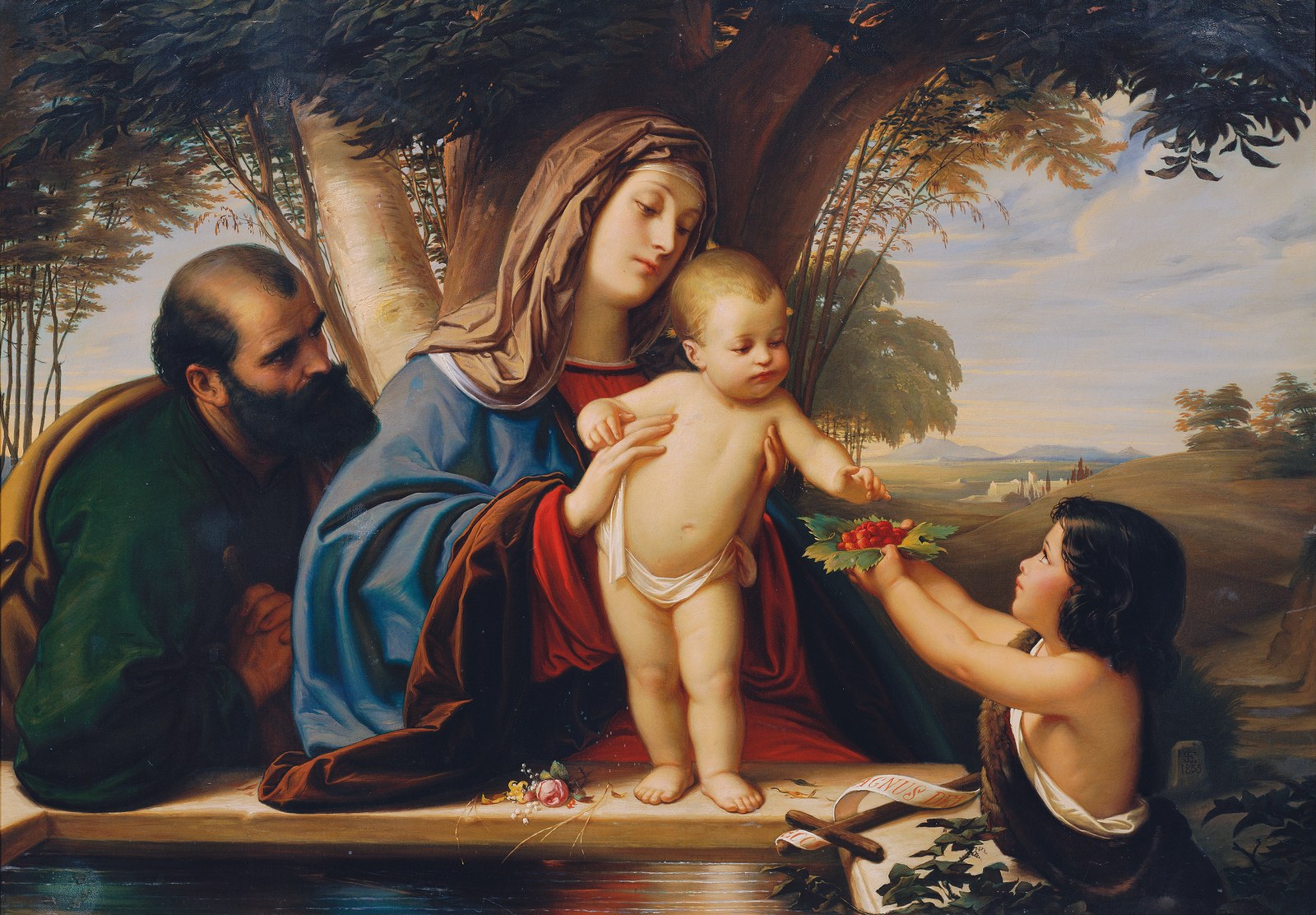
German: Heilige Familie mit Johannesknaben. Image: Eduard von Steinle · Public domain · Wikimedia Commons, accessed 2026-08-04
The Nazarene movement began in 1809, when a small group of German, Austrian, and Swiss art students in Vienna, dissatisfied with what they saw as the empty, mechanical conventions of academic Neoclassical training, formed a brotherhood called the Lukasbund, or Brotherhood of Saint Luke, named for the patron saint of painters. In 1810 several members relocated to Rome, where they settled in the abandoned monastery of Sant'Isidoro, adopting communal living, medieval dress, and even hairstyles in deliberate emulation of the guild workshops of the early Renaissance — a lifestyle that earned them the mocking nickname Nazarenes from Roman observers, referencing the biblical Nazarene appearance they cultivated.
Stylistically, the Nazarenes rejected both Neoclassicism's cool antique idealism and the loose, painterly virtuosity prized by later academic training, looking instead to the clear outline, luminous color, and devout sincerity of artists like Raphael, Perugino, and the German and Netherlandish painters of the fifteenth century. Their paintings favor precise, almost linear draftsmanship, flat or gently modulated color, and compositions organized with the calm legibility of early Renaissance altarpieces. Subject matter was overwhelmingly religious and moralizing, intended to restore what the group saw as art's lost spiritual seriousness and craft integrity.
The Nazarenes worked collaboratively on major fresco commissions in Rome, notably decorating rooms in the Casa Bartholdy and, later, the Villa Massimo, reviving large-scale narrative fresco cycles depicting biblical and literary stories as a deliberate throwback to Renaissance workshop practice. Leading figures included Friedrich Overbeck, who remained in Rome and increasingly devoted his career to sacred subjects, and Peter von Cornelius, who eventually returned to Germany to lead major fresco projects and academic reform in Munich and Berlin.
The movement matters as one of the first organized, self-consciously anti-academic artist collectives in modern art history, and as an early instance of artists using a real historical style — early Renaissance religious painting — as a deliberate program of moral and artistic reform. Its model of a communal brotherhood pursuing spiritual purity through art anticipated later nineteenth-century groups, most directly England's Pre-Raphaelite Brotherhood, who took both name and inspiration partly from the Nazarene example.
What defines Nazarene Movement
Clear, precise line
Nazarene painters favored crisp, controlled contour drawing over painterly brushwork, echoing the linear discipline of Raphael and earlier German and Italian masters. Draftsmanship, often developed through careful preparatory drawings, was treated as the foundation of artistic honesty.
Devotional, religious subject matter
The group's subjects centered on biblical and devotional religious themes but also extended to allegorical and literary narrative cycles, drawing on writers such as Dante, Ariosto, Tasso, and Goethe, intended to restore spiritual seriousness to an art world they saw as increasingly secular and academically hollow. Even these literary and allegorical works often carried devotional overtones.
Early Renaissance compositional models
Compositions draw on the calm symmetry and clear spatial organization of fifteenth and early sixteenth-century altarpieces, avoiding Baroque drama or Rococo ornament in favor of legible, stable groupings of figures.
Communal, guild-inspired working method
The Nazarenes lived and often worked collaboratively, reviving the medieval workshop model in which several artists jointly executed large fresco commissions, a deliberate rejection of the individualist academy system.
Restrained, luminous color
Color tends toward clarity and gentle modulation rather than dramatic chiaroscuro, closer to the tempera-like luminosity of early Renaissance panel painting than to the deep shadow of Baroque or the pastel softness of Rococo.
Symbolic pairing and allegory
The group favored allegorical devices, such as paired female personifications representing nations or ideals, to express abstract themes of friendship, faith, or cultural identity within otherwise naturalistic figure painting.
History
The Nazarene movement originated in 1809 at the Vienna Academy, where a group of students including Friedrich Overbeck, Franz Pforr, and Johann Konrad Hottinger formed the Lukasbund, rejecting what they viewed as the sterile formalism of contemporary academic instruction, itself still largely Neoclassical. In 1810, several members moved to Rome, taking up residence in the disused monastery of Sant'Isidoro, where they lived a semi-monastic communal life explicitly modeled on medieval artist guilds, complete with period dress and long hair, which prompted Roman locals to nickname them Nazarenes.
In Rome, the group grew to include Peter von Cornelius, Wilhelm von Schadow, and Philipp Veit, among others, and undertook major collaborative fresco commissions that let them realize their guild ideal in practice, most notably decorating rooms in the Casa Bartholdy, the Prussian consul's residence, between 1816 and 1817 with scenes from the biblical story of Joseph, and later contributing to fresco cycles at the Villa Massimo.
The Nazarenes' devout Catholic sympathies — several members, including Overbeck, converted to Catholicism — and their idealization of the medieval and early Renaissance past aligned them with broader Romantic-era currents of religious revival and nostalgia for a supposedly more unified, spiritually integrated past.
By the 1820s, the group had largely dispersed as a physical community: Cornelius returned to Germany to direct major academies and fresco projects in Düsseldorf, Munich, and Berlin, spreading Nazarene principles through German academic art education, while Overbeck remained in Rome for the rest of his life, increasingly focused on devotional painting. The movement's direct influence waned by mid-century, but its example of a self-consciously reformist artist brotherhood, dedicated to reviving early art for moral purposes, directly inspired England's Pre-Raphaelite Brotherhood in 1848.
Key works
| Work | Artist | Year | Why it matters |
|---|---|---|---|
| Italia and Germania | Friedrich Overbeck | 1828 | An allegorical double portrait symbolizing the Nazarenes' devotion to both Italian Renaissance ideals and German craft tradition. |
| Sulamith and Maria | Franz Pforr | 1811 | A founding image of the Nazarene brotherhood, pairing Italian and German female personifications of art. |
| Illustrations to Goethe's Faust | Peter von Cornelius | 1816 | A series of clear-lined drawings that helped spread the Nazarene linear style through Germany. |
How to make art in this style
Working in a Nazarene Style
Palette: Use clear, gently modulated color rather than dramatic chiaroscuro — soft blues, warm reds, and muted golds reminiscent of early Renaissance tempera and fresco, avoiding the deep shadow of Baroque or the pastel excess of Rococo.
Composition: Arrange figures with the calm symmetry and legible grouping of an early Renaissance altarpiece. Favor clear, stable compositions over dynamic diagonals, with each figure's role in the narrative immediately readable.
Drawing and technique: Build the image from precise, confident contour drawing, treating line as the foundation of the work rather than something brushwork later obscures. Study early Renaissance masters directly for their combination of clarity, calm, and devotional feeling, and consider working in thin, even paint layers rather than heavy impasto.
Subjects: Choose devotional, biblical, or moralizing themes treated with sincerity rather than irony or theatrical drama. Allegorical figures — personifications of virtues, nations, or ideals, often paired for symbolic contrast — suit the mode well, as do narrative cycles depicting a sequence of related biblical events across multiple panels or wall sections.
Approach: Consider the Nazarenes' own working method as much as their visual style: careful preparatory drawing, collaborative or workshop-based execution for larger projects, and a genuine investment in the moral or spiritual content of the subject, since the movement's conviction was that technique alone could not substitute for sincerity of purpose.
Legacy
The Nazarenes' most direct legacy is the Pre-Raphaelite Brotherhood, founded in England in 1848, which explicitly borrowed the Nazarenes' model of a small, named artist brotherhood dedicated to reviving the sincerity of art before Raphael, and their shared conviction that recent academic training had corrupted painting's moral seriousness. Through the Pre-Raphaelites, Nazarene ideas indirectly shaped later nineteenth-century revivalist and Arts and Crafts thinking about craft, spirituality, and the workshop ideal.
Within Germany, Nazarene-trained painters like Peter von Cornelius and Wilhelm von Schadow shaped academic art instruction for decades through leadership positions at major academies, spreading an emphasis on disciplined drawing and narrative clarity that persisted in German history painting well past the movement's peak.
The Nazarenes are also historically significant as an early, clearly documented example of artists organizing themselves as a self-conscious reform movement with a shared program and communal identity — a template that recurs throughout later art history, from the Pre-Raphaelites to twentieth-century avant-garde groups, even when their specific religious and stylistic aims diverged sharply from the Nazarenes' own devout classicism.
Frequently asked questions
What was the Nazarene movement?
The Nazarene movement was a group of early nineteenth-century German and Austrian painters who rejected academic Neoclassicism in favor of the clear line and devout sincerity of early Renaissance religious art, living communally in Rome to pursue this revival.
Why were they called Nazarenes?
Roman observers mockingly nicknamed the group Nazarenes because several members wore their hair long and dressed in a manner evoking biblical depictions of Jesus of Nazareth, part of their deliberate emulation of medieval artist guilds.
How did the Nazarenes influence later art?
The Nazarenes directly inspired England's Pre-Raphaelite Brotherhood, founded in 1848, which shared their conviction that art had lost its sincerity since Raphael and adopted a similar model of a small, named reform-minded artist brotherhood.
What subjects did Nazarene painters favor?
Nazarene painters favored biblical narratives, devotional themes, and moralizing allegory, alongside allegorical and literary narrative cycles drawing on writers such as Dante, Ariosto, Tasso, and Goethe, often executed as collaborative fresco cycles that revived the workshop model of early Renaissance and medieval art.
Who were the key Nazarene painters?
Friedrich Overbeck and Franz Pforr founded the movement in Vienna in 1809, and Peter von Cornelius and Wilhelm von Schadow became central figures after the group relocated to Rome and later spread its influence through German academies.