 Art
Art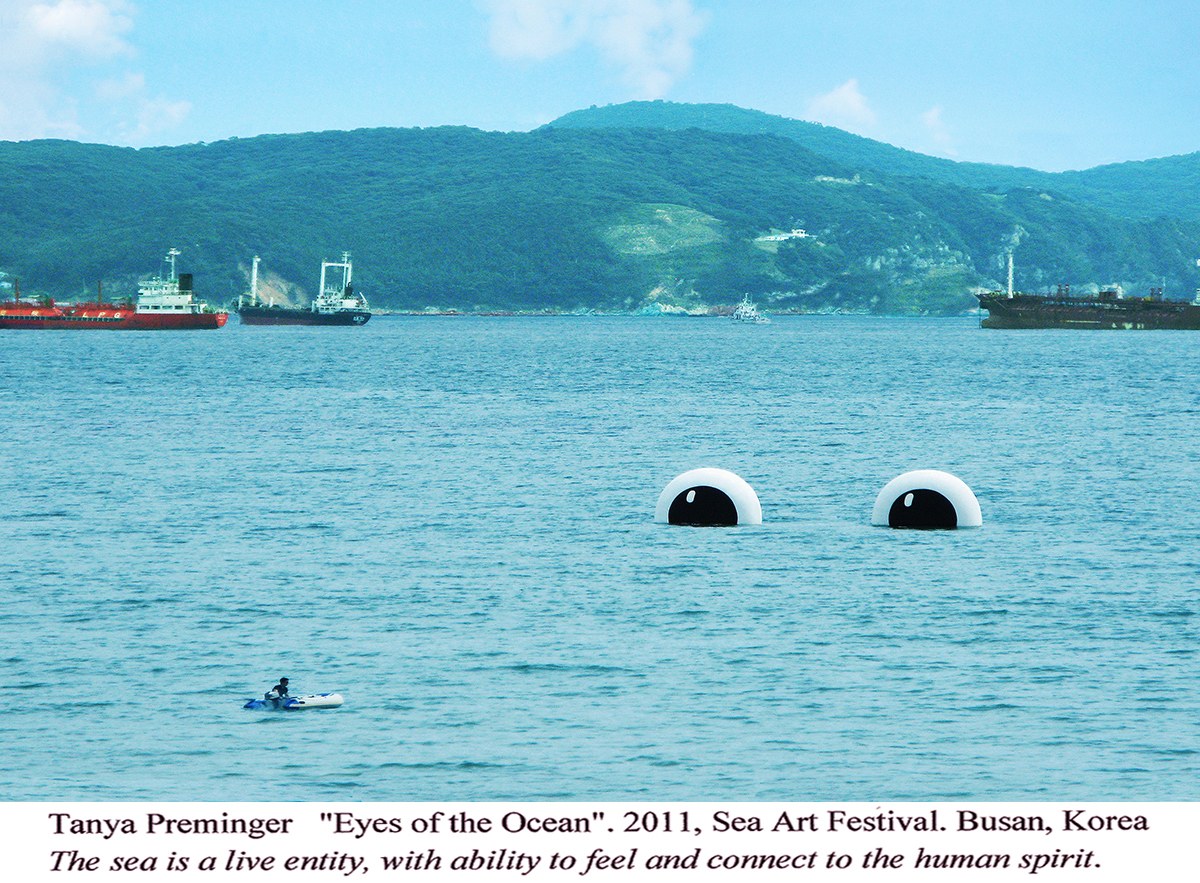
"Eyes of Ocean" -Tanya Preminger -installation. Image: עודד.ש · CC BY-SA 4.0 · Wikimedia Commons, accessed 2026-08-04
Land Art, also called Earth Art or Earthworks, emerged in the United States and Britain around 1967–68 as artists began moving out of the gallery entirely and into deserts, dry lakebeds, and open countryside. Rather than making objects to be sold and displayed indoors, Land artists reshaped the earth itself—bulldozing trenches, arranging boulders, or tracing paths across miles of terrain—creating works too large, too remote, or too temporary to fit inside a museum.
The look of Land Art ranged from the monumental to the barely visible. Robert Smithson's "Spiral Jetty" (1970) coiled 1,500 feet of black basalt rock into Utah's Great Salt Lake, its color shifting with algae blooms in the pink water. Michael Heizer's "Double Negative" (1969) was two enormous trenches cut into a Nevada mesa, displacing hundreds of thousands of tons of rock to create a sculpture defined as much by absence as by mass. At a gentler scale, Richard Long simply walked back and forth across a field until his footsteps traced a visible line, then photographed the result.
Land Art rebelled against the commercial gallery system as directly as any postwar movement. Its works were often physically impossible to buy, sell, or hang on a wall; many existed for most viewers only as photographs, maps, and written documentation once exhibited indoors, since the actual earthwork sat hundreds of miles from any city. This also pushed back against Minimalism's industrial, indoor geometric objects by taking similar reductive forms—lines, spirals, grids—out into raw landscape and weather.
Land Art also carried an early ecological awareness, made in the same years as the first Earth Day and rising environmental consciousness, even as some of its bulldozer-scale interventions sat uneasily alongside that sentiment. It matters because it radically redefined where and what sculpture could be, treated the land itself as both material and subject, and produced some of the most photographed and mythologized works of postwar American art—icons known to millions who have never stood on their actual, remote sites.
What defines Land Art
Monumental, Site-Specific Scale
Works were built at a scale of acres or miles rather than inches, inseparable from their specific desert, lakebed, or mesa location. Moving the piece anywhere else would destroy its meaning.
Earth and Rock as Primary Material
Rather than bronze, marble, or paint, Land artists sculpted directly with soil, rock, salt, and vegetation, often using bulldozers and heavy earth-moving equipment more associated with construction than art.
Remote, Often Inaccessible Sites
Many works were built in deserts or on private land far from cities, deliberately resisting casual gallery-going audiences and requiring real effort, or a plane ticket, to visit.
Documentation as Secondary Artwork
Because most people could never visit the actual site, photographs, films, and maps became the primary way audiences encountered the work, turning documentation into an artwork in its own right.
Ephemerality and Erosion
Many earthworks were left exposed to weather, rising water, or erosion, so that wind, rain, and time visibly altered or eventually reclaimed them, folding natural change into the work's identity.
Geometric, Reductive Forms
Despite their raw materials, many works used simple geometric forms—spirals, lines, circles, grids—echoing Minimalist sculpture's reduction of form even as they abandoned its indoor, fabricated materials.
History
Land Art emerged in the United States in the late 1960s, developing out of Minimalism and Conceptual art's interest in simple forms, systems, and the rejection of the traditional gallery object. Several of its key figures—Robert Smithson, Michael Heizer, Walter De Maria—had worked in or around Minimalist circles in New York before turning to the American West's deserts and open land as both material and site.
Robert Smithson's 1970 "Spiral Jetty," built from black basalt rock and earth coiled into Utah's Great Salt Lake, became the movement's most iconic and most written-about work, partly because Smithson documented and theorized his own practice extensively in essays and a film. Michael Heizer's "Double Negative" (1969), two massive trenches cut into a Nevada mesa, and Walter De Maria's "The Lightning Field" (1977), four hundred stainless steel poles arranged in a New Mexico grid to attract lightning strikes, extended the movement's ambition toward near-industrial scale and engineering.
The movement was not confined to the American West. In Britain, Richard Long began making Land Art as early as 1967, working at a far gentler, more personal scale—walking a straight line into a field of grass, or arranging stones collected on long walks, then documenting the results in photographs and text. This British strand emphasized the artist's body moving through landscape over the earth-moving machinery favored by American peers.
Dealers and early patrons played a central role funding and promoting American earthworks through the late 1960s and 1970s, while institutions like the Dia Art Foundation later took on stewardship of major sites, including "Spiral Jetty" and "The Lightning Field," ensuring public access decades on. By around 1980, the first wave of large-scale American earthworks had largely concluded as key figures like Smithson, who died in a 1973 plane crash surveying a work site, were gone or had moved to other projects, though Land Art's influence continued through the site-specific and environmental art that followed.
Key works
| Work | Artist | Year | Why it matters |
|---|---|---|---|
| Spiral Jetty | Robert Smithson | 1970 | A 1,500-foot coil of black basalt rock built into Utah's Great Salt Lake, the movement's best-known and most photographed work, its visibility rising and falling with the lake's water level. |
| Double Negative | Michael Heizer | 1969 | Two enormous trenches cut into a Nevada mesa, displacing hundreds of thousands of tons of rock to create a sculpture defined by absence as much as mass. |
| The Lightning Field | Walter De Maria | 1977 | A grid of 400 stainless steel poles in the New Mexico desert designed to attract lightning, meant to be experienced by visitors staying overnight on site. |
| Sun Tunnels | Nancy Holt | 1976 | Four large concrete cylinders aligned with the sunrise and sunset on the summer and winter solstices, framing views of the Utah desert sky. |
| A Line Made by Walking | Richard Long | 1967 | A line worn into a grass field simply by the artist walking back and forth, photographed as the finished work—one of the earliest and most minimal Land Art gestures. |
How to make art in this style
Working in the Land Art Spirit
Land Art starts with site, not material—choose a landscape first and let its geology, light, and scale dictate the work. Deserts, beaches, riverbeds, and open fields all offer the kind of raw, undeveloped space the movement favored, though even a local park or backyard can support a modest version of the same idea.
Work directly with what the site offers: soil, sand, stone, driftwood, snow, or vegetation, arranged rather than imported from elsewhere. Favor simple, legible forms—spirals, straight lines, circles, grids—that read clearly from a distance or from above, since much Land Art is designed to be seen as a whole shape rather than examined up close.
Think about scale honestly. You do not need heavy machinery to work in this tradition; walking a repeated path until it leaves a visible line, or arranging a long row of stones, follows the same logic as the monumental earthworks at a human scale. Let the piece's size match what your site and materials can actually support.
Plan for impermanence. Tide, wind, rain, and growing plants will likely alter or erase the work, and that change can be treated as part of its meaning rather than a failure. Photograph the piece from a fixed vantage point, ideally including some sense of scale, such as a figure or a horizon line, so viewers can judge its size.
Keep documentation plain: clear daylight photographs, a simple map or description of the site, and, if relevant, notes on how the piece changed over time. The photograph and the record are how almost everyone will encounter the work, so treat them with the same care as the piece itself.
Legacy
Land Art permanently expanded sculpture's possible scale, material, and location, establishing the idea that a site itself—its geology, weather, and remoteness—could be both medium and subject. Its emphasis on documentation, since most audiences could never visit the actual earthworks, anticipated how much of today's art, particularly site-specific and ephemeral work, circulates primarily as photography and video rather than as an object seen in person.
The movement's central works have become genuine cultural landmarks: "Spiral Jetty" in particular is instantly recognizable even to people with no background in art history, reproduced constantly in photographs, films, and popular culture. Institutions like the Dia Art Foundation have preserved and opened major earthworks to the public, cementing pilgrimage-like visits to remote desert sites as part of contemporary art's mainstream itinerary.
Land Art's influence runs through later environmental and site-specific art, public art commissions that respond to landscape, and any practice using natural materials or geological time as subject matter. Richard Long's walking-based, low-impact British strand also anticipated today's interest in art that leaves minimal physical trace, offering an alternative to the bulldozer-scale ambition of the American earthworks that first defined the movement.
Frequently asked questions
What is Land Art?
Land Art, also called Earth Art or Earthworks, is a movement from the late 1960s in which artists made sculpture directly from the landscape—earth, rock, and natural materials—often at a massive scale and in remote locations rather than in galleries.
What is the most famous Land Art work?
Robert Smithson's "Spiral Jetty" (1970), a 1,500-foot coil of black basalt built into Utah's Great Salt Lake, is generally considered the movement's most iconic work and remains a popular pilgrimage site.
Why did Land Art artists work in such remote places?
Working far from cities let artists build at a scale impossible in any gallery and deliberately resisted the commercial art market, since the resulting earthworks were essentially impossible to buy, sell, or move. Most audiences encountered the works only through photographs, film, and maps.
How is Land Art different from Arte Povera?
Both movements rejected traditional art materials in favor of raw, natural substances, but Land Art worked at a landscape scale outdoors, reshaping actual terrain, while Arte Povera made indoor, gallery-scaled sculptures and installations from humble found materials. Land Art is also specifically American and British in origin, while Arte Povera centered on Turin and Rome.
Can you still visit Land Art works today?
Several major works, including "Spiral Jetty" and Walter De Maria's "The Lightning Field," are preserved and open to visitors, some through organizations like the Dia Art Foundation, though many require travel to remote desert locations.