 Art
Art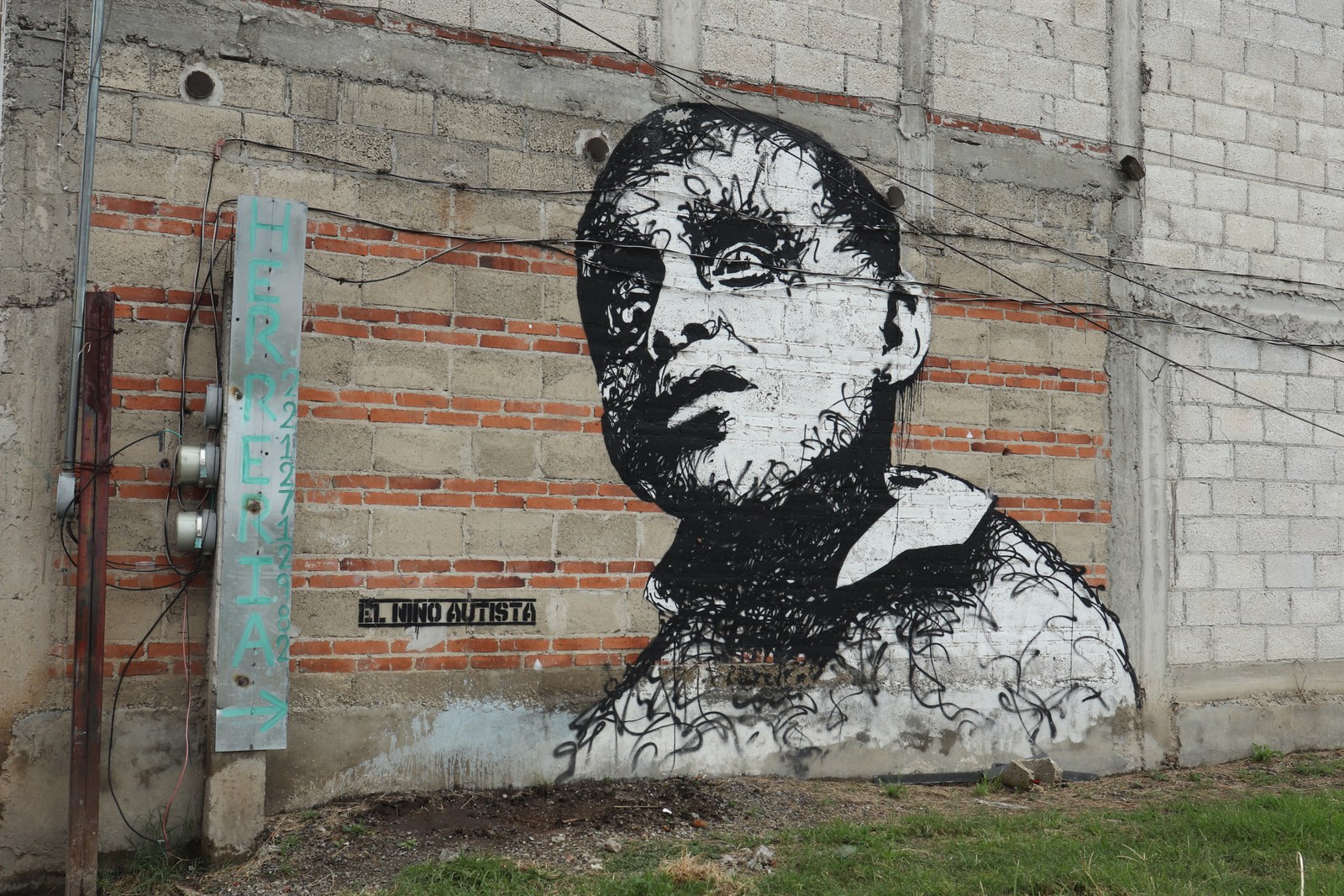
"El niño autista". Image: Milhojas 72 · CC0 · Wikimedia Commons, accessed 2026-08-04
Graffiti Art originated as "writing," the practice of young people marking city surfaces, especially subway cars, with their names or pseudonyms, developing first in Philadelphia in the late 1960s and then explosively in New York City in the early 1970s. What began as simple tags — a stylized signature repeated across the city to build reputation and visibility — evolved rapidly into a sophisticated visual art form, as writers competed to develop increasingly elaborate lettering styles, larger "pieces" (from "masterpiece"), and eventually entire subway cars covered edge to edge with complex, multicolor compositions.
Visually, graffiti art centers on stylized lettering as its core visual language: bubble letters, sharp-angled "wildstyle" interlocking forms, three-dimensional shading and highlighting, arrows, stars, and connecting flourishes that make individual letters difficult for outsiders to decipher but instantly legible within writer culture. Aerosol spray paint is the movement's defining medium, chosen for speed and portability given the illicit conditions under which most work was made. Cartoon-derived characters, drawn from comics and animation, frequently accompanied or anchored lettering compositions. Crews of writers worked collaboratively, and reputation was built through pseudonymous tags rather than legal names, with risk of arrest and physical danger from moving trains and rail yards constant.
The movement rebelled against the total absence of ordinary young people, most of them Black and Latino teenagers in economically marginalized New York neighborhoods, from any sanctioned avenue for public visibility or artistic recognition. Writing offered a way to claim presence and status within a city that offered these young people little institutional voice, transforming public transit into a moving, city-wide gallery no official body had sanctioned or could easily suppress.
Graffiti Art matters because it represents one of the only major art movements to emerge entirely from youth culture outside any art-school or gallery system, developing its own internal aesthetic standards, hierarchy, and history before the broader art world took notice. Its emergence alongside early hip-hop music and breakdancing made it one of that culture's four foundational pillars, and its crossover into galleries in the early 1980s permanently blurred the line between street-level youth culture and the fine-art establishment, setting the template later followed by Street Art.
What defines Graffiti Art
Stylized lettering: tags, throw-ups, and pieces
The core vocabulary runs from quick single-color tags through fuller two-tone "throw-ups" to elaborate multicolor "pieces," each representing increasing time investment and technical ambition.
Wildstyle interlocking letterforms
Advanced pieces developed sharp, interlocking, arrow-laden letters so stylized they become difficult for outsiders to read, prioritizing visual complexity and writer-community legibility over general public clarity.
Aerosol spray paint as primary medium
Spray paint's speed and portability suited the illicit, often nighttime conditions under which most early graffiti was made, becoming inseparable from the movement's technique and visual texture.
Subway cars and public walls as canvas
New York's subway system, especially, became the movement's primary exhibition space, with whole-car pieces functioning as a citywide, constantly moving gallery seen by millions of riders.
Bold outlines and dimensional lettering effects
Writers developed drop shadows, 3D block effects, and bold contrasting outlines to make letters read clearly from a distance despite their stylization.
Crews and pseudonymous writer identity
Writers worked in named crews and were known citywide by tags rather than legal names, building reputation through visibility, technical skill, and the number of pieces attributed to a given name.
History
Graffiti writing's documented origins trace to Philadelphia in the late 1960s, where a writer known as Cornbread is often credited among the first to tag his name repeatedly across the city to gain notice. The practice spread and intensified in New York City in the early 1970s, where a Manhattan teenager tagging as TAKI 183 gained citywide attention after a 1971 New York Times profile, inspiring a wave of imitators competing for visibility across the five boroughs.
Through the mid-1970s, writers escalated from simple tags to larger, more technically ambitious pieces, and by the end of the decade, entire subway cars covered top-to-bottom in coordinated, multicolor compositions had become the movement's most prized and dangerous achievement, requiring writers to work in rail yards at night under real risk of arrest or injury. Distinct crews formed, and "style wars" — competitive rivalries over technical innovation and citywide visibility — drove rapid aesthetic development within writer culture itself.
The early 1980s brought graffiti's crossover into the gallery system, as figures including Fab 5 Freddy, Futura 2000, Lady Pink, and Dondi White exhibited canvas-based work in downtown New York galleries, and Jean-Michel Basquiat, who began as a tagger writing SAMO© with collaborator Al Diaz before turning to canvas, became the movement's most commercially and critically celebrated crossover figure. Keith Haring, working in a related but distinct chalk-drawing practice in subway stations, became similarly prominent. The documentary "Style Wars" (1983) and the photographic book "Subway Art" (1984) by Martha Cooper and Henry Chalfant documented the culture for a wider audience just as it faced institutional pressure.
New York's Metropolitan Transportation Authority responded with an intensified anti-graffiti campaign through the 1980s, including improved yard security, buffing (repainting) affected cars, and eventually a fleet-wide effort that effectively ended subway graffiti by 1989. Writing continued on walls and other surfaces and evolved internationally, while its aesthetic and cultural DNA fed directly into the broader Street Art movement that followed.
Key works
| Work | Artist | Year | Why it matters |
|---|---|---|---|
| Campbell's Soup Car train | Fab 5 Freddy | 1980 | A whole subway car referencing Andy Warhol's soup can imagery, a widely cited moment linking graffiti directly to Pop Art and helping bring the culture downtown-gallery attention. |
| SAMO© tags | Jean-Michel Basquiat and Al Diaz | 1978 | Cryptic, philosophically pointed tags across Lower Manhattan that launched Basquiat's public art career before his move to canvas and gallery exhibition. |
How to make art in this style
Working in a Graffiti Art sensibility today
Start with lettering, since the writer's name or pseudonym is the movement's core visual subject rather than an afterthought. Develop a consistent personal tag or name and practice its letterforms repeatedly until the hand-style becomes distinctive and fluent.
Technique. Spray paint remains the traditional medium, valued for speed, coverage, and the specific drip and overspray texture it produces; if working legally on canvas or a sanctioned wall, aerosol still reads as the most authentic technical choice. Build compositions in stages: block in the letterforms first, then add fill color, then outline and dimensional shading (drop shadows, highlights, 3D block edges) last.
Palette. Bold, high-contrast, often neon-adjacent color combinations are characteristic — bright pinks, blues, yellows against black or white grounds read clearly at a distance, which mattered for work meant to be seen from moving trains or across a street.
Composition. Favor dynamic, angular letterforms with interlocking strokes, arrows, and connecting flourishes over rigid, static type. "Wildstyle" complexity, where letters distort and interlock heavily, signals higher technical ambition than simpler bubble-letter tags.
Subjects. Beyond lettering, cartoon-derived characters drawn in a bold outlined style traditionally accompany or anchor pieces. Work at large scale where possible; whole-surface coverage, whether a subway car historically or a wall today, is part of the tradition's ambition.
Context. The movement's history is inseparable from public space and risk; working with legal permission on designated walls today is the responsible way to engage with the style's techniques.
Legacy
Graffiti Art established that a major visual art movement could originate entirely outside the gallery and art-school system, developing its own aesthetic standards, hierarchy, and history within youth culture before institutions took notice. As one of hip-hop culture's four foundational pillars alongside DJing, MCing, and breakdancing, it tied visual art permanently to a broader popular cultural movement that has since become globally dominant.
Its crossover into commercial galleries in the early 1980s established a template for street-originated art gaining fine-art legitimacy without fully abandoning its subcultural roots, a path Street Art followed directly afterward. Basquiat's continued posthumous prominence, including record-setting auction results, kept graffiti's aesthetic vocabulary — raw lettering, symbols, layered mark-making — visible at the highest levels of the contemporary art market. Typographic and lettering styles pioneered by graffiti writers, particularly wildstyle's interlocking, dimensional letterforms, have become a standard visual reference across commercial design, album art, apparel branding, and animation, far beyond their original subway-yard origins. Municipal and commercial mural programs worldwide, along with dedicated graffiti-art museums and legal "writer's benches" and walls, now formally preserve and commission work in a style once treated purely as vandalism.
Frequently asked questions
What is Graffiti Art?
It is an art movement originating in early-1970s Philadelphia and New York in which young writers developed stylized lettering, characters, and whole-train murals using spray paint, evolving from simple name-tagging into a sophisticated visual art form.
Who started Graffiti Art?
Philadelphia's Cornbread is often cited among the earliest taggers in the late 1960s, while New York's TAKI 183 helped popularize the practice citywide after a 1971 newspaper profile, launching the movement's rapid development.
What is the difference between graffiti and street art?
Graffiti art centers on stylized lettering, tags, and writer-culture identity built through pseudonymous reputation, while street art, which developed later, encompasses a wider range of techniques like stencils and wheatpaste aimed at a broader public audience.
What does "wildstyle" mean in graffiti?
Wildstyle refers to a highly stylized, interlocking lettering technique with sharp angles and arrows that makes letters difficult for outsiders to read, representing one of the movement's most technically advanced lettering forms.
Why did subway graffiti end in New York?
The Metropolitan Transportation Authority's intensified anti-graffiti campaign through the 1980s, including improved yard security and systematic repainting of affected cars, effectively ended subway car graffiti by 1989.
How did graffiti art move into galleries?
In the early 1980s, writers including Fab 5 Freddy, Futura 2000, Lady Pink, Dondi White, and Jean-Michel Basquiat began exhibiting canvas-based work in downtown New York galleries, translating subway-yard techniques into gallery-scale fine art.