 Art
Art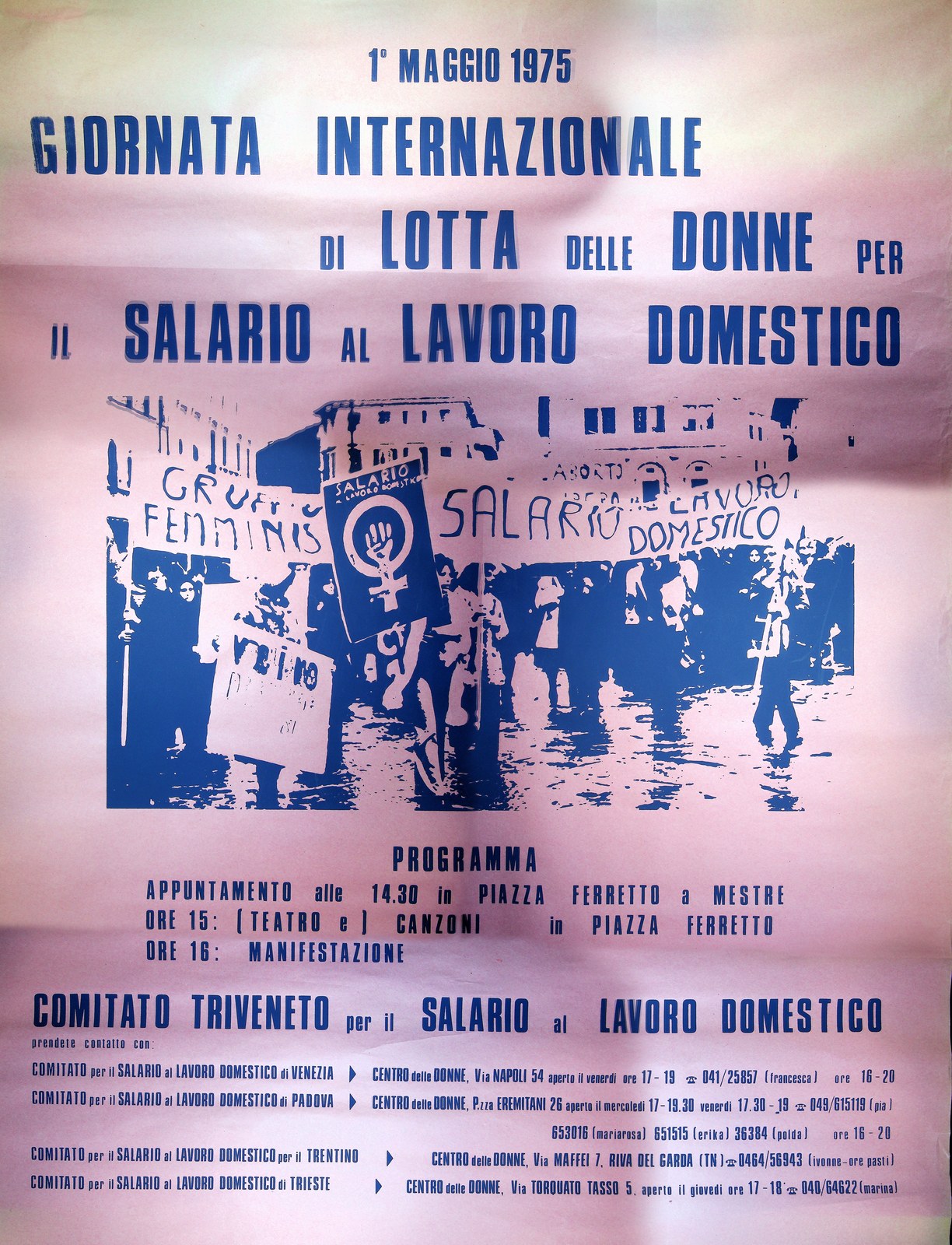
"1 Maggio 1975" (1975 Mayday Protest for Wages for Housework in Mestre, Italy). Image: Salario per il lavoro domestico (Wages for Housework) groups in the Triveneto region. · CC BY-SA 4.0 · Wikimedia Commons, accessed 2026-08-04
The Feminist Art Movement grew out of the broader women's liberation movement of the late 1960s, as women artists in the United States and Britain confronted an art world that treated them as marginal. Museums rarely showed their work, art schools rarely taught it as a serious subject, and critics rarely reviewed it on equal terms with men's. Feminist artists responded by making that exclusion itself a subject, and by insisting that experiences long coded as private or trivial — menstruation, childbirth, housework, sexual violence, the body on display — belonged in galleries and museums.
Visually, the movement had no single style; it was defined by subject and stance rather than technique. Some artists worked in performance and body art, using their own bodies as material to confront audiences directly. Others reclaimed traditionally "feminine" crafts — embroidery, china painting, quilting, weaving — as legitimate fine-art media, arguing that the hierarchy separating craft from art was itself a form of gender bias. Judy Chicago developed what she called "central-core" imagery, abstracted floral and vaginal forms asserting a distinctly female visual vocabulary. Others used photography, text, and appropriated advertising imagery to dissect how mass media constructed and controlled images of women.
The movement rebelled against several targets at once: the near-total absence of women from museum collections and art history surveys, the assumption that major art required male genius and scale, and modernism's tendency to treat the female body chiefly as an object for a male viewer rather than a subject with its own point of view. Feminist artists also built new institutions to bypass an unwelcoming establishment — cooperative galleries, feminist art programs at universities, journals, and archives — rather than waiting for inclusion.
The movement matters because it permanently expanded what counted as valid subject matter and material in contemporary art, and because its institution-building model — collectives, alternative spaces, artist-run publications — became a template later adopted by other marginalized groups seeking visibility in the art world. Its insistence that the personal is political reshaped how several subsequent generations of artists, regardless of gender, thought about identity, the body, and autobiography as legitimate artistic territory.
What defines Feminist Art Movement
Body-centered imagery and performance
Many feminist artists used their own bodies directly as material, staging performances that confronted audiences with menstruation, aging, sexuality, or violence. This made the body a site of political argument rather than passive display.
Central-core and body-derived abstraction
Judy Chicago and others developed abstracted floral and vulvar forms as a deliberately female visual vocabulary, countering a modernist abstraction they saw as coded male. The imagery was often symmetrical, layered, and organic.
Reclaimed craft techniques
Needlework, china painting, quilting, and weaving were elevated to fine-art status, challenging the hierarchy that had long dismissed domestic crafts as decorative women's work rather than serious art.
Autobiography and domestic subject matter
Kitchens, birth, housework, and family life appeared as primary subjects rather than backdrop, treated with the same seriousness previously reserved for history painting or heroic subjects.
Collaborative and large-scale collective works
Projects were frequently made by groups rather than a single hand, reflecting the movement's emphasis on shared labor and consciousness-raising over the myth of the solitary male genius.
Text and appropriated media imagery
Later feminist artists layered blunt, often accusatory text over cropped advertising and film-still photography, exposing how mass media constructed and sold images of women.
History
The movement's institutional starting point is usually dated to 1970-71, when Judy Chicago founded the first Feminist Art Program at Fresno State College, later moving it to CalArts with Miriam Schapiro. In 1972 the program's students, with Chicago and Schapiro, transformed a derelict Hollywood mansion into Womanhouse, an installation of room-by-room environments addressing domestic life from a female perspective; it became one of the movement's foundational public statements. The same years saw the founding of feminist cooperative galleries, journals such as The Feminist Art Journal, and archives dedicated to recovering women artists erased from standard art-history surveys.
Judy Chicago's The Dinner Party (begun 1974, completed 1979) became the movement's most ambitious and widely seen work, a triangular table set with place settings honoring 39 historical and mythological women, made through large-scale collaborative labor involving ceramics, china painting, and needlework. In New York, artists such as Carolee Schneemann and Martha Rosler used performance and video to interrogate the body and domestic labor, while Barbara Kruger, working somewhat later, applied advertising's own graphic language against itself in text-and-image works critiquing the male gaze.
The movement was never confined to one style or country; in Britain, feminist artists engaged more directly with theory, psychoanalysis, and the politics of representation, producing a more conceptual and text-based strand. By the mid-1980s, the movement's most identifiable phase gave way to a broader, less unified feminist practice absorbed into postmodern and identity-based art more generally, as younger artists worked across the concerns feminist art had opened up — body, identity, media critique — without organizing under a single banner. Its institutions, however, including women's studies programs, feminist presses, and dedicated archives, persisted and continued shaping how art history was written and taught.
Key works
| Work | Artist | Year | Why it matters |
|---|---|---|---|
| The Dinner Party | Judy Chicago | 1979 | A monumental collaborative installation of place settings honoring historical women, the movement's most famous and widely exhibited work. |
| Womanhouse | Judy Chicago and Miriam Schapiro | 1972 | A room-by-room installation in a Hollywood mansion made with students, one of the movement's foundational collective statements on domestic life. |
| Interior Scroll | Carolee Schneemann | 1975 | A performance in which Schneemann read text pulled from her own body, a landmark of body-centered feminist performance art. |
| Semiotics of the Kitchen | Martha Rosler | 1975 | A deadpan video performance parodying cooking-show conventions to expose the violence latent in domestic routine. |
| Untitled (Your Body Is a Battleground) | Barbara Kruger | 1989 | A text-over-photography work made for a pro-choice march, exemplifying the movement's later graphic, media-critical strand. |
How to make art in this style
Working in a Feminist Art sensibility today
Start from subject rather than a fixed visual formula, since the movement's coherence came from stance, not style. Choose subject matter drawn from lived, often domestic or bodily experience — labor, care, the body, family history — and treat it with the scale and seriousness traditionally reserved for grand historical themes.
Materials and technique. Consider working in a craft medium historically coded as feminine and undervalued: embroidery, quilting, ceramics, weaving, or china painting. Combine it deliberately with fine-art conventions such as large scale, formal composition, or gallery presentation, so the pairing itself makes an argument about hierarchy.
Palette. No single feminist palette exists, but many key works favor either soft, layered pastels tied to floral and body-derived abstraction, or stark black-and-white or red-and-white combinations for text-based, advertising-critical pieces. Let the palette follow the strategy: decorative and organic for reclaimed-craft work, blunt and high-contrast for media critique.
Composition. For body-derived abstraction, use radial, layered, or concentric forms rather than a single fixed vanishing point, echoing organic and bodily structure. For text-based work, crop photographic imagery tightly and overlay short, direct, often second-person text in bold sans-serif type.
Process. Collaborative or collective making is central to the movement's history; consider working with others, and let visible labor — stitches, repeated marks, accumulated small gestures — remain evident rather than smoothed away, since that visible labor is itself part of the content.
Subjects. Domestic interiors, the body, birth and care work, historical women omitted from standard accounts, and the mechanics of media representation are all traditional territory for this approach.
Legacy
Feminist Art permanently widened what museums and critics treat as valid subject matter and material, opening the door for autobiography, domestic life, and the body to be handled with the seriousness once reserved for history painting. Its recovery of craft techniques helped dissolve the rigid modernist hierarchy separating fine art from applied and decorative art, a shift later generations of painters and installation artists took for granted. The movement's collective, do-it-yourself institution-building — cooperative galleries, artist-run journals, dedicated archives — became a template other marginalized groups later adapted to gain visibility on their own terms.
Its influence is visible across contemporary practice, from the confessional and body-based work of later performance artists to the text-and-image strategies of media-critical photography and graphic design descended from Kruger's advertising-inflected style. University art history and museum curatorial practice were reshaped by feminist scholarship's insistence on recovering overlooked women artists, a project still ongoing. In popular visual culture, the movement's blunt reclamation of the body and its skepticism toward media-constructed femininity continue to inform advertising critique, protest graphics, and identity-centered contemporary art.
Frequently asked questions
What is the Feminist Art Movement?
It is a movement beginning in the late 1960s in which women artists made gender, the body, and domestic life central artistic subjects while challenging their exclusion from museums, galleries, and art history.
Who started the Feminist Art Movement?
The movement had no single founder. Judy Chicago and Miriam Schapiro are among the most-cited early figures, through the Feminist Art Program they established at Fresno State and later CalArts and the collective installation Womanhouse in 1972, but it emerged simultaneously through New York artist collectives and cooperative galleries, feminist art criticism such as Linda Nochlin's 1971 essay, and a parallel British strand centered on theory and representation.
What is Judy Chicago's The Dinner Party?
It is a large triangular table installation with 39 place settings honoring historical and mythological women, made through collaborative ceramics and needlework, and remains the movement's best-known work.
How is Feminist Art different from feminist theory in general?
Feminist Art refers specifically to visual artworks and the artists who made them, while feminist theory is the broader intellectual framework about gender and power that informed, but is not identical to, the art movement.
Why did Feminist Art reclaim craft techniques like embroidery?
Because crafts historically practiced by women, such as needlework and china painting, had been excluded from "fine art" status; using them in serious gallery contexts challenged that hierarchy directly.
When did the Feminist Art Movement end?
Its most identifiable phase ran roughly from 1965 to 1985, after which its concerns about identity, the body, and media representation continued but dispersed into broader postmodern and identity-based art practices.