 Art
Art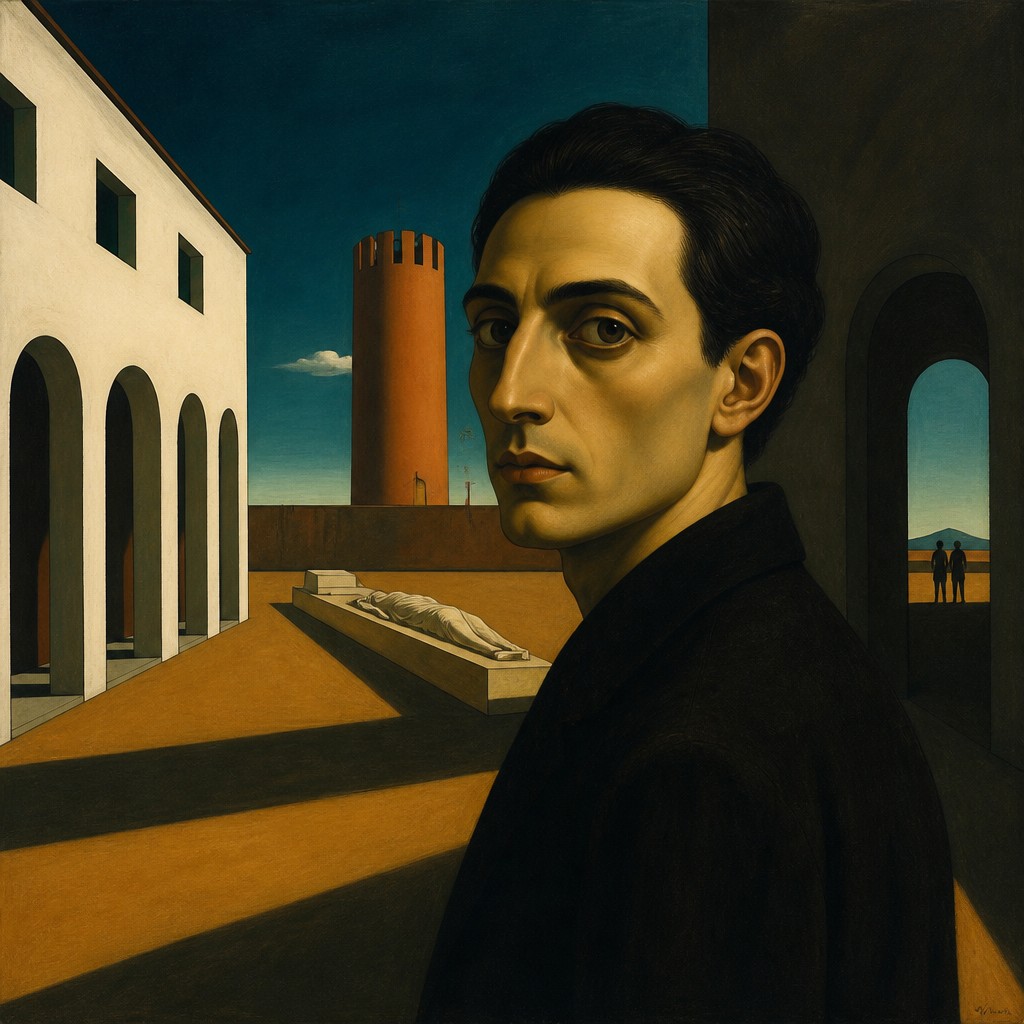 AI-generated
 AI-generated
 AI-generated
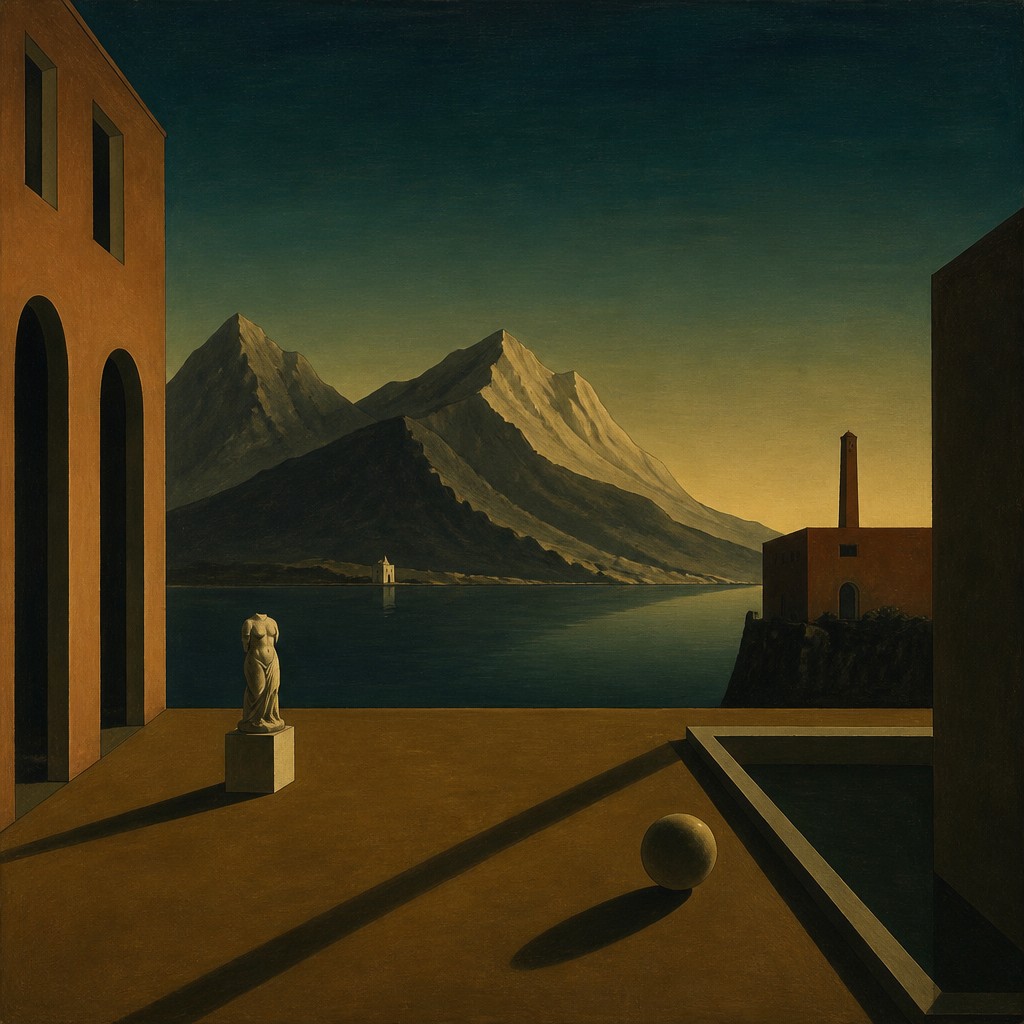
Metaphysical Painting, or Pittura Metafisica, was a short-lived Italian movement built almost entirely around the eerie, dreamlike cityscapes Giorgio de Chirico began painting around 1911. His canvases show deserted Italian piazzas rendered in exaggerated, often contradictory perspective, populated not by people but by classical statues, faceless mannequins, and ordinary objects — a glove, a banana, a clock — placed in combinations that feel charged with meaning yet resist explanation. Long, theatrical shadows fall across empty arcades in a stillness that suggests something has just happened, or is about to.
De Chirico described wanting to capture "the metaphysical aspect of things" — a sense of revelation triggered by the unexpected juxtaposition of familiar objects, a strangeness lurking beneath ordinary appearances. The term itself was coined around 1917, when de Chirico met fellow painter Carlo Carrà while both were stationed at a military hospital in Ferrara during World War I; together they formalized the style's shared vocabulary. Giorgio Morandi briefly joined them, applying the same hushed mystery to quiet still-life compositions.
The movement rebelled against the dominant Italian avant-garde of the moment, Futurism, with its celebration of speed, machinery, and dynamic motion. Where Futurism fractured the picture plane with movement, Metaphysical Painting froze it into total stillness, reviving Renaissance perspective and classical architecture only to distort them psychologically. It also stood apart from Cubism's formal fragmentation, keeping legible, illusionistic space while making that space feel subtly, unaccountably wrong.
As a cohesive group, the movement barely lasted a decade — by 1920, de Chirico himself had largely abandoned it for a more academic, classicizing style, and Carrà moved toward naturalism. Yet its brief existence proved enormously consequential: the poet and critic André Breton was captivated by de Chirico's pre-war piazzas, and Metaphysical Painting's atmosphere of dream logic, uncanny objects, and psychological dislocation became a direct and openly acknowledged forerunner of Surrealism, which would formally emerge in Paris just a few years later.
What defines Metaphysical Painting
Deserted architectural space
Empty Italian piazzas, colonnades, and arcades were rendered in exaggerated Renaissance perspective, often with multiple, subtly contradictory vanishing points that create quiet spatial unease.
Long, theatrical shadows
Late-afternoon light casts elongated, sharply defined shadows that heighten the sense of suspended time and impending, unexplained event.
Enigmatic objects and mannequins
Faceless tailor's dummies, classical statues, and ordinary items like clocks or gloves appear in illogical combinations, generating meaning without ever resolving into clear narrative.
Classical quotation
Greco-Roman statuary, towers, and arcades reference antiquity, frequently set beside incongruous modern elements such as trains or factory chimneys.
Flat, muted color and smooth finish
A restrained palette of ochre, terracotta, and gray-green is applied in a clean, almost illustrative technique with little visible brushwork.
Uncanny stillness
The near or total absence of living figures, or their replacement with doll-like mannequins, produces a silent, dreamlike atmosphere rather than depicted action.
History
Giorgio de Chirico began his metaphysical style in Florence in 1910 with The Enigma of an Autumn Afternoon, then developed it further in Paris from 1911 — drawing on the philosophy of Nietzsche and Schopenhauer and the moody symbolist landscapes of Arnold Böcklin — as he continued his celebrated series of Italian piazza paintings. During World War I he returned to Italy and was stationed in Ferrara, where in 1917 he met the painter Carlo Carrà; the two worked side by side and together articulated the ideas that became "pittura metafisica." Giorgio Morandi joined the circle briefly around 1918–1919, translating its uncanny stillness into quiet still-life painting.
The movement never issued a formal manifesto in the manner of Futurism or Surrealism, but it gained a public platform through the journal Valori Plastici, founded in 1918, which circulated its imagery and ideas across Europe. De Chirico's Paris gallery exhibitions and writings brought his work to the attention of the poet André Breton and other future Surrealists, who recognized in his pre-war piazzas a direct anticipation of the dream logic they were beginning to theorize.
By around 1920, de Chirico had begun retreating from the metaphysical style toward a more conservative, classically inspired manner that many critics considered a decline, while Carrà moved toward a naturalistic mode rooted in Italian tradition. As an organized, active movement, Metaphysical Painting effectively ended within this brief window of less than a decade. Its afterlife, however, proved far longer: when the Surrealists championed de Chirico's early canvases throughout the 1920s, they cemented Metaphysical Painting's place in art history as an essential bridge between the classical tradition and the unconscious-driven imagery that would define Surrealism for the following decades.
Key works
| Work | Artist | Year | Why it matters |
|---|---|---|---|
| The Song of Love | Giorgio de Chirico | 1914 | The pairing of a classical bust with a rubber glove and a ball became a touchstone image for the later Surrealists. |
| The Uncertainty of the Poet | Giorgio de Chirico | 1913 | A fragmented classical torso set beside bananas in an empty piazza exemplifies the movement's dream logic. |
| The Red Tower | Giorgio de Chirico | 1913 | Elongated shadows and impossible architectural space typify de Chirico's eerie piazza series. |
| The Metaphysical Muse | Carlo Carrà | 1917 | A faceless mannequin figure created during Carrà's wartime collaboration with de Chirico in Ferrara. |
How to make art in this style
Palette: Work in muted ochres, terracotta, dusty rose, olive green, and gray, reserving one unexpected saturated color — a red tower, a green shadow — as a focal disruption within the restrained scheme.
Composition: Construct exaggerated one- or multi-point perspective within an architectural space — an arcade, colonnade, or open piazza. Place a small number of objects far apart within that space to create ambiguous scale and a sense of unease; resist the urge to fill the composition.
Technique: Apply paint smoothly and evenly, avoiding visible brushwork or expressive gesture. Render shadows as hard-edged and geometrically improbable — longer, sharper, or angled differently than the implied light source would produce — since this quiet wrongness is central to the effect.
Subjects: Depict deserted classical or arcaded architecture, faceless mannequins or unlabeled statues, and ordinary objects removed from their expected context. Clocks, trains, and towers are useful motifs for suggesting displaced or frozen time.
Mood over narrative: Prioritize stillness and silence rather than depicted action. The goal is not to tell a story but to produce the sensation of having interrupted one — a scene charged with implication that never resolves into explanation. Study how far you can push ordinary elements toward strangeness using only placement, scale, and light, without resorting to fantastical or impossible imagery.
Legacy
Metaphysical Painting's most direct legacy is Surrealism itself: André Breton, Max Ernst, René Magritte, and Salvador Dalí all pointed to de Chirico's early piazzas as a foundational influence, and his imagery of dislocated objects and impossible architecture reappears, transformed, throughout their work. Magritte's habit of rendering ordinary objects strange through juxtaposition, and Dalí's use of dramatic perspective and elongated shadow, both carry traces of de Chirico's vocabulary.
The movement also fed into Italian painting's Novecento current and into broader currents of "magic realism" in early twentieth-century European art, where everyday scenes are rendered with an unsettling, hyper-clear precision. Its imagery of empty, geometrically exaggerated urban space has echoed since in cinema and photography whenever a scene calls for architectural unease or psychological suspension — silent squares, oversized shadows, a sense that something has been arranged rather than simply observed.
Contemporary artists interested in liminal space, the uncanny, and dream imagery continue to draw on Metaphysical Painting's central insight: that strangeness does not require distortion of reality, only its careful, unexplained rearrangement. A movement that lasted less than a decade remains, a century later, a standing reference point for how art can unsettle through stillness rather than spectacle.
Frequently asked questions
What is Metaphysical Painting?
Metaphysical Painting, or Pittura Metafisica, is an Italian art movement centered on Giorgio de Chirico's dreamlike paintings of deserted piazzas, classical statuary, and faceless mannequins, active roughly from 1911 to 1920.
Who founded Metaphysical Painting?
Giorgio de Chirico developed the style beginning around 1911; it was formalized as a shared idea when he met Carlo Carrà in Ferrara in 1917, with Giorgio Morandi briefly joining the circle.
How is Metaphysical Painting different from Surrealism?
Metaphysical Painting preceded Surrealism by over a decade and had no formal manifesto or theory of the unconscious; it relied on classical architecture and eerie stillness rather than the automatism, chance techniques, and explicitly Freudian framework Surrealism later developed.
Why did the movement end so quickly?
De Chirico himself abandoned the style around 1920 for a more classical, academic manner, and Carrà moved toward naturalism, leaving the movement without its central figures to sustain it as an active group.
What was Valori Plastici?
Valori Plastici was an Italian art journal founded in 1918 that promoted Metaphysical Painting's ideas and imagery, helping spread them across Europe even as the original group's cohesion faded.
![Cats (rayist percep.[tion] in rose, black, and yellow) — Rayonism](https://media.artmovements.com/encyclopedia/rayonism/commons-0-thumb.jpg)