 Art
Art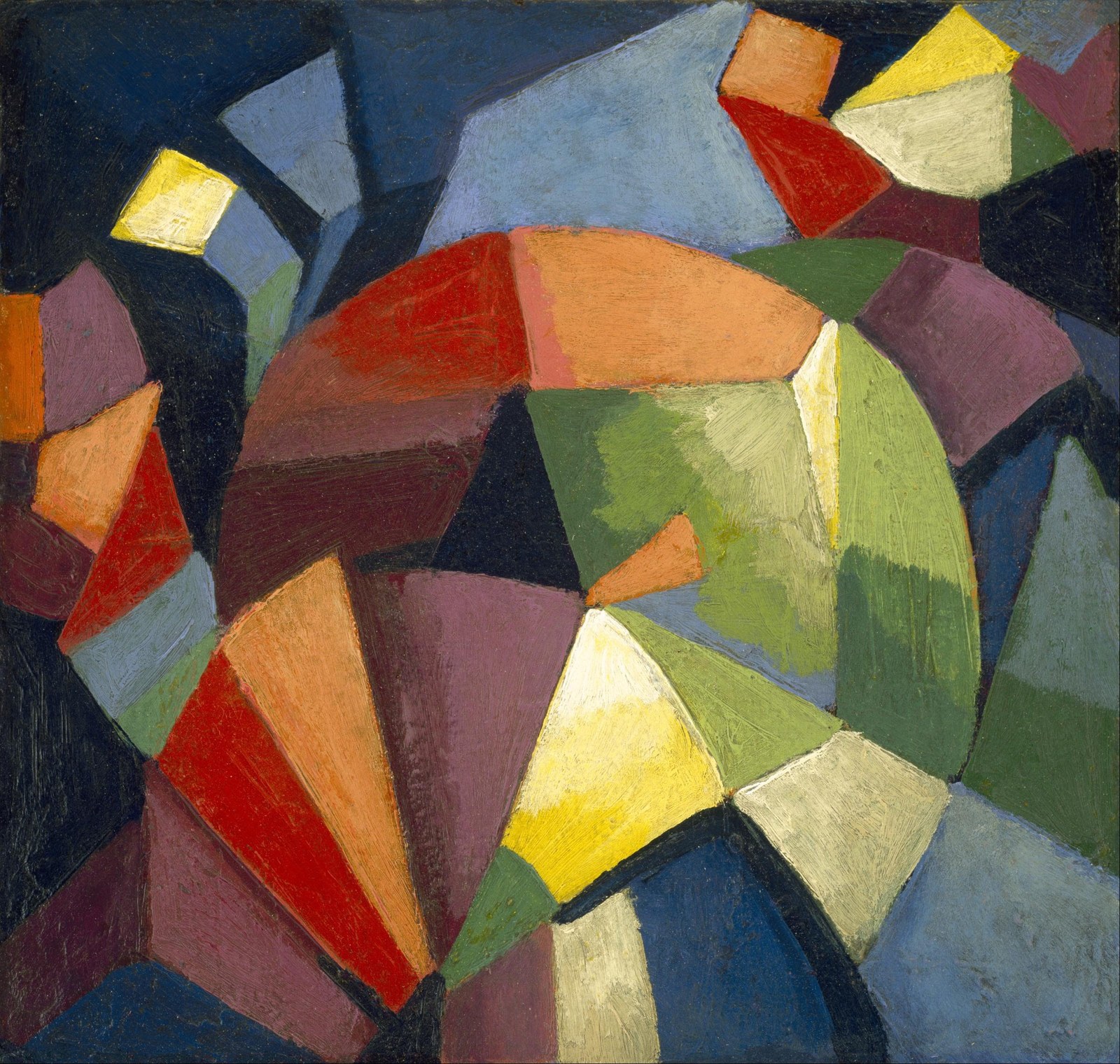
Synchromy. Image: Morgan Russell · Public domain · Wikimedia Commons, accessed 2026-08-04
Synchromism was a short-lived but historically important abstract art movement launched in Paris in 1912–13 by two American painters, Stanton Macdonald-Wright and Morgan Russell. The name comes from "syn" (with) and "chrome" (color) — deliberately echoing "symphony," since the founders believed color could be organized into sequences as rhythmic and structured as music. Where Cubism broke form into faceted planes and analyzed objects from multiple viewpoints, Synchromism used color itself as the primary structural device: warm hues advance, cool hues recede, and a canvas built from carefully calibrated color intervals could suggest volume, movement, and depth without any figurative content at all.
Visually, Synchromist paintings are dense fields of saturated, prismatic color — arcs, spirals, and interlocking wedges of red, orange, blue, and violet that pulse and rotate across the canvas. Early works retained loose figurative armatures (a nude, a landscape) beneath the color structure, but the most radical canvases, such as Russell's "Synchromy in Orange: To Form," dispensed with subject matter almost entirely, making them among the first fully abstract paintings by American artists.
Synchromism developed in close, sometimes contentious dialogue with Robert and Sonia Delaunay's Orphism, which was exploring similar territory in Paris at the same moment; Macdonald-Wright and Russell insisted on their movement's independence and priority, and the two circles never fully reconciled. The movement rebelled against both academic representation and what its founders saw as Cubism's neglect of color in favor of form and structure. For Macdonald-Wright and Russell, color was not decoration applied to a composition — it was the composition.
The founders exhibited in Munich, Paris, and then brought the movement to New York in 1913–14, where it briefly rivaled Cubism and Futurism for attention in the American avant-garde press. Synchromism never developed a large following and had effectively dissolved by the mid-1920s as its founders moved toward other styles, but it holds a distinct place as one of the first genuinely abstract movements founded by American artists, and a bridge between European color theory and the abstraction that would flourish in American painting decades later.
What defines Synchromism
Color as structure
Form is built entirely from calibrated color relationships rather than line or tonal shading. Warm colors are pushed forward and cool colors recede, generating an illusion of three-dimensional volume using hue alone.
Musical analogy
Paintings are organized like musical compositions, with color sequences meant to be read as rhythmic movements or chords. Titles frequently use musical terms such as "synchromy" in place of conventional subject titles.
Prismatic, high-key palette
Canvases favor intense, saturated hues straight from the color wheel — reds, oranges, blues, and violets — rather than the muted, tonal palettes common in academic painting of the period.
Spiraling, interlocking forms
Compositions are typically built from arcs, wedges, and spiral shapes that rotate around a central axis, creating a sense of centrifugal motion across the canvas.
Residual figuration
Many Synchromist works retain a faint underlying figure or landscape armature beneath the color structure, functioning as a scaffold for the color relationships rather than as a subject in its own right.
Non-objective ambition
The most advanced Synchromist canvases abandoned recognizable subject matter altogether, ranking among the earliest fully abstract paintings produced by American artists.
History
Synchromism began in Paris around 1912, when Stanton Macdonald-Wright and Morgan Russell, two American painters studying color theory together, developed a system for organizing color into rhythmic, quasi-musical sequences. Both had studied with the Canadian-born color theorist Percyval Tudor-Hart, whose ideas about color and sound informed the movement's central premise. The two staged their first joint exhibition of Synchromist work in Munich in 1913, followed quickly by a show in Paris the same year, publicly announcing the new movement with a manifesto asserting its independence from — and priority over — the closely related Orphism of Robert Delaunay, with whom relations were tense.
The movement crossed the Atlantic in 1913–14, when Synchromist works appeared in New York exhibitions and stirred debate in the American press, which struggled to distinguish the new style from Cubism and Futurism. For a brief period Synchromism was treated as a serious rival to European abstraction, and it introduced American audiences to fully non-representational painting years before Abstract Expressionism.
The movement's momentum was short-lived. World War I disrupted the Paris art world and scattered its practitioners, and by the late 1910s both founders had begun drifting toward more figurative or decorative work. Macdonald-Wright eventually relocated to Los Angeles, where he became an influential teacher and later explored Asian philosophy and Synchromist ideas in mural work; Russell continued painting in France with diminishing visibility. By the mid-1920s, Synchromism as an organized movement had effectively ended, though its two founders never entirely abandoned its color principles.
Despite its brevity, Synchromism is remembered as a pioneering chapter in American modernism — the first instance of American painters originating, rather than merely importing, an abstract art movement, and a direct precedent for later American engagement with color-based abstraction.
Key works
| Work | Artist | Year | Why it matters |
|---|---|---|---|
| Synchromy in Orange: To Form | Morgan Russell | 1913 | One of the movement's most fully abstract canvases, built almost entirely from prismatic color arcs rather than a figurative underpinning. |
| Conception Synchromy | Stanton Macdonald-Wright | 1914 | A key example of Macdonald-Wright's mature Synchromist style, combining a loosely readable figure with rotating bands of saturated color. |
How to make art in this style
Working in a Synchromist style
Palette: Start from a full, saturated color wheel rather than a muted or naturalistic palette. Build the composition from warm colors (reds, oranges, yellows) that visually advance and cool colors (blues, violets, greens) that recede — the illusion of depth should come entirely from this warm/cool relationship, not from tonal shading or perspective lines.
Composition: Think in terms of rotation and rhythm. Lay out interlocking arcs, wedges, or spiral bands that circle around a central axis, the way a piece of music builds around a recurring phrase. It can help to sketch a loose figure or landscape first and then translate its masses into color shapes, letting the underlying form dissolve as the color relationships take over.
Brushwork and technique: Apply paint in flat, clearly bounded zones of color rather than blended gradients — each color area should read as a distinct "note" in the overall chord. Keep edges between color shapes crisp enough that the eye can trace the rhythm of warm advancing toward cool receding.
Subjects: Traditional Synchromism used the nude figure or a simple landscape as a hidden scaffold, but the subject is not the point — the color sequence is. Choose a simple, symmetrical starting form (a standing figure, a seated pose, a rolling hillside) purely as an armature for the color composition, and be willing to let it become unrecognizable as the color logic takes over.
Practical tip: Work out the color sequence first as a small thumbnail using only labeled color blocks before committing to the final canvas — this keeps the "musical" logic of the color progression intact rather than letting it become arbitrary decoration.
Legacy
Synchromism's direct following was small, but its underlying premise — that color relationships alone could generate form, depth, and emotional rhythm — fed into the broader current of American color-field and abstract painting that matured decades later. Macdonald-Wright's subsequent teaching career in Los Angeles carried Synchromist color theory to a new generation of West Coast artists, and his later fusion of color abstraction with Asian aesthetic ideas anticipated concerns that would resurface in postwar American painting.
More broadly, Synchromism holds a symbolic importance disproportionate to its short lifespan: it demonstrated that American artists could originate an international avant-garde movement rather than simply follow European precedents, a claim that shaped how later American abstraction, from Arthur Dove's early experiments to the ambitions of Abstract Expressionism, was framed and understood.
Today, Synchromist canvases are valued as some of the earliest fully non-representational paintings produced anywhere, and the movement is frequently cited in surveys of early abstraction alongside Orphism, Rayonism, and early Kandinsky as evidence that the leap into pure abstraction occurred simultaneously, and independently, in several places at once. Its emphasis on color-as-structure also anticipates design and branding practices that rely on color contrast and warm/cool spatial illusion, a principle now taught in basic color theory well beyond fine art.
Frequently asked questions
What is Synchromism?
Synchromism is an early abstract art movement founded in Paris around 1912–13 by American painters Stanton Macdonald-Wright and Morgan Russell, which used color relationships, structured like musical harmony, to build form and depth without representational subject matter.
Who started Synchromism?
Synchromism was founded by two American expatriate painters working in Paris, Stanton Macdonald-Wright and Morgan Russell, who developed the movement's color theory together before launching it publicly in Munich and Paris in 1913.
Synchromism vs Orphism: what's the difference?
Both movements emerged in Paris around the same time and used prismatic color to build abstract compositions, but Synchromism's founders insisted their color system, developed independently, predated and differed from Robert Delaunay's Orphism; the two circles remained rivals rather than collaborators.
Is Synchromism the same as abstract art?
Synchromism is a specific historical movement within the broader category of abstract art — one of the earliest examples of fully non-representational painting, but not synonymous with abstraction as a whole, which encompasses many later and unrelated movements.
Why is Synchromism important?
It was among the first fully abstract art movements founded by American artists, proving American painters could originate rather than merely follow European avant-garde developments, and it directly influenced later American color-based abstraction.
![Cats (rayist percep.[tion] in rose, black, and yellow) — Rayonism](https://media.artmovements.com/encyclopedia/rayonism/commons-0-thumb.jpg)