 Art
Art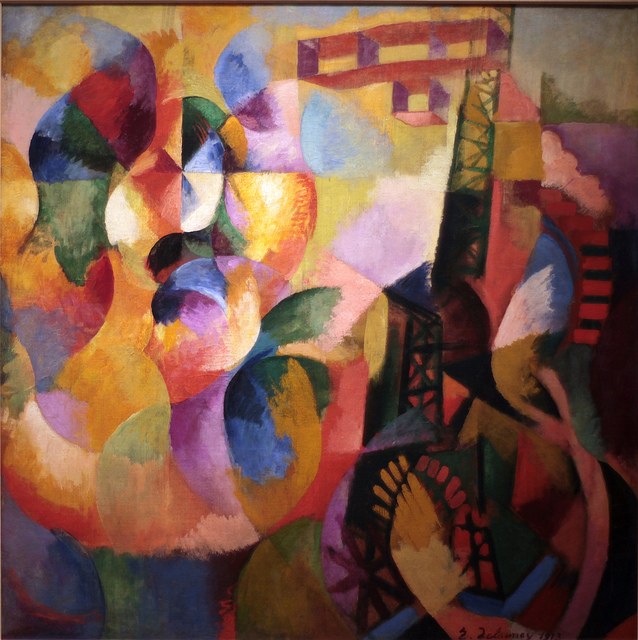
Sun, Tower, Airplane. Image: Robert Delaunay · Public domain · Wikimedia Commons, accessed 2026-08-04
Orphism, or Orphic Cubism, emerged in Paris around 1912 when Robert Delaunay and a handful of like-minded painters pushed Cubism's fractured geometry toward pure color and near-total abstraction. The poet and critic Guillaume Apollinaire coined the name in 1912, comparing the movement's lyrical, musical use of color to Orpheus, the mythical poet-musician, to distinguish it from what he saw as the drabber, more analytical Cubism of Picasso and Braque.
Where Analytical Cubism restrained itself to browns and grays to foreground structure, Orphism embraced saturated, contrasting hues—reds against greens, blues against oranges—built from disks, arcs, and interlocking circular forms. Robert Delaunay's "Simultaneous Windows" and "Disk" paintings dissolved the Eiffel Tower and Parisian rooftops into radiating color, while his wife Sonia Delaunay extended the same color logic into textiles, fashion, bookbinding, and interior design, treating fine and applied art as equally valid territory for abstraction. The couple developed their approach from the color theories of chemist Michel-Eugène Chevreul, whose research into "simultaneous contrast"—how adjacent colors intensify or mute one another—gave the Delaunays the term for their own method: "Simultanism."
Orphism rebelled against Cubism's near-monochrome restraint and against representation altogether, arguing that color relationships alone, without any legible subject, could generate rhythm, depth, and emotional charge—an argument that placed the Delaunays among the earliest painters anywhere to approach pure abstraction. František Kupka, working in Paris independently but grouped with Orphism by critics, arrived at fully abstract, color-based compositions by 1912 through his own interest in theosophy and the analogy between painting and music.
Orphism matters because it demonstrated, at almost the same historical moment as Kandinsky in Munich, that painting could dispense with subject matter entirely and still communicate through color and rhythm alone. Its emphasis on optical vibration and simultaneous contrast also anticipated later movements interested in color's perceptual effects, from Op Art to color-field painting, and Sonia Delaunay's crossover into textiles and fashion prefigured the later blurring of fine art and design.
What defines Orphism
Simultaneous color contrast
Adjacent complementary and near-complementary colors are placed side by side so each intensifies the other, producing an optical vibration the Delaunays called 'Simultanism,' drawn from Chevreul's color theory.
Circular and disk-based forms
Compositions are built from arcs, disks, and concentric rings of color rather than Cubism's angular facets, giving the work a rhythmic, almost musical rotation.
Near-total abstraction
Orphist paintings frequently abandon a legible subject entirely, letting color relationships alone generate the sense of movement, depth, and light.
Modern subjects as starting points
Even abstracted works often began from modern urban motifs—the Eiffel Tower, airplanes, electric streetlamps—celebrating technology and the modern city as sources of color and rhythm.
Bright, saturated palette
Unlike Analytical Cubism's browns and grays, Orphist canvases favor vivid reds, blues, oranges, and greens at full or near-full saturation.
Crossover into design and textiles
Sonia Delaunay extended Orphist color principles beyond painting into clothing, fabric, and book design, treating applied art as a legitimate extension of the movement's ideas.
History
Orphism formed within the wider Cubist milieu of Paris around 1911–1912, as Robert Delaunay grew dissatisfied with what he saw as Analytical Cubism's monochrome austerity. Delaunay had already begun painting a series of views of the Eiffel Tower and, from 1912, his "Windows" series, breaking the cityscape into transparent, overlapping planes of pure color rather than gray facets. His wife, the Ukrainian-born painter and designer Sonia Delaunay (born Sarah Stern, later Sonia Terk), developed the same color principles in parallel, applying them to a patchwork quilt for their newborn son in 1911 before extending the approach into painting, textiles, and fashion.
The poet Guillaume Apollinaire, a close friend and champion of the Delaunays, coined the term "Orphism" in 1912 to describe this color-centered branch of Cubism, naming it after Orpheus to evoke music and lyrical abstraction. The name stuck for the small circle of painters associated with the idea, which also loosely included František Kupka, a Czech painter in Paris who arrived independently at abstract, color-driven compositions such as "Amorpha, Fugue in Two Colors" (1912).
Orphism had its most visible public moment at the Salon des Indépendants and Salon d'Automne exhibitions in Paris in 1912–1913, and it drew international notice through the German Expressionist Der Sturm gallery in Berlin, where Robert Delaunay exhibited in 1913, influencing German and Russian painters interested in abstraction, including some in the Der Blaue Reiter circle.
As a named, cohesive movement Orphism was short-lived, largely fading as a distinct label by the outbreak of World War I in 1914, though the Delaunays continued developing its color principles for decades afterward—Robert into the 1930s and Sonia across a long career in textile and fashion design that carried Orphist ideas into applied art well into the twentieth century.
Key works
| Work | Artist | Year | Why it matters |
|---|---|---|---|
| Simultaneous Windows on the City | Robert Delaunay | 1912 | A dissolving view of Paris and the Eiffel Tower rendered as overlapping transparent planes of pure color rather than gray Cubist facets. |
| Homage to Blériot | Robert Delaunay | 1914 | A large composition of rotating color disks and an airplane, celebrating aviation and modern technology through pure color rhythm. |
| Electric Prisms | Sonia Delaunay | 1914 | A large-scale painting of concentric color disks inspired by Paris's new electric streetlamps, extending Orphist color theory into monumental abstraction. |
| Amorpha, Fugue in Two Colors | František Kupka | 1912 | One of the earliest fully abstract paintings in Western art, built from rhythmic curving bands of color. |
| Eiffel Tower | Robert Delaunay | 1911 | An earlier work showing the tower fractured into dynamic, overlapping planes, marking Delaunay's transition from Cubism toward Orphist color. |
How to make art in this style
Painting in the Orphist Style Today
Palette: Work with fully saturated, contrasting hues—red against green, blue against orange, violet against yellow—placed directly next to each other so they visually vibrate. Avoid muddying colors with gray or brown; Orphism depends on clean, high-chroma pigment relationships.
Composition: Build the image from arcs, disks, and concentric or overlapping circles rather than angular Cubist facets. Let forms radiate from one or more centers, echoing the rotation of a wheel or the spread of light, so the composition reads as rhythmic movement rather than a static arrangement.
Brushwork/technique: Apply color in clean, flat or gently blended bands rather than heavy impasto or fine detail. Where two colors of similar intensity meet, keep the edge crisp so the eye perceives real optical contrast; where softer transitions are wanted, blend gradually across a wider band. Study color-wheel relationships before starting, since Orphism's effect depends on calculated contrast rather than intuitive mixing.
Subjects: Start from a recognizable modern motif—a tower, an airplane, a city street, a window—and let it dissolve into radiating color planes, or dispense with subject matter entirely and compose from color and form alone. Circular, rotational subjects such as wheels or discs of light suit the style especially well.
Practical tip: Try painting the same simple motif twice—once in a restrained, naturalistic palette and again pushing every color to its most saturated, contrasting version—to feel how much of Orphism's effect comes purely from color intensity rather than form.
Legacy
Orphism's central claim—that color and rhythm alone, without any legible subject, could carry a painting's meaning—placed it among the handful of movements, alongside Kandinsky's contemporaneous Munich experiments and Malevich's Suprematism, that opened the door to fully abstract art. Its color theory, rooted in Chevreul's research on simultaneous contrast, fed directly into later movements concerned with color's optical effects, including Op Art's investigations of visual vibration and postwar color-field painting's interest in color as sole subject.
Sonia Delaunay's extension of Orphist principles into textiles, clothing, and book design helped legitimize the idea that fine-art abstraction could operate just as validly in applied and commercial design, a stance that anticipated the twentieth century's increasing blur between gallery art and fashion, graphic design, and product design. Her patterns remain widely referenced in fashion and textile design today. Orphism's celebration of modern technology—airplanes, electric light, the Eiffel Tower—as fit subjects for abstract color composition also fed into later movements' embrace of the machine age. Though smaller and shorter-lived than Cubism or Futurism, Orphism's insistence on color's independent expressive power continues to inform how designers and painters use juxtaposed hues to generate a sense of energy and motion without representation.
Frequently asked questions
What is Orphism in art?
Orphism, or Orphic Cubism, was a Paris-based art movement from around 1912 to 1914 that pushed Cubism toward pure abstraction using saturated, contrasting color and circular, rhythmic forms rather than Cubism's muted, angular facets.
Who named Orphism?
The poet and critic Guillaume Apollinaire coined the term in 1912, naming it after the mythical musician Orpheus to capture the movement's lyrical, music-like use of color.
How is Orphism different from Cubism?
Analytical Cubism restrained itself to browns, grays, and angular facets to emphasize structure. Orphism instead used vivid, contrasting color and curving, circular forms, often moving toward complete abstraction rather than the partial fragmentation typical of Cubism.
Who were the main Orphist artists?
Robert Delaunay and Sonia Delaunay were the movement's central figures, with the Czech painter František Kupka often associated with it for his own independent, color-based abstract work.
Is Orphism the same as abstract art?
Not exactly, but it is one of the earliest movements to approach full abstraction. Some Orphist works retain a recognizable subject dissolved into color, while others, particularly by Kupka, are fully non-representational.
What is "Simultanism"?
Simultanism was the Delaunays' own term for their method, based on Michel-Eugène Chevreul's theory of simultaneous contrast—the idea that adjacent colors intensify each other when placed side by side.
![Cats (rayist percep.[tion] in rose, black, and yellow) — Rayonism](https://media.artmovements.com/encyclopedia/rayonism/commons-0-thumb.jpg)