 Art
Art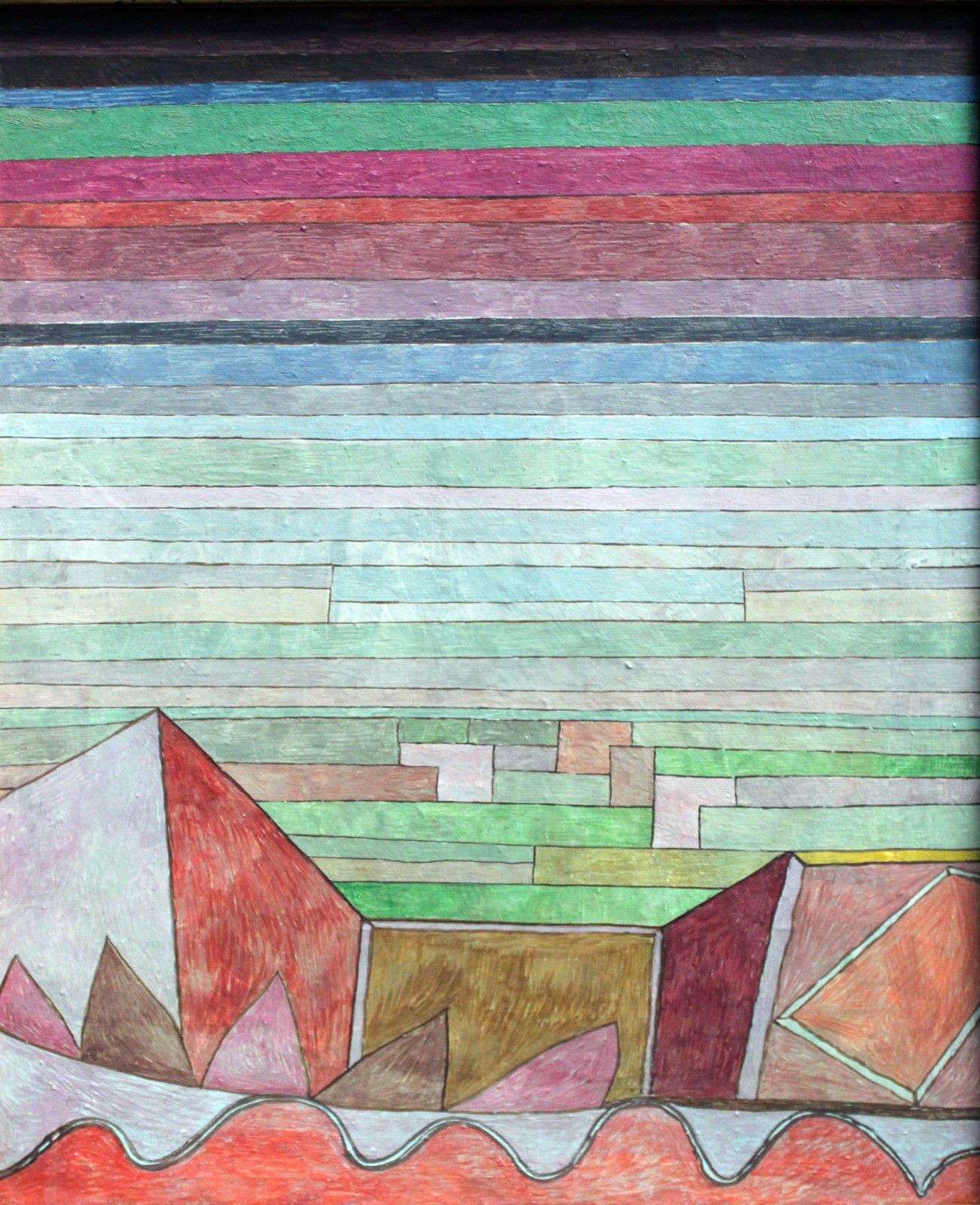
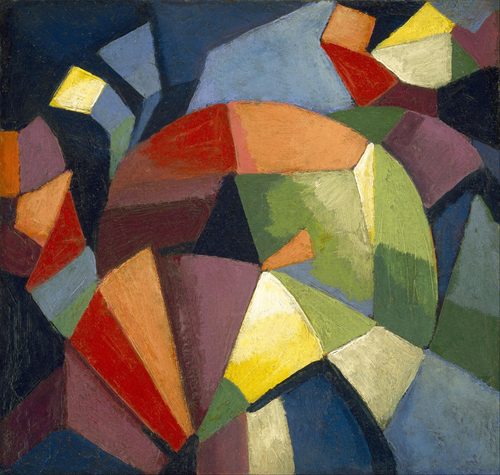
German: Blick in das Fruchtland View into the Fertile Country. Image: Paul Klee · Public domain · Wikimedia Commons, accessed 2026-08-04
Der Blaue Reiter, or "The Blue Rider," named itself after motifs its two founders shared: by Kandinsky's own account both men loved the color blue, Marc loved horses, and Kandinsky loved riders. Formed in Munich in 1911 after Kandinsky's earlier group, the Neue Künstlervereinigung München, rejected one of his more radical paintings, the new circle brought together Russian, German, and international artists who believed painting should reach past visible reality toward inner, spiritual experience.
Unlike the harsher, more confrontational Expressionism of Die Brücke in Dresden, Der Blaue Reiter artists worked with a gentler, more lyrical intensity. Kandinsky pursued near-total abstraction, treating color and line as a visual equivalent to music—his "Improvisations" and "Compositions" aimed to trigger emotion the way a symphony does, without depicting anything recognizable. Franz Marc painted animals, especially horses, in unnatural blues, reds, and yellows, using color symbolically: blue for the masculine and spiritual, yellow for the feminine and joyful, red for brutal matter. August Macke brought a sunnier, more observational eye to scenes of parks, shop windows, and city life, closer to Fauvism in temperament. Gabriele Münter grounded the group with bold, simplified compositions in flat color derived from Bavarian folk glass painting.
The group rebelled against academic naturalism and the idea that art should represent the external world accurately. They drew inspiration from children's drawings, folk art, medieval woodcuts, and non-Western artifacts, believing untrained and non-academic image-making carried a directness that Western art academies had trained out of painters. In 1912 the group published the Blaue Reiter Almanac, an anthology mixing essays, reproductions of Bavarian glass paintings, children's art, and Kandinsky's own contributions "On the Question of Form" and "On Stage Composition."
Der Blaue Reiter matters because it pushed European painting decisively toward abstraction, treating color and form as capable of independent expressive power rather than mere description. It also modeled an unusually international, cross-media outlook, linking painting to music and folk tradition. The group's life was brief: it never had a fixed membership or manifesto beyond two exhibitions, and it ended abruptly when the First World War broke out in 1914, killing Marc and Macke and scattering the others.
What defines Der Blaue Reiter
Color as spiritual language
Blue, red, and yellow were used symbolically rather than descriptively—Marc's animals appear in colors no living creature has, chosen to evoke emotional or spiritual states rather than to describe fur or hide.
Animals and nature as subjects
Horses, deer, and other animals recur throughout the group's work, seen as beings purer and closer to nature than modern humans. Landscape and animal form were simplified into interlocking curved and angular planes.
Move toward abstraction
Kandinsky's paintings progressively shed recognizable subject matter, using color, line, and gesture alone to carry meaning, anticipating fully non-representational painting.
Influence of folk and children's art
The group collected and exhibited Bavarian reverse-glass painting, children's drawings, and material from non-Western cultures alongside their own work, valuing directness over academic polish.
Fractured, faceted composition
Later work by Marc and Macke absorbed Cubist and Futurist fragmentation, breaking landscapes and figures into interlocking translucent planes of color.
Music as a model
Kandinsky in particular treated painting as analogous to music, titling works 'Improvisation' and 'Composition' and aiming for canvases that functioned like abstract symphonies of color and shape.
History
Der Blaue Reiter grew out of the Neue Künstlervereinigung München (New Artists' Association of Munich), a group Kandinsky had helped found in 1909. When the association's jury rejected one of Kandinsky's increasingly abstract paintings in 1911, he and Franz Marc resigned and quickly organized a rival exhibition under the name Der Blaue Reiter, held that December at the Moderne Galerie Thannhauser in Munich. A second, larger exhibition followed in early 1912, devoted mostly to works on paper and including artists such as Paul Klee, along with international contributors.
The group never adopted a formal manifesto or fixed roster; it functioned more as a loose editorial and exhibiting circle around Kandinsky and Marc. Its clearest statement of purpose was the Blaue Reiter Almanac, published in 1912, which juxtaposed reproductions of the artists' own work with folk art, children's drawings, medieval sculpture, and non-Western artifacts, implying that all these forms shared a common spiritual authenticity that academic training had lost. Kandinsky's treatise "Concerning the Spiritual in Art," published the same year, laid out his belief that color and form could evoke states of the soul independent of subject matter.
Members and close associates included Kandinsky, Marc, August Macke, Gabriele Münter, Alexej von Jawlensky, Marianne von Werefkin, and, more loosely, Paul Klee. The circle exhibited alongside contemporaries elsewhere in Europe, absorbing ideas from French Fauvism and Cubism and Italian Futurism, which increasingly fractured Marc's and Macke's compositions between 1912 and 1914.
The movement ended almost as suddenly as it began. When World War I broke out in August 1914, Kandinsky, a Russian citizen, was forced to leave Germany; Macke was killed in action that September, and Marc died at Verdun in 1916. With its founders gone from Munich or dead, Der Blaue Reiter never reconstituted, though Kandinsky continued developing its ideas toward pure abstraction after the war, notably at the Bauhaus.
Key works
| Work | Artist | Year | Why it matters |
|---|---|---|---|
| Composition VII | Wassily Kandinsky | 1913 | One of Kandinsky's most complex near-abstract canvases, synthesizing years of studies into a swirling, non-representational composition. |
| The Large Blue Horses | Franz Marc | 1911 | Marc's best-known painting, using saturated blue to symbolically charge three horses within a rounded, harmonized landscape. |
| Fate of the Animals | Franz Marc | 1913 | A fractured composition of animals engulfed in fire and collapsing forms, later read by many as a premonition of World War I. |
| Zoological Garden I | August Macke | 1912 | A brightly colored scene of figures and animals at the zoo, showing Macke's lighter, more Fauvist-inflected touch within the group. |
| Improvisation 28 (second version) | Wassily Kandinsky | 1912 | Part of Kandinsky's series testing how far color and gesture alone could carry emotional meaning without a legible subject. |
How to make art in this style
Painting in the Der Blaue Reiter Style Today
Palette: Start from saturated, non-naturalistic color assigned by feeling rather than observation—deep ultramarine or cobalt blue, crimson red, golden yellow, forest green. Choose a dominant color for symbolic weight (blue for calm or spirituality, red for intensity, yellow for warmth) before deciding what it will depict.
Composition: Build scenes around simplified, rounded forms—animals, hills, trees—interlocking like stained glass. Avoid deep, illusionistic perspective; let shapes overlap and nest within a shallow, decorative space. Curved, sweeping lines calm a composition; jagged, angular ones borrowed from Cubism and Futurism introduce tension.
Brushwork/technique: Apply paint in flat or lightly modulated planes rather than blended, academic shading. Outline forms with dark contour lines in the manner of Bavarian folk glass painting, then fill them with unmodulated color. Let color relationships—not tonal value—carry the composition's structure.
Subjects: Animals, especially horses and deer, are the movement's signature subject, chosen for their perceived purity. Landscapes, gardens, and everyday urban scenes are also characteristic. Avoid narrative literalism; use the subject as a vehicle for color and form, not as a record of appearances.
Practical tip: Work from memory or imagination once the basic subject is established, adjusting color and shape for expressive effect rather than accuracy. Studying Kandinsky's essay "Concerning the Spiritual in Art" reveals the group's own account of color's emotional associations.
Legacy
Der Blaue Reiter's championing of color as an autonomous emotional force fed directly into the development of abstract art across twentieth-century Europe. Kandinsky carried its ideas forward at the Bauhaus in the 1920s, formalizing color theory and composition principles that shaped generations of design and art education. The group's insistence that children's drawings, folk art, and non-Western artifacts held aesthetic authority equal to academic painting anticipated later interest in vernacular and untrained art, and its cross-disciplinary Almanac—mixing painting, music, and ethnographic material—prefigured the multimedia ambitions of later avant-gardes.
Franz Marc's animal paintings remain some of the most reproduced images in German art, appearing widely on posters, book covers, and museum merchandise, and his saturated, symbolic use of color still shapes how illustrators and animators depict animals expressively rather than naturalistically. The group's short life and violent end—two of its central figures killed within the first years of World War I—also cemented it in cultural memory as emblematic of a lost pre-war idealism, a poignant marker of the moment European modernism turned from optimism toward catastrophe. Museums in Munich, above all the Lenbachhaus, continue to build their identity around the group's legacy.
Frequently asked questions
What is Der Blaue Reiter?
Der Blaue Reiter ("The Blue Rider") was a Munich-based group of Expressionist painters active from 1911 to 1914, led by Wassily Kandinsky and Franz Marc. They believed color and form could express spiritual and emotional truths beyond realistic depiction, pushing European painting toward abstraction.
Why is it called "Der Blaue Reiter"?
The name reportedly reflected motifs its two founders shared: by Kandinsky's own account both men loved the color blue, Marc loved horses, and Kandinsky loved riders. The two also used a blue rider image on the cover of their 1912 almanac, cementing the name.
How does Der Blaue Reiter differ from Die Brücke?
Die Brücke, founded in Dresden in 1905, favored harsh, angular forms and raw, confrontational emotion tied to urban anxiety. Der Blaue Reiter, centered in Munich, leaned toward lyrical color, spiritual symbolism, and a gentler sensibility influenced by folk art and music.
Who were the main artists in Der Blaue Reiter?
Its core figures were Wassily Kandinsky, Franz Marc, August Macke, and Gabriele Münter, with close associates including Alexej von Jawlensky, Marianne von Werefkin, and Paul Klee.
Why did Der Blaue Reiter end?
The group had no formal structure beyond shared exhibitions and publications, and it dissolved when World War I broke out in 1914. Macke was killed that year and Marc in 1916, while Kandinsky, a Russian national, had to leave Germany.
Is Der Blaue Reiter considered abstract art?
Some of it is. Kandinsky's contributions moved close to full abstraction, while Marc's and Macke's paintings remained recognizably representational, using unnatural color and simplified form rather than abandoning subject matter altogether.

![Cats (rayist percep.[tion] in rose, black, and yellow) — Rayonism](https://media.artmovements.com/encyclopedia/rayonism/commons-0-thumb.jpg)