 Art
Art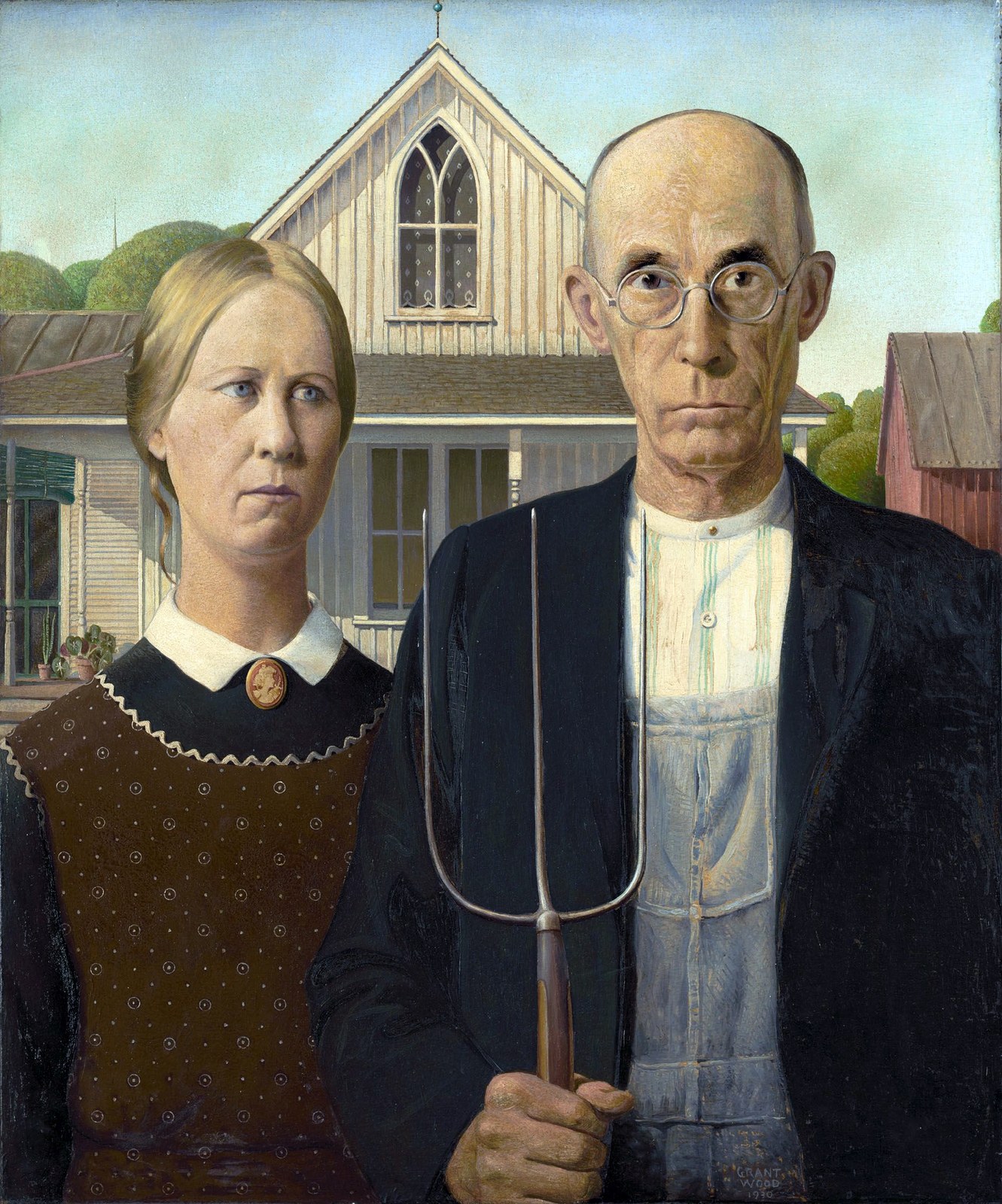
American Gothic. Image: Grant Wood · Public domain · Wikimedia Commons, accessed 2026-08-04
American Regionalism, sometimes called American Scene Painting, was a realist movement of the 1930s and early 1940s centered on rural and small-town American subject matter, led chiefly by Grant Wood, Thomas Hart Benton, and John Steuart Curry. The three were promoted by critic Thomas Craven as leaders of a distinctly homegrown American art, deliberately positioned against the European modernism — Cubism especially — that dominated fashionable art criticism at the time.
Regionalist painters turned to the farms, small towns, and folklore of the Midwest and South for subject matter, rendering it in clear, legible, representational realism rather than abstraction. Grant Wood's precise, almost folk-art-flat technique carried a satirical edge; Thomas Hart Benton favored rhythmic, muscular, sculptural forms in landscapes and figures that seem to ripple with motion; John Steuart Curry painted dramatic Kansas weather and rural religious life with theatrical intensity.
The movement rebelled against what its champions saw as an elitist, imported European modernism disconnected from ordinary American experience, insisting that American art should look directly at American life — its labor, its landscapes, its regional character — for its subjects. It found a receptive audience during the Great Depression, when economic hardship and rising cultural nationalism made heartland imagery, self-reliance, and homegrown pride especially resonant.
Regionalism achieved enormous popular visibility: Grant Wood's American Gothic became a sensation almost overnight after its 1930 debut, and Benton appeared on the cover of Time magazine in 1934. All three received major public mural commissions during the New Deal era. Yet the movement's association with cultural nationalism and, in the changed political climate after World War II, with a perceived provincialism and isolationism, contributed to its critical eclipse once Abstract Expressionism moved the center of American art to New York by the late 1940s.
Regionalism matters both for its enormous, still-visible imprint on American popular visual culture and for the complicated political questions it raises about nostalgia, national identity, and whose America gets depicted as the American scene.
What defines American Regionalism
Rural and small-town subject matter
Farms, prairie towns, agricultural labor, and regional folklore replaced urban and European subjects, grounding the movement firmly in the American Midwest and South.
Clear, legible representational realism
Regionalists deliberately rejected Cubist and other abstract modernist approaches in favor of straightforward, easily readable representational painting.
Sturdy, simplified, rhythmic forms
Thomas Hart Benton in particular favored rounded, almost sculptural, undulating forms in both landscape and figure, giving his compositions a muscular sense of motion.
Precise, flattened technique with satirical edge
Grant Wood's smooth, exacting surfaces and slightly stylized, folk-art-like flatness often carried gentle or pointed satire beneath an outwardly earnest surface.
Dramatic weather and landscape
John Steuart Curry frequently used stormy Kansas skies and dynamic natural forces as backdrop and metaphor for the intensity of rural and religious life.
Nationalist, nostalgic sensibility
The movement carried an explicit cultural-nationalist agenda, positioning heartland American subject matter, sometimes idealized and sometimes satirized, as the true subject of American art.
History
American Regionalism rose to national prominence in the early 1930s, as the Great Depression turned American culture inward and critics and artists alike sought a native visual idiom distinct from the Parisian modernism that had dominated avant-garde taste through the 1920s. Critic Thomas Craven championed Grant Wood, Thomas Hart Benton, and John Steuart Curry as a triumvirate representing authentic American art, giving the loosely connected trio a public identity as a movement.
Grant Wood's American Gothic debuted at the Art Institute of Chicago in 1930 and became an immediate sensation, quickly entering popular consciousness as one of the most recognizable images in American art. Benton's rising profile culminated in a 1934 Time magazine cover story. All three artists secured major public mural commissions through New Deal programs including the Public Works of Art Project and the Section of Fine Arts, embedding Regionalist imagery in courthouses, post offices, and state capitols across the country.
Benton's years teaching at the Art Students League in New York produced an unexpected legacy: among his students there in the early 1930s was a young Jackson Pollock, who would later become the leading figure of Abstract Expressionism, the very movement that eclipsed Regionalism's dominance.
After World War II, the cultural mood shifted. New York displaced regional centers as the hub of American art, and Abstract Expressionism's international, avant-garde ambitions made Regionalism's rural, nationalist subject matter feel provincial and, to some critics, uncomfortably close to the isolationist politics of the era. By the late 1940s the movement had faded from critical favor, even as its imagery remained deeply lodged in American popular culture. Later scholarship has continued to reassess Regionalism's legacy, examining both its genuine populist achievement and its narrower, sometimes exclusionary vision of who counted as American.
Key works
| Work | Artist | Year | Why it matters |
|---|---|---|---|
| American Gothic | Grant Wood | 1930 | The iconic farmer-and-daughter portrait, among the most reproduced and parodied images in American art history. |
| A Social History of the State of Missouri | Thomas Hart Benton | 1936 | A sweeping mural cycle for the Missouri State Capitol depicting the state's history in Benton's rhythmic, muscular style. |
| Baptism in Kansas | John Steuart Curry | 1928 | An early defining Regionalist scene of rural religious ritual set against the dramatic Kansas landscape. |
| Daughters of Revolution | Grant Wood | 1932 | A satirical group portrait of conservative patriotic society women, revealing Wood's sharper, critical undercurrent. |
How to make art in this style
Palette. Use muted, earthy tones — ochre, olive, warm brown, dusty green — grounded in the colors of farmland and prairie. Reserve more dramatic color, particularly in the sky, for moments of weather or emotional intensity, following Curry's example of stormy, theatrical skies.
Composition. Center compositions on farms, small-town streets, or rural figures, often placed frontally and symmetrically for a sense of plainspoken directness. Use rounded, simplified, rhythmic forms, especially in landscape elements like hills, clouds, and haystacks, to give the image a sense of sculptural motion, following Benton's undulating approach.
Technique. Favor smooth, precise paint handling with minimal visible brushwork for a crisp, almost folk-art clarity, in the manner of Wood, or embrace more dynamic, curving, muscular modeling of form for a Benton-like sense of movement. Either way, keep the image sharply legible rather than painterly or abstracted.
Subjects. Draw on rural labor, agricultural landscape, small-town life, and regional folklore or religious ritual. A single farmhouse, a harvest scene, a country church gathering, or a portrait of local figures in front of their land are all characteristic choices.
Tone. Decide deliberately whether the image leans toward earnest, dignified homage to rural life or toward gentle, pointed satire of provincial manners, since both registers coexist within the movement's history.
Legacy
American Gothic remains one of the most recognized and endlessly parodied images in American visual culture, a shorthand instantly reused across advertising, political cartooning, and popular media for decades after its creation. Regionalism's insistence on accessible, homegrown American subject matter influenced later realist and narrative painting, and its populist visual language arguably prefigures Pop Art's later engagement with recognizable American iconography, even though the two movements differ sharply in tone and intent.
Though critically eclipsed by Abstract Expressionism by the 1950s, Regionalism's imagery has never left American popular consciousness, persisting through illustration, tourism branding, calendar art, and continued public fascination with its central images. The movement's complicated political legacy, nostalgic regional pride that could shade into nationalist insularity and exclusion of urban, immigrant, and non-white American experience, remains an active subject of art-historical reassessment today, making Regionalism as significant for the questions it now raises about American identity as for the paintings themselves.
Frequently asked questions
What is American Regionalism?
American Regionalism was a realist art movement of the 1930s and early 1940s that depicted rural and small-town American life, especially in the Midwest, in clear representational style, led by Grant Wood, Thomas Hart Benton, and John Steuart Curry.
Is American Regionalism the same as American Scene Painting?
The terms are closely related and often used interchangeably, though American Scene Painting is sometimes used as a broader umbrella that also includes urban and socially critical realist painters, while Regionalism specifically emphasizes rural, small-town subject matter.
Who painted American Gothic?
Grant Wood painted American Gothic in 1930. It depicts a stern farmer and his daughter in front of a Carpenter Gothic-style house and remains one of the most recognized images in American art.
Why did American Regionalism decline?
After World War II, New York-centered Abstract Expressionism displaced regional art centers, and Regionalism's nationalist, rural subject matter came to seem provincial and politically uncomfortable in the changed postwar climate.