 Art
Art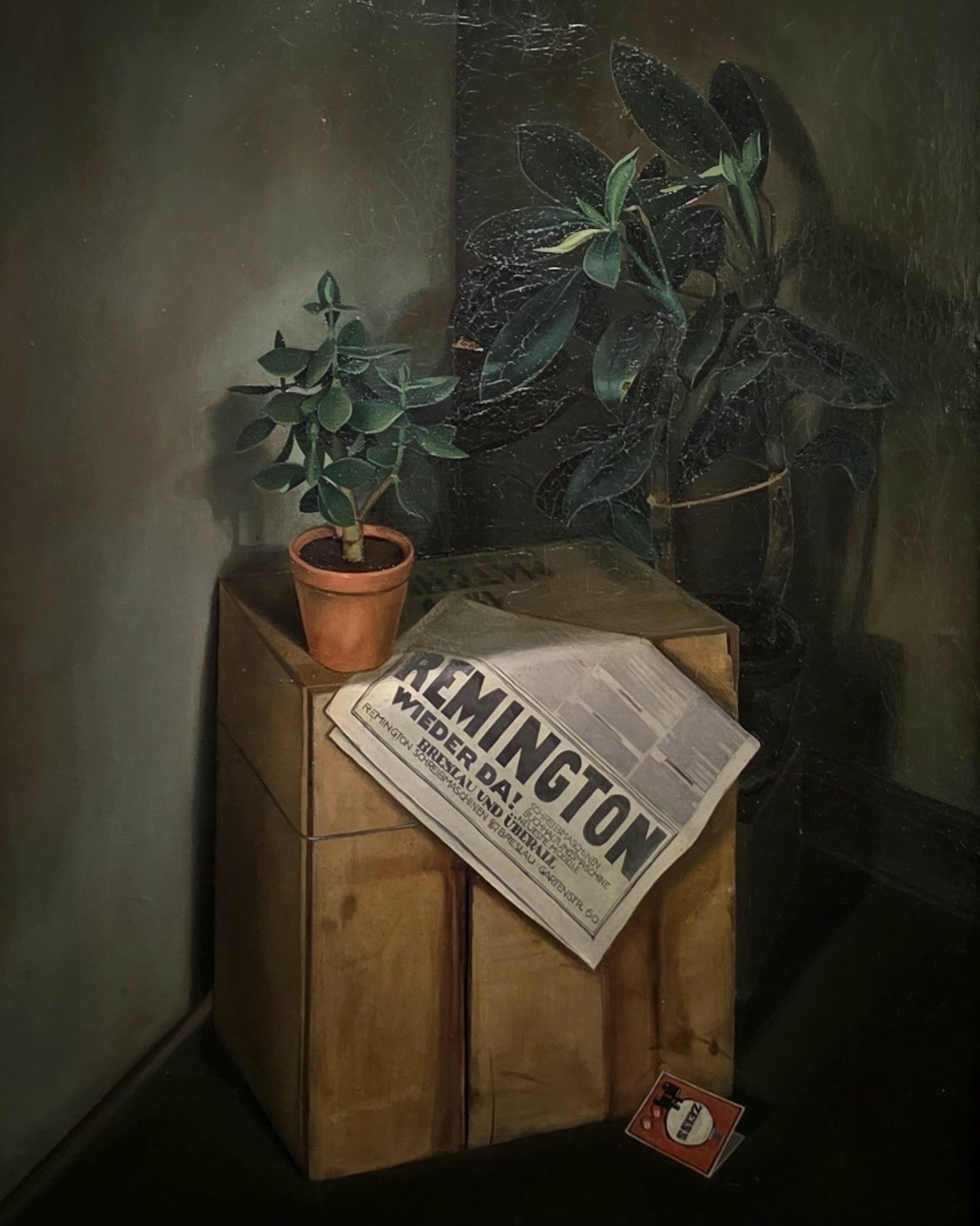
Arno Henschel, Stillleben mit Zeitung. Image: Arno Henschel (1897-1945) · Public domain · Wikimedia Commons, accessed 2026-08-04
New Objectivity, or Neue Sachlichkeit, arose in Germany in the early 1920s as a deliberate rejection of Expressionism's emotional intensity and Dada's nihilistic irony, though it inherited Dada's appetite for social critique. The name was coined by museum director Gustav Hartlaub, who organized the movement's defining 1925 group exhibition in Mannheim, "Neue Sachlichkeit," and identified two loose currents within it: the "Verists," led by Otto Dix and George Grosz, who used harsh satire and grotesque exaggeration to expose the corruption, violence, and moral decay of Weimar-era Germany; and the "Classicists" or "magic realists," including Christian Schad and Georg Schrimpf, who painted cool, static, hyper-detailed portraits and still lifes with an unsettling, clinical clarity.
Stylistically, both currents shared a hard-edged, meticulous technique that revived the precision of Northern Renaissance painters like Dürer and Holbein rather than the loose, gestural brushwork of Expressionism. Subject matter confronted the raw psychological and social wounds of the era directly: mutilated war veterans, profiteers, prostitutes, decadent nightlife, and the widening gulf between rich and poor under hyperinflation. Many of the movement's leading figures, including Dix, had served in World War I themselves and painted its horrors — amputees, prosthetics, disfigurement — with a bluntness that refused sentimentality or heroic framing.
The movement rebelled explicitly against Expressionism's inward emotional focus, insisting instead on unflinching outward observation of contemporary society. Grosz's biting caricatures of militarists, capitalists, and clergy repeatedly drew legal prosecution for obscenity and blasphemy, making him one of the era's most controversial artists. New Objectivity matters as one of art history's most direct uses of technical precision in service of political and social critique — a visual record of interwar German anxiety unmatched in its bluntness.
The movement ended abruptly with the Nazi rise to power in 1933. Its unsparing realism was branded "degenerate," works were seized (many later displayed in the infamous 1937 "Degenerate Art" exhibition), and its artists were dismissed from teaching positions, forced into exile, or driven into inner silence — a decade's worth of unsparing social observation extinguished almost overnight.
What defines New Objectivity
Hard-edged, meticulous realism
Surfaces and textures were rendered with near-photographic precision, reviving Northern Renaissance clarity in place of Expressionist gesture and painterly looseness.
Satirical, grotesque exaggeration
The Verist wing, especially Grosz and Dix, distorted features into caricature to expose moral hypocrisy and social corruption within Weimar society.
Unflinching depiction of war trauma
Amputees, prosthetics, and disfigured veterans were shown directly and without sentimentality, confronting the physical and psychological toll of World War I.
Cool, detached portraiture
Subjects were rendered with an emotionally flat, almost clinical gaze, frequently isolated against sparse or ambiguous backgrounds.
Social critique of decadence and inequality
Nightlife, prostitution, profiteering, and stark class division were depicted as visible symptoms of a morally exhausted postwar society.
Sober palette with sharp linear detail
Restrained, often slightly acidic color emphasized crisp contour and surface detail over expressive or decorative color effects.
History
New Objectivity grew out of the ashes of German Expressionism and Dada in the turbulent aftermath of World War I and the German Revolution of 1918–19. Otto Dix and George Grosz, both war veterans, moved away from their earlier Expressionist and Dadaist styles toward a harder, more observational realism suited to processing wartime trauma and critiquing the volatile Weimar Republic. The tendency gained its name and public identity through Gustav Hartlaub, director of the Mannheim Kunsthalle, whose landmark 1925 exhibition "Neue Sachlichkeit" grouped its artists and articulated the split between the satirical Verists and the cooler Classicists or magic realists.
The movement flourished through the mid-to-late 1920s alongside Berlin's cabaret culture, ongoing economic instability, and rising political extremism — all frequent subjects of its paintings. Grosz's ferocious caricatures of the military, clergy, and capitalist elite led to repeated prosecutions for obscenity and blasphemy, cementing his reputation as one of the era's most provocative artists. Dix's war paintings and unsparing portraits of dealers, doctors, and journalists captured Weimar society's extremes with equal bluntness. The movement's documentary impulse extended beyond painting into photography, notably August Sander's ambitious typological portraits of German society across all classes and professions.
The Nazi Party's rise to power in 1933 ended the movement decisively. Its artists were dismissed from teaching positions, and many works were later confiscated and displayed as propaganda in the 1937 "Degenerate Art" exhibition designed to humiliate modernist art. Grosz emigrated to the United States before the Nazi takeover; Dix, forced to remain under restricted membership in the Reich Chamber of Fine Arts, retreated into painting allegorical and landscape subjects far removed from his earlier social critique. New Objectivity's brief decade left one of the most searing visual records of interwar Europe, cut short by the very political forces its artists had spent years exposing.
Key works
| Work | Artist | Year | Why it matters |
|---|---|---|---|
| The Skat Players | Otto Dix | 1920 | A grotesque depiction of disfigured World War I veterans playing cards, fusing satire with direct war trauma. |
| Portrait of the Journalist Sylvia von Harden | Otto Dix | 1926 | A cool, unflattering portrait embodying the era's independent "New Woman" and the movement's clinical realism. |
| The Pillars of Society | George Grosz | 1926 | A savage caricature of Weimar Germany's militarist, clerical, and capitalist elite. |
| Eclipse of the Sun | George Grosz | 1926 | A satirical allegory skewering wartime profiteers and political corruption in the Weimar Republic. |
| Self-Portrait with Model | Christian Schad | 1927 | A hyper-detailed, sexually charged portrait exemplifying the Classicist, "magic realist" strand of the movement. |
How to make art in this style
Palette: Use muted, slightly acidic tones — ochre, gray-green, dull red, sallow flesh tones — avoiding lush, decorative, or purely expressive color choices.
Composition: Favor tight, often frontal or directly confrontational framing of figures, isolated against plain or symbolically loaded backgrounds rather than busy, atmospheric settings.
Technique: Work with hard, precise linework and smooth modeling reminiscent of Old Master panel painting. Keep brushwork minimal and controlled, paying sharp attention to surface detail — skin texture, fabric weave, the specific material of a prosthetic limb or piece of jewelry.
Subjects: Choose portraits that expose character through unflattering honesty rather than idealization, scenes of urban nightlife and visible social inequality, or direct depictions of war's physical aftermath.
Approach: Look at your subject with a cold, clinical eye rather than sentiment or sympathy, letting exaggerated or heightened detail — rather than distortion of form — carry the critique. Where the Verist tradition leans toward caricature and grotesque exaggeration, the Classicist strand achieves its unease through sheer, unnerving clarity; choose one register and apply it consistently rather than blending sentimentality into either.
Practical note: This is a style built on observation, not invention — work from careful study of real faces, clothing, and settings rather than imagined or fantastical imagery, since the movement's power lies in its claim to unsparing documentary truth.
Legacy
New Objectivity established a lasting template for using hyperrealist, hard-edged technique as a vehicle for direct social and political critique, an approach later echoed in politically engaged figurative painting and photorealism. August Sander's parallel photographic project extended the movement's documentary impulse into a systematic portrait of an entire society, and remains a foundational reference for documentary and typological photography today.
The movement's unsparing imagery of war trauma helped shape a broader tradition within German art of confronting national history and collective guilt directly, an approach later artists such as Anselm Kiefer would extend into the postwar era. The "Degenerate Art" persecution its artists suffered under the Nazis became a defining case study in the history of art censorship and the politics of realism, still cited whenever authoritarian regimes target unflinching representational art as subversive.
Contemporary political caricature, graphic novels, and socially critical figurative painting continue to draw on New Objectivity's central technique: combining meticulous, almost clinical precision with satirical or critical intent, letting exaggerated detail rather than expressive distortion carry the emotional and political charge.
Frequently asked questions
What is New Objectivity (Neue Sachlichkeit)?
New Objectivity was a German art movement of the 1920s that rejected Expressionist emotionalism for cold, precise realism, using satire and unflinching detail to critique Weimar-era society, war trauma, and social inequality.
Who were the main artists of New Objectivity?
Otto Dix and George Grosz led the movement's satirical "Verist" wing, while Christian Schad represented its cooler "Classicist" or "magic realist" strand of hyper-detailed portraiture.
How is New Objectivity different from Expressionism?
Expressionism used distorted form and color to convey inner emotion, while New Objectivity rejected that subjectivity for hard-edged, meticulous, almost clinical realism turned outward on contemporary social conditions.
Why was New Objectivity condemned by the Nazis?
Its artists' unsparing depictions of war trauma, inequality, and moral decay were branded "degenerate" by the Nazi regime after 1933; many works were confiscated and later displayed in the 1937 Degenerate Art exhibition meant to discredit modernist art.
What is the difference between Verism and magic realism within New Objectivity?
Verism, associated with Dix and Grosz, used satirical exaggeration to expose social corruption, while magic realism, associated with Schad, achieved its unsettling effect through cool, almost photographic clarity rather than caricature.