 Art
Art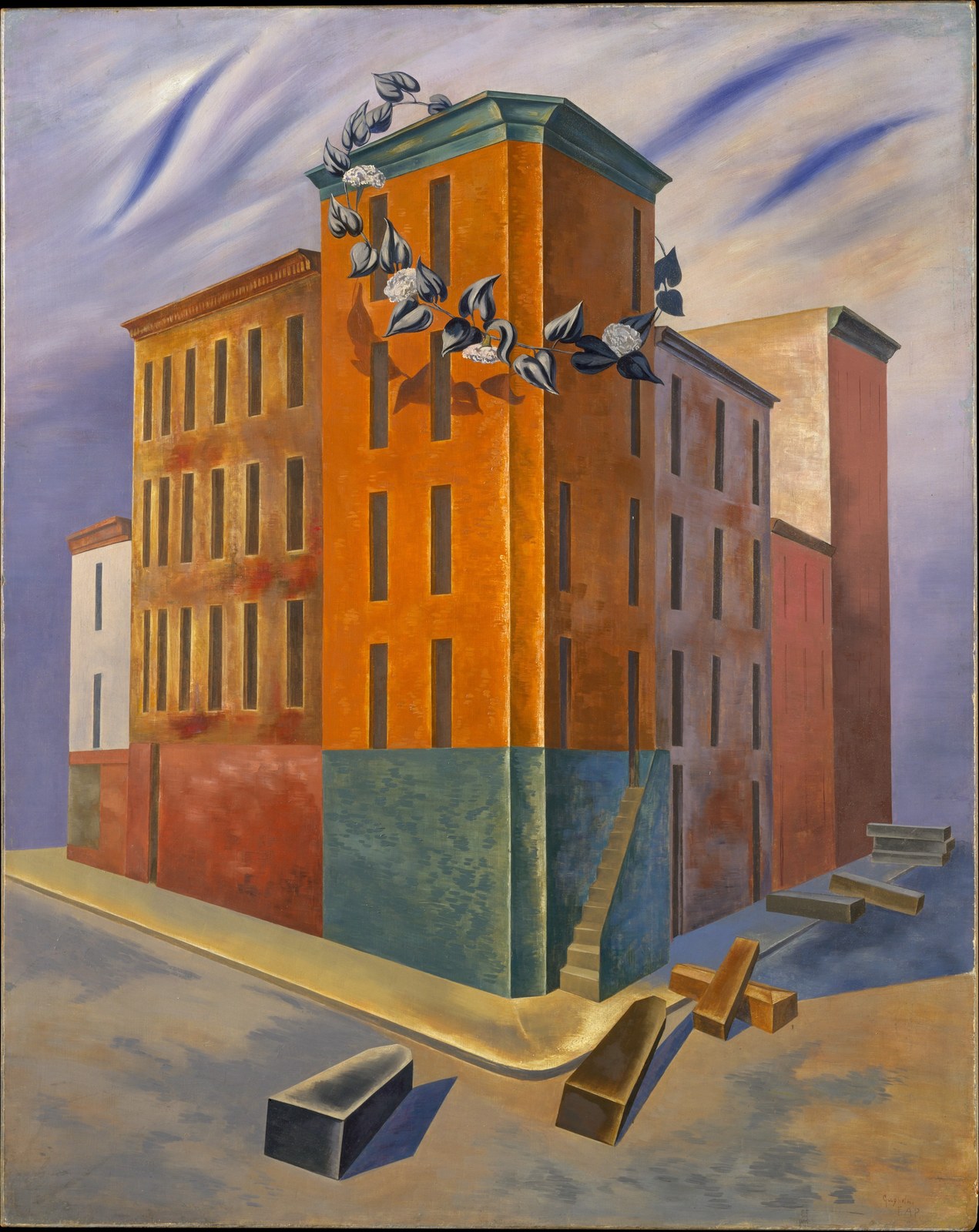
"One Third of a Nation". Image: Osvaldo Louis Guglielmi · Public domain · Wikimedia Commons, accessed 2026-08-04
Precisionism, sometimes called Cubist Realism or "the Immaculates" by contemporaries, was an American modernist movement of the 1920s and 1930s centered on the industrial and architectural landscape of a rapidly modernizing nation. Its leading figures — Charles Demuth, Charles Sheeler, and, in her early architectural paintings, Georgia O'Keeffe — depicted factories, grain elevators, bridges, skyscrapers, and barns with sharp-edged geometric simplification and smooth, almost photographic paint surfaces that eliminated visible brushwork entirely.
The style absorbed Cubism's faceted structure and Futurism's fascination with machinery but tempered both into legible, realist imagery rather than radical abstraction — a distinctly American compromise between European avant-garde form and native subject matter. Human figures are almost entirely absent from Precisionist paintings; the emphasis falls instead on the clean geometry of industrial and architectural form itself. Sheeler, who worked simultaneously as a commercial photographer, often used photographs as source material, most famously his images and paintings of the Ford Motor Company's River Rouge plant, which became touchstones of the style's crisp, emptied-out aesthetic.
Precisionism gave visual form to a particular strand of American optimism about industry and technology in the years following World War I — pride in scale, efficiency, and modernization — though some works carry an undercurrent of ambiguity about a landscape stripped of human presence. The movement rebelled against both radical European abstraction and conventional academic realism, forging an idiom that felt unmistakably modern yet remained rooted in recognizable American subject matter, tied closely to a sense of national identity built on industrial achievement.
Precisionism never organized around a manifesto or formal group identity; it was a loose stylistic affinity rather than an avant-garde movement in the European sense. It lost momentum through the 1930s as the Great Depression turned American art's attention toward human labor and hardship via Social Realism and Regionalism. Its importance lies in establishing industrial and urban subject matter as serious American modernist territory, and in pioneering a cool, detached, camera-like way of seeing that would resurface decades later in Photorealism.
What defines Precisionism
Geometric simplification
Complex industrial and architectural forms were reduced to clean planes, straight lines, and hard edges, echoing Cubism's structural discipline without its fragmentation of the picture plane.
Smooth, impersonal surfaces
Paint was applied with almost no visible brushwork, producing a crisp, photograph-like finish that removed any trace of the artist's hand or spontaneous gesture.
Absence of human figures
Factories, cityscapes, and machinery appear emptied of people, shifting emphasis entirely onto industrial order, scale, and geometric form.
American industrial subjects
Grain elevators, skyscrapers, bridges, factories, and barns were treated as modern equivalents of traditional landscape or architectural subject matter.
Sharp directional light
Strong, clearly sourced light produced crisp geometric shadows that modeled volume cleanly, often recalling the architectural photography of the same period.
Restrained, cool palette
Muted grays, browns, and industrial blues dominated, punctuated occasionally by a single saturated color for compositional emphasis.
History
Precisionism's roots trace to the landmark 1913 Armory Show, which introduced American audiences and artists to Cubism and Futurism and prompted a generation of painters to adapt European abstraction to distinctly American subject matter. The term "Precisionism" was applied retrospectively; contemporaries more often spoke of "Cubist Realism" or "the Immaculates." Charles Demuth and Charles Sheeler emerged as the movement's central figures through the 1920s. Sheeler worked simultaneously as a commercial and fine-art photographer, and his 1927 photographs and subsequent paintings of the Ford Motor Company's River Rouge plant became defining images of the style. Demuth's grain-elevator and factory paintings of his native Lancaster, Pennsylvania, along with symbolic "poster portraits" of fellow artists and writers such as I Saw the Figure 5 in Gold (1928), his tribute to the poet William Carlos Williams, further defined the movement's crisp geometric vocabulary.
Georgia O'Keeffe's precisely rendered late-1920s paintings of New York skyscrapers are frequently grouped with Precisionism, though she pursued a largely independent artistic path. The circle gained visibility partly through Alfred Stieglitz's influential New York gallery network, which supported several of the artists and connected them to the wider American modernist scene.
The movement peaked in the late 1920s, in step with the era's industrial boom and cultural confidence in American technology, but lost momentum through the Great Depression as Social Realism and Regionalism redirected artistic attention toward human labor, hardship, and rural American life rather than pristine, emptied machinery. Some artists, including Ralston Crawford, carried a related sensibility into the 1930s and 1940s. Precisionism never organized around a formal manifesto or group exhibition identity, remaining throughout its active years a loose stylistic affinity rather than a coordinated avant-garde movement.
Key works
| Work | Artist | Year | Why it matters |
|---|---|---|---|
| My Egypt | Charles Demuth | 1927 | A monumental grain elevator painted with pyramid-like geometric grandeur, an icon of the movement's reverence for industrial architecture. |
| American Landscape | Charles Sheeler | 1930 | The Ford River Rouge plant rendered with the emptied, geometric calm characteristic of Precisionist painting. |
| Radiator Building—Night, New York | Georgia O'Keeffe | 1927 | A glowing skyscraper composition applying Precisionist clarity to the modern city skyline. |
| Classic Landscape | Charles Sheeler | 1931 | An industrial cement plant composed with the serene order traditionally reserved for landscape painting. |
| I Saw the Figure 5 in Gold | Charles Demuth | 1928 | A bold geometric abstraction inspired by a William Carlos Williams poem, blending Precisionist crispness with poster-like dynamism. |
How to make art in this style
Palette: Use muted industrial tones — grays, browns, steel blue, and rust — reserving a single bright accent, such as a red roof or a patch of yellow sky, for focal contrast against the restrained scheme.
Composition: Build strong geometric structure from architectural or mechanical forms — silos, bridges, factory stacks — simplified into flat planes with clear diagonals and dominant verticals or horizontals. Crop tightly to emphasize scale and monumentality.
Technique: Eliminate visible brushstrokes in favor of smooth, even paint application and hard, ruled edges. Working from photographic reference is consistent with the movement's own practice and helps achieve accurate perspective and clean, directional light.
Subjects: Choose industrial and urban American architecture — grain elevators, skyscrapers, bridges, factories, barns — and empty them of human figures to keep the focus on geometric order and scale rather than narrative.
Light and shadow: Use a single strong, clearly sourced light to carve crisp geometric shadows that reinforce the underlying composition rather than softening it. Avoid atmospheric haze or blended tonal transitions; keep every plane and edge distinct.
Overall approach: Treat the subject with reverence rather than critique — Precisionist works present industry as a form of modern monumentality, closer in spirit to traditional landscape or architectural painting than to satire or documentary reportage.
Legacy
Precisionism established industrial and urban architecture as legitimate territory for American modernist art, a foundation that later Photorealist painters built on directly with their own cool, highly detailed depictions of cars, diners, and cityscapes. The movement's emptied-out, machine-focused compositions anticipated the detachment later found in Pop Art's use of advertising and consumer imagery, even though the styles differ sharply in tone and intent.
Charles Sheeler's parallel careers in photography and painting foreshadowed a more general blurring between photographic and painted image-making that continues in contemporary practice. The movement's visual language of grain elevators, factories, and skyscrapers remains a touchstone for depictions of American regional and industrial identity, still referenced in illustration, corporate photography, and design work seeking a clean, confident, modernist American aesthetic rooted in industry rather than European abstraction.
More broadly, Precisionism demonstrated that a legible, representational style could carry the formal ambitions of European modernism without abandoning recognizable subject matter — a lesson that shaped how later American movements balanced abstraction against realism throughout the twentieth century.
Frequently asked questions
What is Precisionism?
Precisionism was an American art movement of the 1920s and 1930s that depicted factories, skyscrapers, and machinery with crisp geometric simplification and smooth, photograph-like paint surfaces, largely devoid of human figures.
Who were the main Precisionist artists?
Charles Demuth and Charles Sheeler are considered the movement's central figures, with Georgia O'Keeffe's skyscraper paintings and Ralston Crawford's later industrial scenes often included alongside them.
Is Georgia O'Keeffe a Precisionist?
Her late-1920s New York skyscraper paintings share Precisionism's geometric clarity and are often grouped with the movement, though she pursued a broader, independent artistic path across her career.
What is the difference between Precisionism and Cubism?
Precisionism adopted Cubism's faceted, geometric structure but kept subjects clearly legible and realistic rather than fragmenting them into abstraction, applying that structure specifically to American industrial and architectural subjects.
Why did Precisionist paintings avoid people?
Leaving factories and cityscapes empty of figures shifted the visual emphasis entirely onto industrial geometry and order, reinforcing the movement's focus on architecture and machinery as subjects worthy of monumental treatment in their own right.