 Art
Art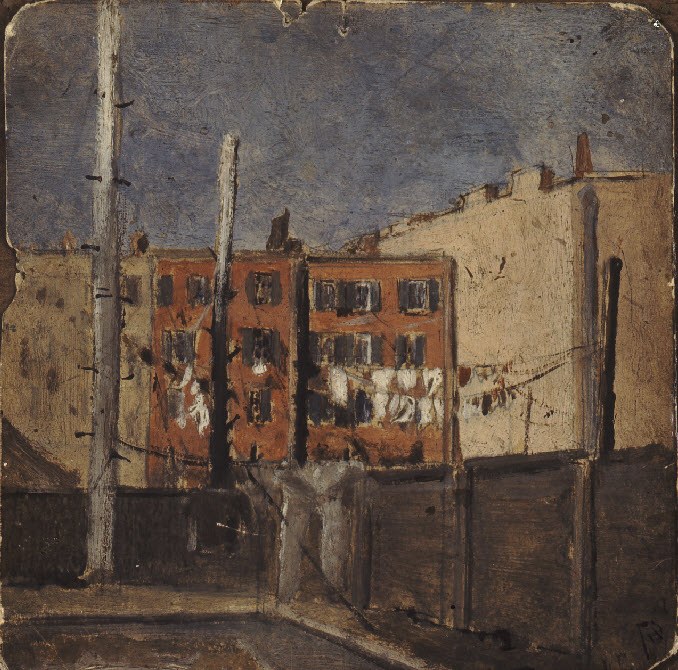
1887 backyard image. Image: BEDownes Artwork by Jerome Myers · CC BY-SA 3.0 · Wikimedia Commons, accessed 2026-08-04
The Ashcan School was a loose circle of American realist painters, active in New York roughly between 1900 and 1915, who turned their attention to the city's unpolished daily life — immigrant neighborhoods, saloons, boxing clubs, backyards hung with laundry, crowded streetcars, and snow-slushed avenues. Several core members, including John Sloan, William Glackens, George Luks, and Everett Shinn, had trained as newspaper illustrators before turning to painting, and that background shaped their working method: quick, observational, and unsentimental, closer to reportage than to academic composition.
Robert Henri became the group's informal leader and chief teacher, urging students at the New York School of Art to paint "life" directly rather than copying idealized academic subjects or imported European salon formulas. The name "Ashcan School" appeared in print while the group was still active, around 1915-16, as a half-mocking reference to the group's fondness for trash cans, alleys, and other unglamorous corners of the city — subjects the conservative National Academy of Design considered beneath serious art — and was popularized more widely in the 1930s.
The group rebelled against the Academy's preference for classical, historical, and genteel subjects, and against what its members saw as an art culture disconnected from the actual texture of modern urban life. Their palette tended dark and tonal, indebted to Old Masters like Frans Hals and Diego Velázquez and to Édouard Manet's bold, direct brushwork, applied to unmistakably American, unmistakably contemporary scenes. In 1908, several members exhibited together as "The Eight" at New York's Macbeth Gallery, a direct protest against the Academy's restrictive jury system.
The Ashcan School matters because it insisted that ordinary, working-class urban life was a legitimate — even urgent — subject for serious painting, at a moment when American art still largely deferred to European academic taste. Ironically, several of its members helped organize the pivotal 1913 Armory Show, which introduced American audiences to European modernism and quickly redirected avant-garde attention away from realism and toward Cubism and abstraction.
What defines Ashcan School
Urban, Working-Class Subjects
Streets, tenements, saloons, boxing arenas, and immigrant neighborhoods replace the pastoral landscapes and refined portraiture favored by the academy, treating everyday city life as worthy subject matter in its own right.
Dark, Tonal Palette
Muted browns, grays, and blacks dominate, occasionally broken by a flash of brighter color, giving paintings a smoky, gaslit atmosphere closer to Old Master tonalism than to Impressionist brightness.
Loose, Vigorous Brushwork
Paint is applied quickly and confidently, with visible strokes that prioritize energy and immediacy over fine finish, reflecting many members' backgrounds as fast-working newspaper illustrators.
Candid, Unidealized Figures
Ordinary people — boxers, street kids, working women, bar patrons — are shown without flattery or moralizing, caught in unposed, everyday moments rather than staged compositions.
Journalistic Immediacy
Compositions often feel snatched from life, with cropped framing and an on-the-spot quality that carries over directly from the group's newspaper sketching backgrounds.
Movement and Modern City Life
Crowds, elevated trains, streetcars, and the general bustle of the metropolis appear frequently, capturing the sensory overload of the rapidly growing early-twentieth-century American city.
History
The Ashcan School's roots trace to Philadelphia in the 1890s, where John Sloan, William Glackens, George Luks, and Everett Shinn worked together as newspaper illustrators and gathered around the painter Robert Henri, meeting informally to discuss art and paint together. Henri, older and more widely traveled, became their de facto teacher, preaching a philosophy of direct, vigorous, life-based painting influenced by his own admiration for Manet, Hals, and Velázquez. Around the turn of the century, the group relocated to New York, then in the midst of explosive growth, and found in the city an inexhaustible subject.
Henri's teaching at the New York School of Art brought a younger generation, including George Bellows, into the circle. The group's defining public moment came in 1908, when eight painters — Henri, Sloan, Glackens, Shinn, Luks, and three others working in different, related styles — exhibited together as "The Eight" at the Macbeth Gallery, protesting the National Academy of Design's restrictive exhibition jury. The show drew significant press attention and cemented the group's reputation as insurgents against academic taste, even though not all eight members painted strictly urban, working-class subjects.
The Ashcan painters' influence peaked in the years around 1908 to 1913. Some members of the circle were involved with the landmark 1913 Armory Show, which brought European modernism — Cubism, Fauvism, and Post-Impressionism — to American audiences on a large scale for the first time. The exhibition's impact proved double-edged for the Ashcan School itself: it energized the American avant-garde but quickly shifted critical attention toward European-style abstraction, leaving the group's brand of urban realism looking comparatively conservative within just a few years. The term "Ashcan School" itself first appeared in print around 1915-16, while the group was still active, and was popularized more widely only in the 1930s, once the group's historical position was already settled.
Key works
| Work | Artist | Year | Why it matters |
|---|---|---|---|
| Stag at Sharkey's | George Bellows | 1909 | A dynamic depiction of an illegal boxing match that remains the Ashcan School's most famous image of urban spectacle and physical energy. |
| Cliff Dwellers | George Bellows | 1913 | A crowded tenement street scene that captures the density and heat of immigrant New York life. |
| McSorley's Bar | John Sloan | 1912 | A view inside a Manhattan tavern that exemplifies the group's interest in ordinary, unglamorous social spaces. |
| Snow in New York | Robert Henri | 1902 | An early, tonally dark street scene that shows Henri applying his direct, painterly method to the modern city. |
How to make art in this style
Creating Ashcan School-Style Work Today
Palette: keep the range narrow and tonal — umbers, ochres, blacks, and warm grays — reserving brighter color for small, deliberate accents like a red scarf or a lit window. Think of the palette as closer to Old Master underpainting than to plein-air Impressionist brightness.
Composition: choose ordinary, often overlooked corners of urban life — a crowded sidewalk, a bar interior, a tenement backyard, a sporting event — and frame them as if caught in passing, with cropped edges and an off-center focal point rather than a formally balanced composition. Avoid posing figures; aim for the sense that you happened upon the scene.
Brushwork: work quickly and directly, laying down confident, visible strokes rather than blending toward a smooth finish. A limited value range with strong darks, built up in a few decisive passes, will do more for the mood than fine detail. Drawing quickly from memory or observation, in the manner of a newspaper sketch artist working on deadline, is a useful practical exercise for capturing this immediacy.
Subjects: working-class and immigrant city life, sport (boxing is the classic Ashcan subject), transit and crowds, saloons and cafés, and unposed portraits of ordinary people are the movement's core territory. The goal throughout is honest observation without sentimentality or moralizing — show the city's grit and its vitality in the same breath, rather than softening one for the other.
Legacy
The Ashcan School established urban, working-class life as a legitimate and enduring subject for American painting, a precedent later carried forward by Depression-era Social Realism and the government-sponsored regionalist and urban scenes of the 1930s WPA art programs. Its commitment to unsentimental observation of the street anticipated, in spirit, the documentary eye of twentieth-century street photographers, even though the two mediums developed independently. Edward Hopper, who studied under Robert Henri, absorbed the group's interest in ordinary American scenes and quiet urban atmosphere, carrying a related sensibility forward into a very different, more solitary visual language.
Because its members were also active teachers, critics, and exhibition organizers, the Ashcan School's influence extended beyond its own canvases into the broader institutional shape of early-twentieth-century American art, including its indirect role in bringing about the Armory Show. Today, the group's paintings are valued as some of the most vivid visual records of early-1900s American urban life, and their loose, confident brushwork and unglamorous subject matter continue to inform any artist drawn to painting the city as it actually looks, rather than as an idealized backdrop.
Frequently asked questions
What is the Ashcan School?
The Ashcan School was a group of early-1900s American realist painters, based in New York, known for depicting unglamorous, working-class urban life in dark, loosely brushed canvases.
Why is it called the Ashcan School?
The name appeared in print while the group was still active, around 1915-16, as a mocking reference to the group's fondness for painting trash cans, alleys, and other unpolished corners of the city rather than refined academic subjects, and was popularized more widely in the 1930s.
Who were the main Ashcan School artists?
Robert Henri led the group as teacher and organizer, with John Sloan, George Bellows, and Everett Shinn among its best-known painters.
What is the difference between the Ashcan School and American Impressionism?
American Impressionism favored bright color and picturesque, often genteel subjects in the manner of Monet, while the Ashcan School used a darker, tonal palette to depict grittier, working-class urban scenes.
How is the Ashcan School connected to the Armory Show?
Several painters connected to the Ashcan circle, including John Sloan, were involved with the 1913 Armory Show, the exhibition that first introduced European modern art to a wide American audience.