 Art
Art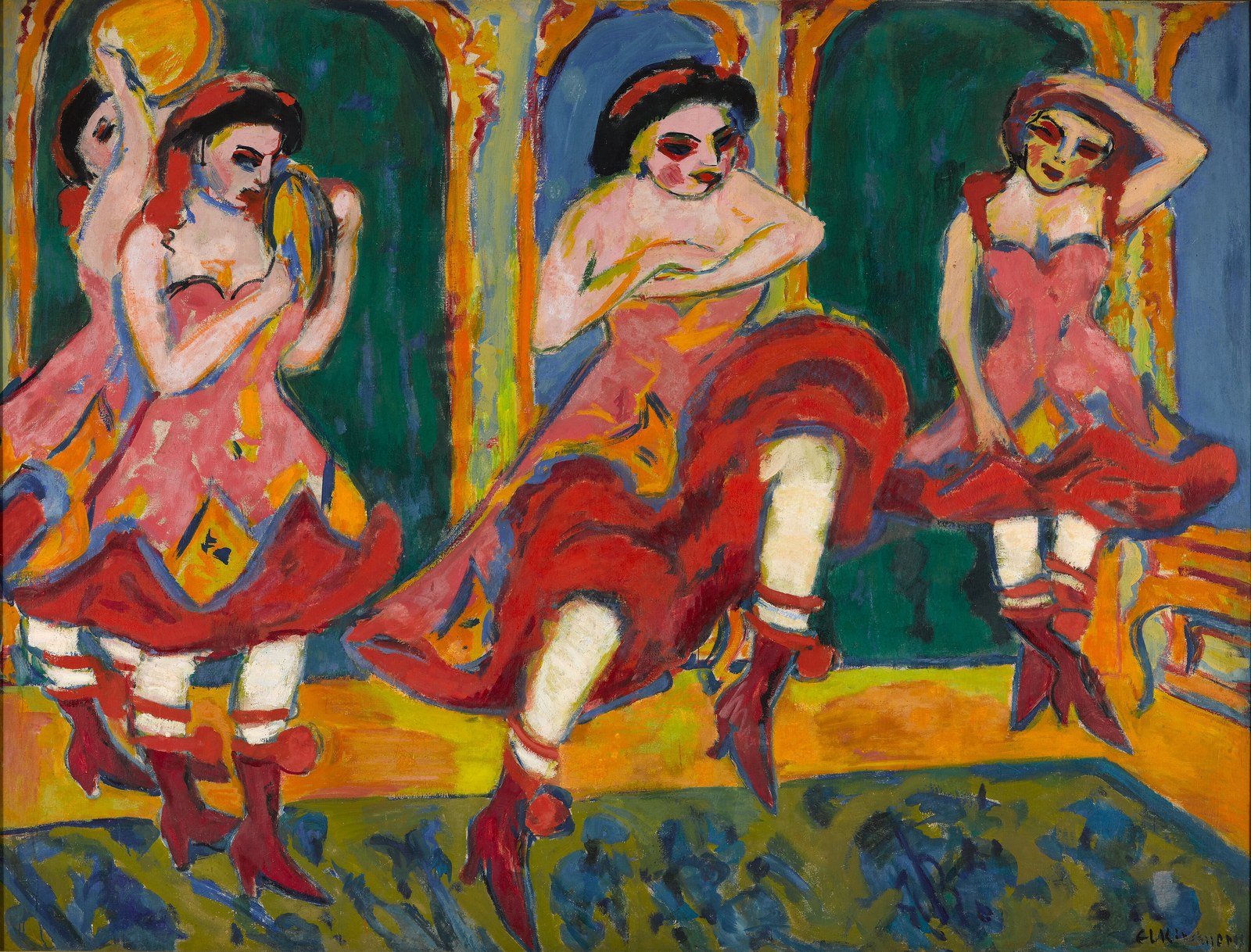
Spanish: Bailarinas de Czardas Czardas Dancers. Image: Ernst Ludwig Kirchner · Public domain · Wikimedia Commons, accessed 2026-08-04
Die Brücke, German for "The Bridge," was founded in Dresden in June 1905 by four architecture students with no formal art training — Ernst Ludwig Kirchner, Erich Heckel, Karl Schmidt-Rottluff, and Fritz Bleyl — who banded together in search of a new, authentically modern German art. The name, drawn from a passage in Nietzsche describing humanity as a bridge toward a higher future, signaled the group's ambition to connect old and new, tradition and revolution. Emil Nolde and Max Pechstein joined within the following year, broadening the group's range.
The Brücke artists rejected both bourgeois academic painting and Impressionism's polished, optically refined surface, seeking instead a raw, direct, deliberately unrefined style. They found inspiration in sources the academy dismissed: German medieval woodcuts, and the African and Oceanic carvings the members studied in Dresden's ethnographic collections, whose bold simplification and expressive distortion offered an alternative to Western academic naturalism. The group lived and worked communally, sharing studios and models, and painted nudes in informal, unposed settings — often each other, or companions moving freely around the studio — as a deliberate break from the static academic life-drawing tradition.
Visually, Brücke work is defined by harsh, clashing, non-naturalistic color and angular, simplified figures, applied with a raw urgency that prized emotional directness over technical polish. The group revived the woodcut as a central medium, valuing its bold black-and-white contrast and the visible trace of the knife or gouge in the block as an expression of the same rawness they sought in painting. Subject matter ranged from nudes in nature — an idealized, almost primal escape from urban convention — to increasingly anxious depictions of city crowds after the group relocated to Berlin in 1911.
Die Brücke matters as the founding group of German Expressionism, the collective that first gave the movement's raw emotional language an organized, communal form. Internal tensions, especially disagreement over Kirchner's own account of the group's history, led to its dissolution in 1913, but its individual members went on to produce some of Expressionism's most significant later work.
What defines Die Brücke
Angular, Simplified Figures
Bodies and faces are reduced to jagged, angular shapes, deliberately abandoning academic proportion and modeling in favor of raw expressive directness.
Harsh, Clashing Color
Non-naturalistic, often dissonant color combinations replace naturalistic palettes, chosen for emotional charge rather than harmony or accuracy.
Revived Woodcut Printmaking
Bold black-and-white woodcuts, with visible knife and gouge marks left in the block, became a central Brücke medium, prized for their raw, hand-worked, unrefined quality.
Communal, Unposed Studio Practice
Members shared studios and models, painting nudes in informal, everyday movement rather than static academic poses, treating the studio itself as a space of shared life.
'Primitive' and Non-Western Influence
African and Oceanic carvings, studied in Dresden's ethnographic museum, and medieval German woodcuts offered the group an alternative visual vocabulary to academic Western naturalism.
Nudes in Nature and Anxious City Scenes
Early work often depicts nudes in natural, outdoor settings as an escape from urban convention, while later Berlin-period work turns toward crowded, anxious depictions of modern city life.
History
Die Brücke was founded in Dresden in June 1905 by four architecture students — Ernst Ludwig Kirchner, Erich Heckel, Karl Schmidt-Rottluff, and Fritz Bleyl — none formally trained as painters, who sought a communal path toward a raw, authentically modern German art. Kirchner designed the group's manifesto as a woodcut, inviting younger artists to join a shared cause. Emil Nolde and Max Pechstein joined in 1906, broadening the group's stylistic range, though Nolde's independent temperament led to a falling-out and his departure within a couple of years.
The group operated communally: members shared studios, painted the same models in informal, unposed settings, studied non-Western art together in Dresden's ethnographic collections, and produced annual print portfolios distributed to paying patron-members, a scheme that helped fund their otherwise precarious existence. They held joint exhibitions and cultivated a deliberately raw, anti-academic identity, positioning themselves against both the conservative academy and Impressionism's refined surface.
In 1911, the group relocated to Berlin, then Germany's fastest-growing and most unsettling metropolis, and their subject matter shifted accordingly, from nudes in nature toward more fragmented, anxious depictions of city streets and crowds. Internal strain grew alongside this move: disagreements over artistic direction and, decisively, objections to Kirchner's 1913 "Chronik der Brücke," a history of the group that other members felt overstated his own role and diminished theirs, led to the group's dissolution in May 1913.
Individual members continued influential, independent careers well beyond the group's formal end. Kirchner's wartime and postwar work grew darker and more psychologically fraught; Nolde developed an increasingly visionary, religiously charged style; Schmidt-Rottluff and Heckel continued producing Expressionist paintings and prints for decades. Like other German modernists, several Brücke artists later had their work confiscated and denounced as "degenerate" by the Nazi regime in the 1930s, a persecution that only reinforced the group's later historical standing as a foundational chapter of German modern art.
Key works
| Work | Artist | Year | Why it matters |
|---|---|---|---|
| Street, Dresden | Ernst Ludwig Kirchner | 1908 | A jagged, acid-colored depiction of a crowded city street that stands as one of Die Brücke's defining images. |
| Bathers at Moritzburg | Ernst Ludwig Kirchner | 1909 | A scene of nudes at a lake near Dresden that reflects the group's communal practice of painting models informally outdoors. |
| Prophet | Emil Nolde | 1912 | A stark, visionary woodcut that exemplifies the group's revival of printmaking for raw expressive and spiritual intensity. |
How to make art in this style
Creating Die Brücke-Style Work Today
Palette: use harsh, non-naturalistic color combinations chosen to clash rather than harmonize — acid greens against magenta, orange against deep blue — favoring emotional charge over pleasing balance.
Composition: simplify figures and forms into angular, slightly awkward shapes, resisting the pull toward smooth academic proportion. For outdoor or communal scenes, aim for an informal, caught-in-motion arrangement of figures rather than a posed, symmetrical grouping; for city scenes, let the composition feel crowded and slightly fractured to suggest urban unease.
Technique: woodcut or a woodcut-inspired approach is the most direct route into this style — carve or draw bold black shapes with visible, deliberately rough edges, letting the marks of the tool remain part of the image rather than smoothing them away. In painting or drawing, aim for the same rawness by working quickly, avoiding blending, and leaving visible, urgent brushstrokes or line work rather than a refined finish.
Subjects: nudes in outdoor, natural settings; communal or studio scenes with figures in informal movement; and, for a harder-edged variation, crowded city streets rendered with anxious, fragmented energy are all core Brücke territory. Studying African, Oceanic, or medieval German woodcut art directly, for its simplification and expressive distortion rather than as a costume to imitate, will do more for authenticity than referencing the group's paintings alone.
Legacy
Die Brücke's most durable legacy is its role in re-establishing woodcut and printmaking as serious, expressive fine-art media, an emphasis that shaped twentieth-century graphic art and illustration well beyond German Expressionism itself. As the founding cell of German Expressionism, the group set the movement's early emotional and stylistic terms — raw color, angular form, communal practice — that Der Blaue Reiter, Austrian Expressionists, and later generations of German artists all responded to or built on. Its members' individual postwar careers, especially Kirchner's increasingly anguished later work and Nolde's visionary religious imagery, extended the group's influence for decades after its 1913 dissolution.
The Nazi regime's persecution of Brücke artists in the 1930s — confiscating works and branding them "degenerate" — has become a widely studied case of totalitarian suppression of modern art, and the group's postwar rediscovery and rehabilitation helped establish German Expressionism as a central chapter of twentieth-century art history rather than a marginal one. The group's communal, anti-academic studio model, in which artists lived, worked, and exhibited together outside institutional structures, also offered an early template that later artist collectives, from Der Blaue Reiter to postwar avant-gardes, would echo in their own ways.
Frequently asked questions
What does Die Brücke mean?
Die Brücke is German for 'The Bridge,' a name the founding artists took from a passage in Nietzsche describing humanity as a bridge toward a higher future.
Who founded Die Brücke?
Four self-taught Dresden architecture students — Ernst Ludwig Kirchner, Erich Heckel, Karl Schmidt-Rottluff, and Fritz Bleyl — founded the group in 1905; Emil Nolde and Max Pechstein joined soon after.
What is the difference between Die Brücke and Der Blaue Reiter?
Die Brücke, founded in Dresden in 1905, favored raw, angular figuration and woodcut printmaking, while Der Blaue Reiter, founded in Munich in 1911, leaned further toward spiritual, symbolic, and near-abstract imagery.
Why is woodcut important to Die Brücke?
The group revived woodcut printmaking for its bold black-and-white contrast and the raw, visible trace of hand-carving, treating it as a direct expression of the unpolished, anti-academic style they sought in painting as well.
When and why did Die Brücke end?
The group dissolved in May 1913, after internal disputes over artistic direction and objections to Ernst Ludwig Kirchner's own written history of the group, which other members felt exaggerated his role.