 Art
Art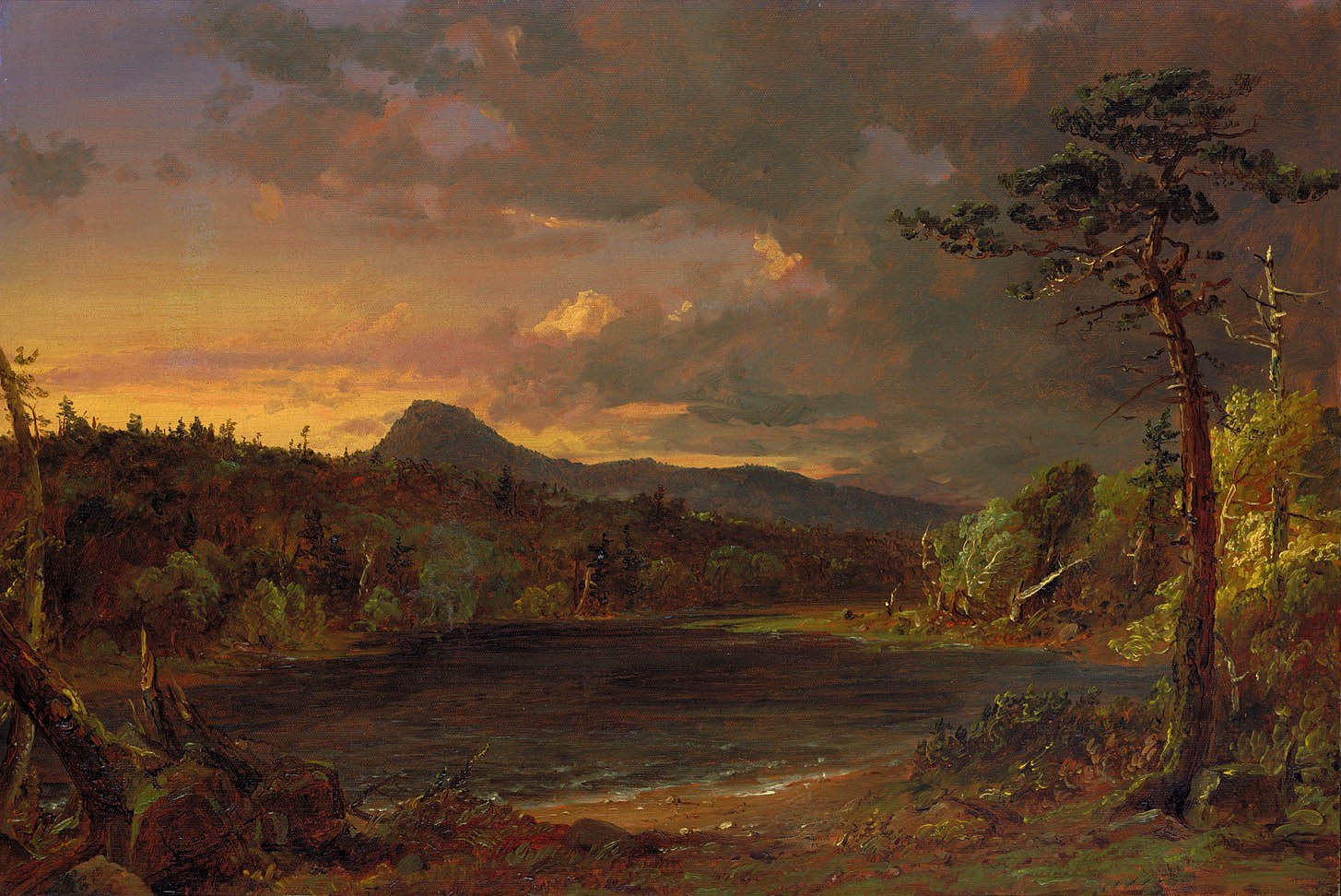
Catskill Creek. Image: Jasper Francis Cropsey · Public domain · Wikimedia Commons, accessed 2026-08-04
Luminism describes a group of American landscape painters active roughly between 1850 and 1875 who shared an unusual devotion to the precise rendering of light and atmosphere over dramatic incident or visible brushwork. Working mostly along the New England coast and inland waterways, painters such as Fitz Henry Lane, John Frederick Kensett, and Martin Johnson Heade produced glassy, still harbors and marshes bathed in soft, closely graduated tonal light, capturing dawn and dusk over salt marshes, tidal flats, and rocky coastal inlets. Their subjects were often modest and specific, a single anchored schooner, a stretch of tidal flat at low water, treated with the same rigor other painters reserved for grand wilderness panoramas.
Where the wider Hudson River School often reached for the sublime through scale and storm, towering peaks and dramatic weather, the Luminists found it in stillness instead. Brushwork is smoothed to near invisibility so nothing interrupts the illusion of atmosphere; water reads as a mirror, skies dissolve into fine tonal gradients, and compositions favor a low, wide horizon over vertical drama. Painters sometimes blended the paint surface so thoroughly that it reads as pure light rather than pigment. Human figures, when present, are small and incidental, included for scale rather than narrative.
Luminism was never a self-declared movement with a manifesto or joint exhibitions; the term itself was coined retrospectively in 1954 by the art historian John I. H. Baur to describe a shared sensibility he traced across otherwise independent painters, who worked instead within the broader Hudson River School and National Academy of Design context of their day. That sensibility resonated with the transcendentalist mood of the period, the sense, present in Emerson and Thoreau, that quiet, close observation of nature could yield spiritual insight. It matters today as a distinctly American contribution to landscape painting: a technically demanding, contemplative alternative to both European academic landscape and the era's taste for scenic spectacle.
What defines Luminism
Invisible brushwork
Paint is blended and smoothed until individual strokes disappear, so the surface reads as pure atmosphere rather than pigment. This restraint sets Luminist canvases apart from the more textured, gestural handling common elsewhere in 19th-century landscape painting.
Closely graduated tonal palette
Rather than bold color contrast, Luminists worked in narrow tonal ranges, subtle shifts from cool blue-grey to warm gold, to render the softening effect of haze and low light.
Glassy, mirror-still water
Harbors, bays, and tidal flats appear almost perfectly still, their surfaces reflecting the sky with minimal disturbance. This stillness reinforces the contemplative, almost silent mood of the work.
Low, wide horizons
Compositions favor a low horizon line and expansive sky and water, emphasizing scale and calm over the vertical drama common in mainstream Hudson River School painting.
Sparse, small-scale figures
When present, boats and figures are small and incidental, included for scale rather than narrative, keeping the emphasis on atmosphere and light.
Dawn and dusk light
Many key Luminist works are set at sunrise or sunset, moments when light is most diffuse and color transitions most subtle, ideal conditions for the movement's tonal precision.
History
Luminism grew out of the same circle as the Hudson River School in the 1850s, sharing its commitment to close observation of the American landscape but pursuing an unusually restrained, light-focused variant of it. Fitz Henry Lane worked from Gloucester, Massachusetts, and the coast of Maine; John Frederick Kensett painted the shores of Long Island Sound and Newport; Martin Johnson Heade moved between salt marshes of the Northeast and, later, more exotic subjects in South America. These artists worked largely independently, sharing an aesthetic sensibility rather than a formal program, manifesto, or joint exhibition society.
The style flourished roughly from 1850 to 1875, a period that overlapped with the rise of photography and its own preoccupation with optical precision, and with the transcendentalist philosophy of Emerson and Thoreau, which held that careful attention to nature could yield spiritual understanding. Unlike the Hudson River School's more overtly theatrical wing, Luminist works rarely depict storms, sublime peaks, or wilderness spectacle, favoring instead calm, inhabited coastal scenes.
By the mid-1870s, the style's leading figures had largely stopped painting in this mode: Lane died in 1865, Kensett in 1872, and Heade's later work moved toward more overtly decorative subjects like orchids and hummingbirds. Broader American taste shifted toward the looser brushwork of Barbizon-influenced Tonalism and, later, American Impressionism, and the tight, tonal Luminist manner fell out of critical fashion. The term Luminism itself did not exist during the painters' lifetimes, it was coined in 1954 by art historian John I. H. Baur and developed further by later scholars, retrospectively defining a sensibility its own practitioners never named or organized around.
Key works
| Work | Artist | Year | Why it matters |
|---|---|---|---|
| Approaching Thunder Storm | Martin Johnson Heade | 1859 | Contrasts an eerily still, glowing shoreline with a darkening sky, showing Luminist tonal precision applied to a dramatic subject. |
| Eaton's Neck, Long Island | John Frederick Kensett | 1872 | A late, spare example of Kensett's reductive coastal compositions, painted the year of his death. |
| Thunder Storm over Narragansett Bay | Martin Johnson Heade | 1868 | Another of Heade's atmospheric storm studies, prized for its tonal handling of encroaching weather over calm water. |
How to make art in this style
Palette. Work within a narrow, closely related tonal range rather than bold contrast, cool blue-greys transitioning gradually into warm golds or pinks near the horizon. Reserve your highest-key color for a small area near the light source and keep the rest of the composition muted and harmonious.
Composition. Choose a low, wide horizon and a calm body of water, a harbor, bay, marsh, or tidal flat, and let sky and water occupy most of the canvas. Keep any figures or boats small and secondary, included for scale rather than story.
Technique. Blend edges smoothly and avoid visible brushwork or impasto; the goal is a surface that reads as light itself rather than paint. Keep the water's stillness by minimizing broken reflections, and work light consistently across the whole scene from a single, clear source, typically low on the horizon at dawn or dusk.
Subjects. Coastal inlets, salt marshes, still lakes, and quiet harbors all suit the approach well. Study the specific quality of light at sunrise and sunset directly from observation; the gradual, almost imperceptible shift in color temperature across the sky is the technical core of the style, more important to get right than any single object in the scene.
Legacy
Rediscovered by art historians in the mid-20th century after decades of relative neglect, Luminism is now recognized as one of the more distinctive American contributions to 19th-century landscape painting, valued for a technical control of light and atmosphere that few contemporaries matched. Its emphasis on tonal harmony and quiet observation fed into the American Tonalist painters of the later 19th century, who carried similar concerns into a softer, more atmospheric idiom.
Scholars have sometimes drawn a comparison, as a matter of visual and thematic resonance rather than direct lineage, between Luminism's meditative stillness and the later interest in light, scale, and quiet intensity found in 20th-century American abstraction. More directly, the style's calm, high-clarity coastal imagery continues to echo through American landscape photography and popular depictions of the New England coast, from fine art to tourism imagery.
Museums across the United States hold significant Luminist collections, and the style remains a touchstone for understanding how American painters translated transcendentalist ideas about nature into a rigorous, contemplative visual language distinct from European landscape traditions.
Frequently asked questions
What is Luminism in art?
Luminism is a 19th-century American landscape painting style, active roughly from 1850 to 1875, known for glassy still water, soft graduated light, and nearly invisible brushwork. It emerged from the same circle as the Hudson River School but focused specifically on atmospheric light over dramatic scale.
Luminism vs Hudson River School, what's the difference?
The Hudson River School is the broader movement, encompassing dramatic wilderness scenes and grand vistas. Luminism describes a quieter strand within and after that movement, focused on calm coastal light rather than sublime spectacle.
Who coined the term Luminism?
The term was coined in 1954 by art historian John I. H. Baur, decades after the artists themselves were active; they never used the label or organized as a formal group.
What makes a painting count as Luminist?
Key traits include smooth, invisible brushwork, a closely graduated tonal palette, a calm horizontal composition with a low horizon, and glassy, mirror-like water, qualities most associated with Fitz Henry Lane, Martin Johnson Heade, and John Frederick Kensett.