 Art
Art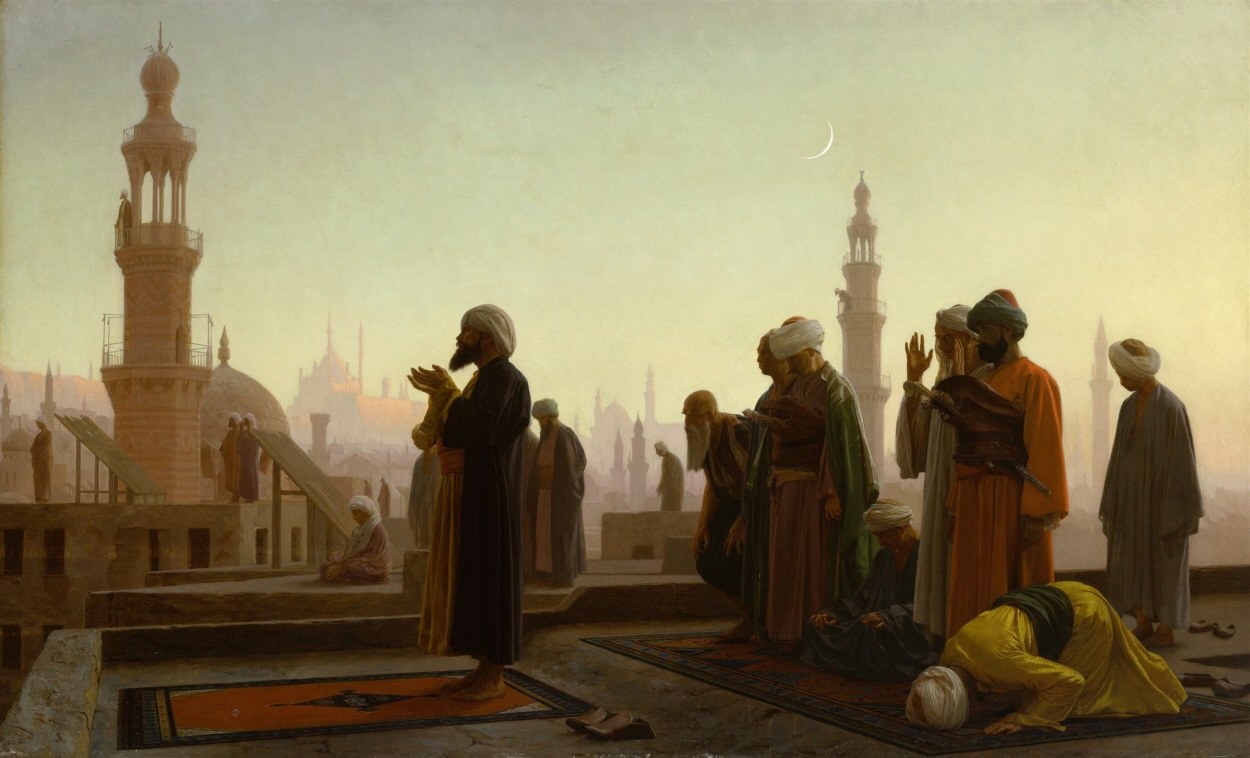
French: La prière au CairePrayer in Cairo. Image: Jean-Léon Gérôme · Public domain · Wikimedia Commons, accessed 2026-08-04
Academic Art refers not to a single style so much as the official, institutionally sanctioned tradition of painting taught in Europe's state art academies, above all the École des Beaux-Arts in Paris, and rewarded through the annual Salon exhibition system that dominated the French art world through most of the nineteenth century. It represents technical polish, idealized form, and a strict hierarchy of subject matter carried forward from Renaissance and Neoclassical tradition, in which history, mythological, and religious painting ranked above portraiture, genre scenes, still life, and landscape.
Academic paintings are typically smooth, meticulously finished, and anatomically idealized, with brushwork suppressed almost entirely in favor of a seamless, almost photographic surface. Subjects draw heavily on classical mythology, ancient history, and religious narrative, often featuring idealized nude or classically draped figures posed with theatrical clarity. William-Adolphe Bouguereau's luminous, flawlessly rendered nudes and Alexandre Cabanel's Birth of Venus exemplify the style's combination of technical virtuosity and idealized, sometimes eroticized, classical subject matter. Jean-Léon Gérôme extended academic precision into meticulously researched historical and Orientalist scenes.
Academic Art was not itself a rebellion against anything; rather, it was the establishment against which nearly every major avant-garde movement of the century defined itself in opposition. Realism rejected its idealization in favor of unflattering observed truth; Impressionism rejected its smooth finish and mythological subject matter in favor of loose brushwork and modern life; Symbolism rejected its literalism in favor of suggestion and mystery. The academic system controlled access to state commissions, exhibition space, and critical legitimacy for most of the century, making rejection from the Salon a real professional obstacle that fueled the formation of independent and avant-garde exhibitions.
Academic Art matters today less as an admired style in its own right than as the essential foil against which the story of modern art is usually told. Understanding its technical standards, its subject hierarchy, and its institutional power is necessary to understand why Impressionists, Post-Impressionists, and other avant-garde painters made the specific choices they did—choices that were often direct, deliberate rejections of what the academies taught and rewarded.
What defines Academic Art
Smooth, seamless finish
Brushwork is almost entirely suppressed, producing a highly polished, near-photographic surface in which individual strokes are invisible, prized as evidence of technical mastery.
Idealized anatomy and form
Figures, especially nudes, are rendered with flawless, classically proportioned bodies rather than individualized or imperfect physical truth, continuing a tradition traced back to Greco-Roman sculpture.
Mythological, historical, and religious subject matter
Subjects draw on classical mythology, ancient and biblical history, and allegory, ranked at the top of the academic hierarchy of genres above portraiture, genre painting, and landscape.
Careful, theatrical composition
Figures and scenes are arranged with clear staging, legible gesture, and often pyramidal or classically balanced groupings, designed for immediate narrative comprehension.
Rigorous technical training pedigree
Artists typically progressed through standardized academic training—drawing from plaster casts and live models, anatomical study, and competition for prizes such as the Prix de Rome—producing consistent technical polish across practitioners.
Salon-scale exhibition ambition
Works were frequently large and designed to command attention within the crowded, densely hung walls of the annual Paris Salon, competing for jury approval and public and critical acclaim.
History
Academic Art's institutional roots trace back to the founding of European royal and state art academies in the 1600s and 1700s, but it reached its most codified and culturally dominant form in nineteenth-century France, centered on the École des Beaux-Arts and the annual Paris Salon, the official juried exhibition that functioned as the primary gateway to professional recognition, patronage, and state commissions.
Through the middle decades of the century, academic painters such as William-Adolphe Bouguereau, Alexandre Cabanel, and Jean-Léon Gérôme achieved enormous contemporary success and wealth, their technically dazzling, idealized canvases consistently favored by Salon juries and popular with buyers, including the rapidly expanding bourgeois art market. Their prestige and institutional power meant that academic standards effectively defined what counted as serious, accomplished painting for most of the general public and critical establishment.
This institutional dominance provoked increasing resistance from artists working outside or against academic norms. The Salon des Refusés of 1863, organized after an unusually large number of rejected works prompted public outcry, became a pivotal early symbol of the growing rift, showcasing works—including Manet's Le Déjeuner sur l'herbe—that the academic jury had refused. Realism, and later Impressionism, defined themselves substantially through opposition to academic subject matter, finish, and institutional gatekeeping, eventually building independent exhibition structures that bypassed the Salon system entirely.
By the final decades of the nineteenth century, avant-garde movements had begun to eclipse academic painting in critical and historical esteem, even as academic artists retained considerable popular and commercial success into the early twentieth century. Twentieth-century modernist historiography then largely wrote academic painters out of the canon, treating them as a conservative rearguard rather than serious artists. Only from the later twentieth century onward has scholarly and market interest in academic painting seen meaningful reassessment, recognizing its genuine technical achievement even while it remains understood as the establishment tradition that modern art defined itself against.
Key works
| Work | Artist | Year | Why it matters |
|---|---|---|---|
| The Birth of Venus | Alexandre Cabanel | 1863 | A polished, idealized mythological nude that epitomizes academic technical finish and classical subject matter, famously purchased by Napoleon III. |
| Nymphs and Satyr | William-Adolphe Bouguereau | 1873 | A large mythological scene showcasing Bouguereau's flawless anatomical rendering and smooth academic finish. |
| Pollice Verso | Jean-Léon Gérôme | 1872 | A meticulously researched ancient Roman gladiatorial scene exemplifying academic historical precision and dramatic staging. |
How to make art in this style
Painting in the Academic Style Today
Palette: Use a controlled, naturalistic palette built from careful tonal modeling rather than bold or expressive color—warm flesh tones, rich but restrained backgrounds, and classical drapery colors like deep red, blue, or gold. Color should serve accurate representation and mood, not draw attention to itself.
Composition: Stage figures with clear, legible arrangement—often pyramidal or classically balanced groupings—so the narrative or subject reads immediately and unambiguously. Draw on mythological, historical, biblical, or allegorical themes if aiming for full academic fidelity, and give the composition a sense of theatrical, deliberate staging rather than a casual or spontaneous glimpse.
Technique: Prioritize a smooth, seamless finish in which individual brushstrokes are minimized or invisible, built through careful layering and glazing rather than direct, visible strokes. Ground the work in rigorous underlying drawing and anatomical accuracy; academic technique depends on precise structural understanding of the body before any surface polish is applied. Study classical sculpture and live models closely to achieve idealized, correctly proportioned anatomy.
Subjects: Choose subjects that reward idealization and narrative clarity—mythological scenes, historical episodes, allegorical figures, or classically posed portraits and nudes. Aim for flawless, harmonious beauty in figures rather than individualized imperfection; academic tradition prizes idealized form over the specific, observed truth that Realism and later movements would instead pursue.
Legacy
Academic Art's most significant legacy is paradoxical: it survives largely as the establishment against which the modern art movement defined its own identity. Nearly every major avant-garde development of the later nineteenth and early twentieth centuries—Realism, Impressionism, Post-Impressionism, Symbolism—articulated its innovations partly in explicit contrast to academic subject hierarchy, finish, and institutional control, meaning academic painting's shadow shaped modern art's self-understanding even as it was being rejected.
The rigorous technical training academic institutions provided, however, did not disappear; drawing, anatomy, and compositional discipline taught in academic settings continued to underpin the skill of artists who rebelled against academic content and style, and academic ateliers remained important training grounds even for artists who would go on to radical innovation.
In recent decades, academic painting has undergone a genuine critical and market reassessment, with museums and collectors increasingly recognizing its technical virtuosity on its own terms rather than dismissing it purely as conservative rearguard production. Contemporary realist and figurative painters, including practitioners in the classical realism and atelier movements, look directly to academic technique—careful anatomical study, glazing, and controlled tonal modeling—as a foundation worth reviving, even while working with contemporary subject matter far removed from the mythological themes academic painters favored.
Frequently asked questions
What is Academic Art?
Academic Art refers to the official, institutionally sanctioned style of painting taught in European state art academies and rewarded at exhibitions like the Paris Salon during the 19th century. It is defined by polished technical finish, idealized form, and mythological or historical subject matter.
Who were the major Academic Art painters?
William-Adolphe Bouguereau, Alexandre Cabanel, and Jean-Léon Gérôme are among the most celebrated academic painters, each achieving major Salon success through technically dazzling, idealized canvases.
Why did Impressionists reject Academic Art?
Impressionists rejected academic painting's smooth finish, idealized subject matter, and reliance on mythological and historical themes, choosing instead loose visible brushwork and scenes of ordinary modern life observed directly.
Is Academic Art the same as Neoclassicism?
They are related but distinct: Neoclassicism is an earlier, specific late-18th and early-19th-century movement emphasizing classical restraint and moral seriousness, while Academic Art is the broader institutional tradition, including Neoclassicism among its influences, that dominated official European taste through most of the 19th century.
Why is Academic Art less famous than Impressionism today?
Twentieth-century modernist art history largely favored the avant-garde movements that rebelled against academic convention, treating academic painters as a conservative establishment rather than pioneers, though recent decades have seen renewed appreciation for their technical achievement.