 Art
Art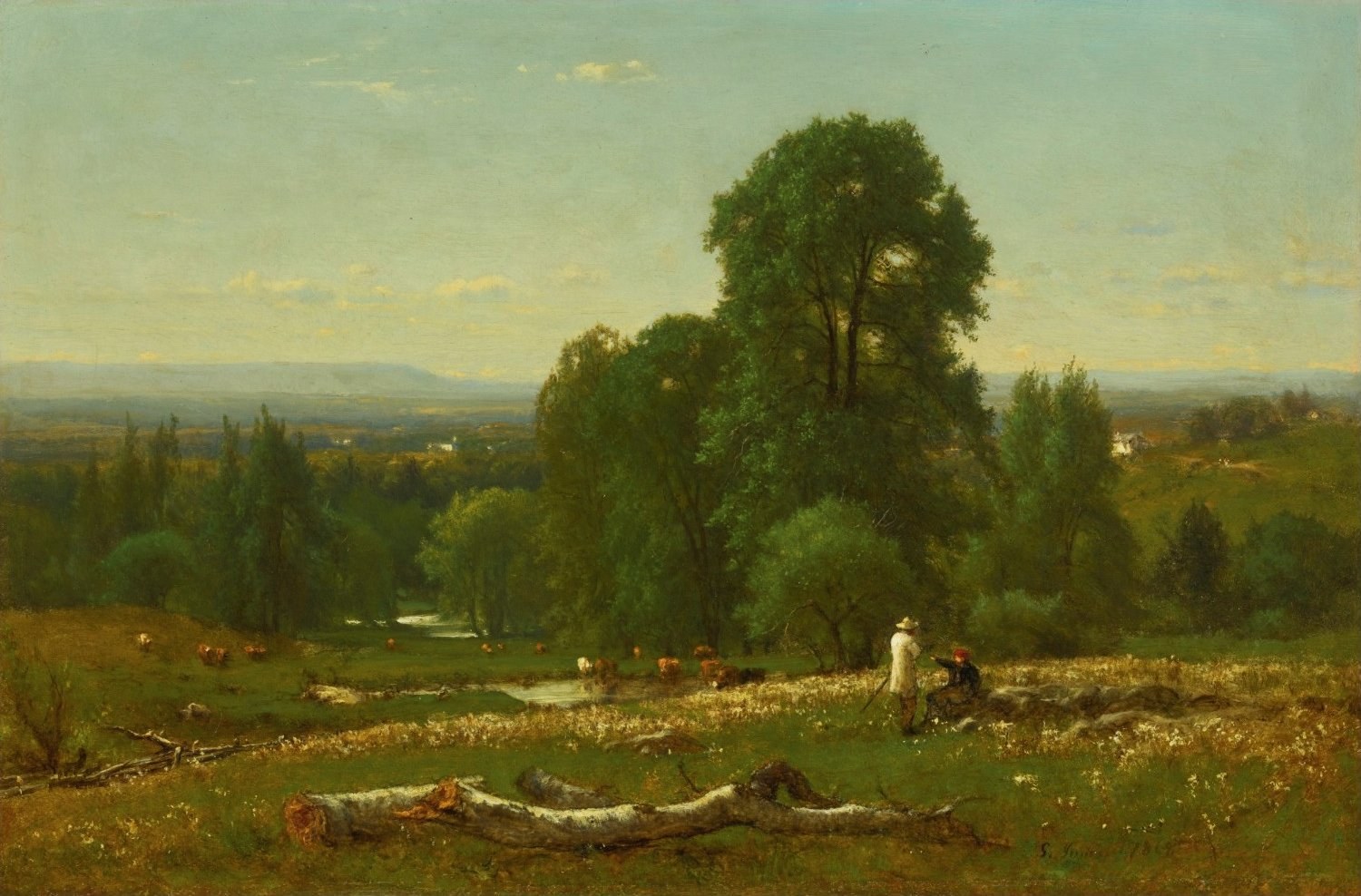
Landscape. Image: George Inness · Public domain · Wikimedia Commons, accessed 2026-08-04
The Hudson River School was the first coherent movement in American painting, active from roughly 1825 to 1875 and centered on the landscapes of the Hudson River Valley, the Catskills, and later the Rocky Mountains and South America. It was never a formal school with a manifesto; rather, it was a loose community of painters, based mainly in New York, who shared a conviction that the American wilderness was a subject as grand and morally significant as any European history painting.
The movement's paintings are typically large in scale, meticulously detailed, and organized around dramatic effects of light—sunrise breaking over a valley, storm clouds parting, golden late-afternoon haze settling on a lake. Figures, when present, are small against the landscape, emphasizing nature's scale and, often, an implicit narrative of settlement or discovery. Founder Thomas Cole treated the wilderness as a stage for meditations on time, mortality, and providence, sometimes through explicit allegorical cycles; his followers, including Frederic Edwin Church and Albert Bierstadt, pushed toward increasingly panoramic, almost theatrical spectacle, exhibiting single canvases as ticketed public events.
The movement rebelled against the assumption, inherited from Europe, that a young nation without ancient ruins or classical history had nothing worth painting. Hudson River School artists answered that America's wilderness itself—untouched, vast, sublime—was the equivalent of Europe's cathedrals and ruins, and arguably superior because it was still unspoiled. This idea drew directly on the aesthetic of the Sublime articulated by Romantic writers and painters in Britain and Germany, adapted to a distinctly American landscape and a distinctly American sense of providential purpose.
The Hudson River School matters because it gave the United States its first visual mythology of itself: a nation defined by its land, its light, and a belief that westward expansion was both natural and sanctioned. That mythology carried real political weight, feeding directly into the ideology of Manifest Destiny even as some of the school's later painters, especially Church, also worked to document and preserve wilderness before it vanished. The movement's technical achievement—an almost photographic command of atmospheric light—remains a benchmark for landscape painting, and its images still shape how Americans picture their own continent.
What defines Hudson River School
Dramatic, idealized light
Sunrise, sunset, and storm-break moments dominate, rendered with a luminous, almost glowing precision. Light functions as both technical showpiece and symbolic device, standing in for divine presence or providential favor.
Panoramic, large-scale canvases
Many major works were painted at exhibition scale, several feet wide, designed to be viewed as immersive public spectacles rather than intimate domestic paintings. Some were toured and exhibited for paid admission.
Minute topographical detail
Foliage, rock strata, and water are rendered with careful, near-scientific observation, often based on outdoor sketching trips even though final canvases were composed in the studio.
Small human presence
Figures, when included, are dwarfed by their surroundings, emphasizing the scale and power of the wilderness over any individual human drama.
Composite, idealized composition
Scenes often combine elements sketched from different real locations into a single invented view, arranged for maximum compositional and emotional effect rather than strict topographical accuracy.
Moral and allegorical undertones
Especially in Cole's work, landscapes carry implicit narratives about civilization's rise and fall, the passage of time, or divine order, even when no explicit story is stated.
History
The Hudson River School began around 1825, when English-born Thomas Cole exhibited landscapes of the Catskill Mountains in New York that immediately drew attention for their combination of topographical fidelity and Romantic grandeur. Cole's success established landscape painting, previously considered a minor genre in America, as a vehicle for serious artistic and national ambition.
Cole's friends and followers, notably Asher Brown Durand, carried the approach forward through the 1830s and 1840s, developing a shared practice of summer sketching trips into the Catskills, White Mountains, and Adirondacks followed by studio composition of finished paintings. Durand's 1849 painting Kindred Spirits, showing Cole and the poet William Cullen Bryant in a Catskill gorge, became an emblem of the movement's link between landscape, poetry, and national identity.
A second generation expanded the movement's geographic and thematic ambition considerably. Frederic Edwin Church traveled to South America and the Arctic, producing enormous, almost operatic canvases exhibited as single-work public spectacles that drew large paying crowds. Albert Bierstadt did similar work with the Rocky Mountains and Yosemite, his paintings helping to build public and political support for the American conservation movement, including the eventual establishment of national parks.
By the 1870s, the movement's popularity was fading. American taste was shifting toward the softer, more atmospheric approach of the Barbizon School and, later, Impressionism, and critics increasingly found the Hudson River School's grand theatricality old-fashioned next to newer European trends. The movement had no formal end date; it simply dissolved as its leading figures aged and died and younger American painters looked to Paris rather than the Catskills for their models. It remains, however, the foundational chapter of American landscape painting, the reference point against which later American approaches to nature and national identity are still measured.
Key works
| Work | Artist | Year | Why it matters |
|---|---|---|---|
| The Oxbow (View from Mount Holyoke) | Thomas Cole | 1836 | A sweeping panorama contrasting wild storm-swept wilderness with cultivated farmland, read as a meditation on America's relationship to nature. |
| Kindred Spirits | Asher Brown Durand | 1849 | A tribute to Thomas Cole showing him with poet William Cullen Bryant in a Catskill landscape, cementing the movement's link between painting and national poetic identity. |
| The Heart of the Andes | Frederic Edwin Church | 1859 | A monumental South American panorama exhibited as a paid public spectacle, exemplifying the movement's theatrical scale and ambition. |
| Among the Sierra Nevada, California | Albert Bierstadt | 1868 | A luminous, idealized vision of the American West that helped shape public imagination of the frontier as sublime and sacred. |
| The Course of Empire (series) | Thomas Cole | 1836 | A five-painting allegorical cycle tracing a civilization's rise and fall, revealing the moralizing ambition underlying Cole's landscape practice. |
How to make art in this style
Painting in the Hudson River School Style Today
Palette: Favor warm, glowing earth tones—amber, gold, russet, and deep green—concentrated around a dramatic light source, whether a rising or setting sun. Skies often shift from pale gold near the horizon to cooler blues or violets higher up; water should reflect and intensify the sky's warmth. Keep foreground shadow areas rich and dark to heighten the contrast with illuminated passages.
Composition: Build a layered, receding composition: a detailed foreground of rock, foliage, or figures, a middle ground of valley or water, and a luminous, hazier background of mountains or sky. Position the main light source so it rakes across the scene, creating a clear focal point. Keep any human presence small and incidental relative to the landscape's scale.
Brushwork and technique: Work toward a smooth, highly finished surface with minimal visible brushstroke, particularly in skies and distant elements—the period's finish is closer to glazed precision than to loose, gestural paint handling. Reserve more textured, detailed brushwork for foreground elements like rocks, tree bark, and foliage, where close observation should be evident.
Subjects: Choose expansive natural subjects—mountain valleys, waterfalls, forests, lakes—ideally combining several real observed elements into one idealized, composed view rather than a strict single-location record. Consider building in a sense of narrative time: a storm clearing, dawn breaking, or the contrast between wild and cultivated land, echoing the movement's interest in landscape as moral and temporal metaphor rather than pure documentation.
Legacy
The Hudson River School established landscape painting as a vehicle for American national identity, a role it has never entirely relinquished. Its paintings helped build public support for wilderness conservation—Bierstadt's Yosemite canvases and Thomas Moran's Yellowstone watercolors circulated among the political circles that created the Yosemite Grant and the first national parks—linking American landscape art directly to the country's environmental movement from its earliest days.
The movement's visual habits persist throughout American popular imagery of the West and wilderness: the golden, sublime light; the small human figure dwarfed by vast terrain; the sense of land as both spiritual and national inheritance. These conventions echo through twentieth-century Western film cinematography, National Park Service imagery, and outdoor-brand advertising, all of which lean on a visual grammar the Hudson River School essentially invented.
Within art history, the movement is also studied critically today for its role in naturalizing westward expansion and erasing Indigenous presence from the landscapes it depicted as empty and providentially available. That tension—between genuine technical and aesthetic achievement and complicity in a particular national mythology—makes the Hudson River School a frequently revisited case study in how landscape painting can carry ideological weight. Its technical legacy, meanwhile, endures wherever painters seek to render atmospheric light and vast natural scale with comparable ambition and precision.
Frequently asked questions
What is the Hudson River School?
The Hudson River School was the first major American landscape painting movement, active from about 1825 to 1875, centered on the Hudson River Valley and Catskill Mountains before expanding to the American West and South America. It treated the American wilderness as a subject of national and spiritual significance.
Who founded the Hudson River School?
Thomas Cole is generally credited as the founder, beginning with landscapes of the Catskills exhibited in New York in 1825. His approach was carried forward and expanded by his pupil Frederic Edwin Church and by later painters working in the same vein, including Asher Brown Durand and Albert Bierstadt.
Is the Hudson River School a real school?
No, it was not a formal academy or institution but a loose, informal community of painters sharing similar subjects, methods, and a base in New York City. The name was coined later, originally as a somewhat dismissive critical label.
What is the difference between the Hudson River School and Luminism?
Luminism is often considered a related, more atmospheric offshoot focused on quiet, glassy light effects over water, with less dramatic composition and visible brushwork. The Hudson River School more broadly encompasses grander, more theatrical panoramic landscapes.
Why does the Hudson River School matter?
It established landscape painting as serious American art, built a visual mythology linking wilderness to national identity, and helped generate public support for early conservation efforts, including the creation of national parks.