 Art
Art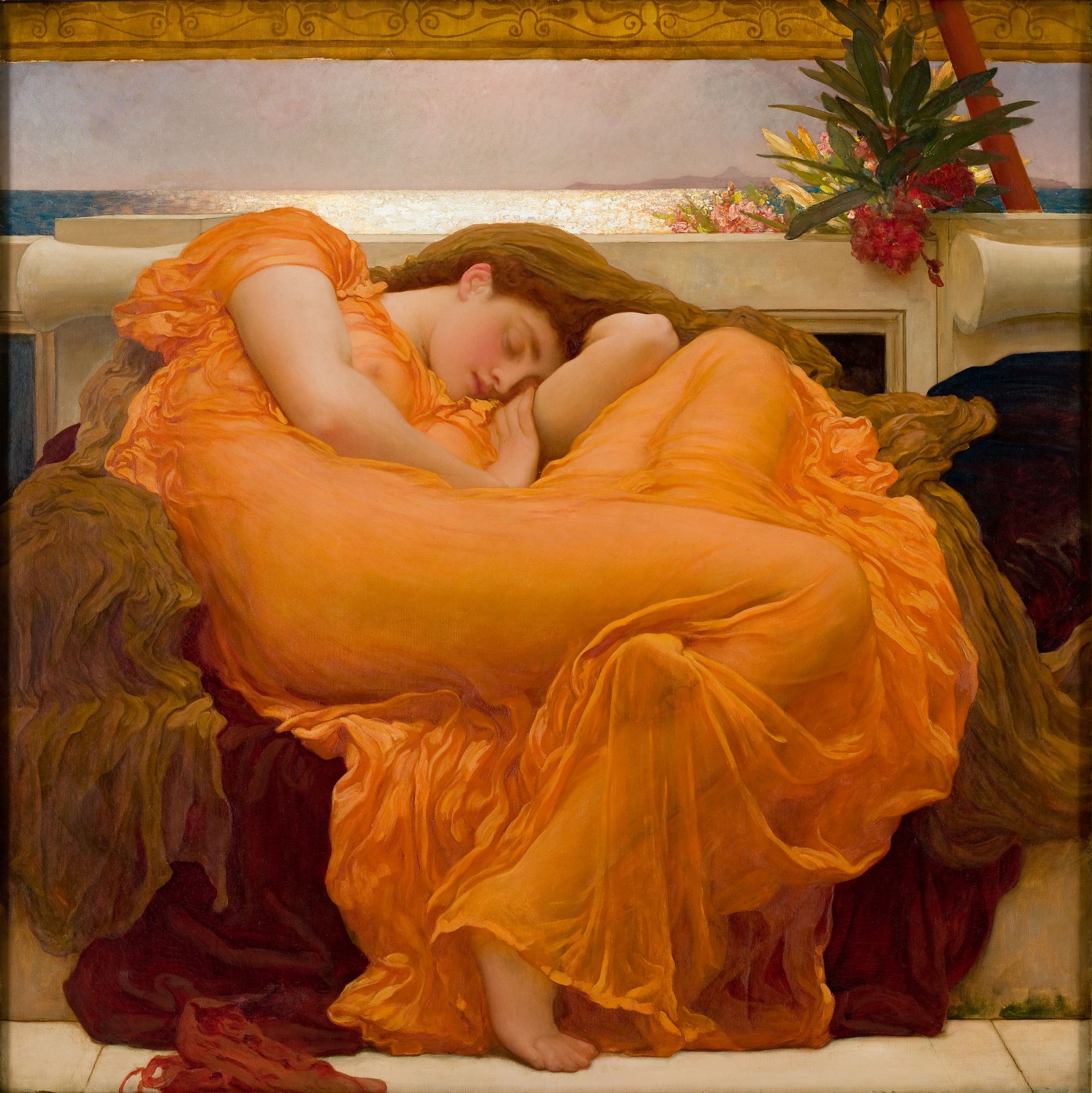
Flaming June. Image: Frederic Leighton · Public domain · Wikimedia Commons, accessed 2026-08-04
The Aesthetic Movement was a late-Victorian British cultural and artistic movement, running roughly from 1860 to 1900, built around the doctrine of art for art's sake, imported from French theorists like Theophile Gautier, which rejected the Victorian expectation that art should teach a moral lesson, illustrate narrative, or serve social improvement. Instead, aesthetes prized beauty, sensuous decorative effect, harmony of color and form, and mood as ends in themselves.
The movement's reach extended well beyond painting into interior design, furniture, textiles, ceramics, and dress, embracing what came to be called the House Beautiful ideal and finding its most visible literary spokesman in Oscar Wilde. Its visual sources absorbed influences from Japonisme, flattened pattern and asymmetry, from the Pre-Raphaelites' sensuous color and medieval revivalism, and from classical antiquity in the languid figures of painters like Frederic Leighton and Albert Moore. Its ambitions extended to book design and typography as well, with figures loosely aligned to the movement producing finely printed volumes and illustrated editions that treated the whole book as a decorative object.
The Aesthetic Movement rebelled against Victorian moralizing narrative painting and the utilitarian, industrial ugliness of the age, implicitly pushing against a strict academic hierarchy that ranked history painting above pure decoration. James McNeill Whistler became its most forceful visual advocate, his musically titled Nocturnes and Symphonies asserting painting's autonomy from subject matter, a claim most famously tested in his 1878 libel suit against critic John Ruskin. The movement matters because it was an early and influential assertion of artistic autonomy, the idea that a work's value lies in formal beauty and mood rather than subject or message, anticipating modernist formalism, and because it fused fine art with interior design and fashion in a way that shaped domestic taste broadly, giving Victorian Britain a recognizable, sometimes satirized, aesthetic interior of peacock feathers, blue-and-white china, sunflowers, and Japanese fans.
What defines Aesthetic Movement
Art for art's sake
The movement rejected the Victorian expectation that art teach a moral lesson or tell an improving story, insisting instead that beauty, harmony, and mood were sufficient ends in themselves.
Musical, mood-based titles
Whistler titled paintings Nocturnes, Symphonies, and Harmonies after musical forms, foregrounding tonal arrangement and mood over subject matter or narrative.
Classicizing, languid figures
Painters like Frederic Leighton and Albert Moore depicted idealized single figures or small groups in flowing classical drapery, drained of narrative urgency and treated as pure decorative harmony.
Japonisme-inflected pattern
Flattened space, decorative motif, and actual Japanese objects, fans, screens, blue-and-white porcelain, appear throughout aesthetic painting and interior design, absorbed from the parallel craze for Japanese art.
Cross-media House Beautiful ideal
The movement extended beyond painting into furniture, wallpaper, textiles, ceramics, and dress, promoting a unified aesthetic environment rather than confining beauty to the picture frame.
Restrained, harmonized palettes
Muted, closely related color schemes, blues, greens, and golds, were chosen for overall tonal harmony rather than realistic description, reinforcing the movement's musical analogy.
History
Roots trace to mid-19th-century critical theory imported from France, particularly Gautier's argument for art for art's sake, and to the sensuous color and medievalism of the Pre-Raphaelites, particularly Dante Gabriel Rossetti's later, more decorative work. Whistler, an American expatriate in London, became the movement's most forceful visual advocate through the 1860s and 1870s, developing his tonal Nocturne and Symphony series and designing the Peacock Room interior in 1876 to 1877 as a total aesthetic environment.
The movement's defining public controversy came in 1877, when critic John Ruskin accused Whistler of flinging a pot of paint in the public's face over his painting Nocturne in Black and Gold: The Falling Rocket. Whistler sued for libel and won the 1878 case, though the derisory damages and legal costs contributed to his bankruptcy soon after, the trial nonetheless became a landmark public argument for art's independence from didactic purpose.
The movement spread through the 1870s and 1880s via figures like Frederic Leighton and Albert Moore, whose classical decorative figures embodied the same principle in a different register, and popular taste-makers who furnished fashionable homes with blue-and-white porcelain, peacock feathers, and Japanese fans. Oscar Wilde became its most visible literary spokesman and popular caricature, including a lecture tour of the United States in 1882, while satirical publications and the operetta Patience, from 1881, lampooned aesthetic affectation for a broad public.
By the 1890s, the movement's sensibility fed into and blurred with the more decadent, continental-inflected Symbolism and the emerging Art Nouveau; its distinct identity faded as a self-conscious movement even as its taste for harmony, pattern, and design-conscious living persisted into the early 20th century.
Key works
| Work | Artist | Year | Why it matters |
|---|---|---|---|
| Nocturne in Black and Gold: The Falling Rocket | James McNeill Whistler | 1875 | The painting at the center of Whistler's 1878 libel trial against John Ruskin, a landmark defense of art's independence from subject matter. |
| Symphony in White, No. 1: The White Girl | James McNeill Whistler | 1862 | An early example of Whistler's musically titled approach, prioritizing tonal harmony over narrative or portrait convention. |
| Harmony in Blue and Gold: The Peacock Room | James McNeill Whistler | 1876 | A complete decorative interior scheme demonstrating the movement's ambition to unify painting, design, and architecture. |
| Flaming June | Frederic Leighton | 1895 | A late, celebrated example of classicizing decorative figure painting, prized purely for its color and formal harmony. |
How to make art in this style
Palette. Choose a narrow, harmonized color family, a range of blues and golds, or greens and greys, and let every element in the composition serve that overall harmony rather than literal color description. Think in terms of a single dominant hue with closely related variations.
Composition. Prioritize arrangement, pattern, and mood over narrative content. A single figure in a considered pose, a quiet interior, or a twilight view can carry a whole composition without needing a story to justify it.
Technique. For a tonal, nocturne-like approach, work with soft, blended, atmospheric brushwork and low contrast; for a decorative, classicizing figure, use crisp contour and smooth modeling. Either approach should prioritize overall visual harmony over descriptive accuracy.
Motif and setting. Incorporate decorative elements, patterned textiles, fans, flowers, peacock feathers, as integrated design features rather than incidental props, and consider how a piece relates to its intended setting, since the movement treated interiors and objects as part of a single aesthetic whole. A single well-chosen object, a fan, a blossom, a piece of blue-and-white porcelain, can anchor an entire color scheme.
Naming and framing. Consider titling a piece in formal or musical terms, a study, a harmony, an arrangement, to keep the viewer's attention on tone, color, and arrangement rather than subject or story.
Legacy
The Aesthetic Movement offered an early and influential claim for art's formal autonomy from narrative and moral duty, anticipating 20th-century modernist formalism's emphasis on color, tone, and composition as subject in themselves. Its fusion of fine art with interior design and fashion shaped the whole idea of a coordinated aesthetic domestic environment, still recognizable in later design movements and in today's curated interiors. Its cross-media reach also anticipated the modern idea of coordinated lifestyle design, in which a single aesthetic sensibility governs everything from a painting to a piece of furniture to a fashion choice.
Whistler's tonal harmonies and restrained palettes influenced American Tonalist painting and later 20th-century interest in mood-driven abstraction. The movement's association with decadence and dandyism, embodied by Oscar Wilde, remains a touchstone for discussions of art, style, and identity in Victorian culture, and its art for art's sake argument continues to underlie debates about art's purpose today, whether art must serve a message or can justify itself through beauty and form alone.
Frequently asked questions
What is the Aesthetic Movement?
The Aesthetic Movement was a late-Victorian British movement, active roughly from 1860 to 1900, built on the principle of art for art's sake, the idea that beauty and formal harmony were sufficient justification for art, without any need for moral or narrative content.
What does art for art's sake mean?
It is the belief that a work of art's value lies in its own beauty, form, and mood, rather than in any moral lesson, story, or social usefulness it might provide, a direct challenge to Victorian expectations that art should educate or improve its audience.
Aesthetic Movement vs Pre-Raphaelites, what's the difference?
The Pre-Raphaelite Brotherhood, active from 1848, combined detailed naturalism with often moralizing or literary subject matter. The Aesthetic Movement grew partly out of the Pre-Raphaelites' later, more decorative phase but explicitly dropped the moral and narrative content in favor of pure formal beauty.
Who was the leading painter of the Aesthetic Movement?
James McNeill Whistler is generally considered the movement's most influential painter, particularly through his tonal Nocturne series and his 1878 libel trial against critic John Ruskin, which became a landmark public defense of art's independence from subject matter.
What was the Whistler v. Ruskin trial?
In 1877, critic John Ruskin accused Whistler of flinging a pot of paint in the public's face over his painting Nocturne in Black and Gold: The Falling Rocket. Whistler sued for libel and won in 1878, though the token damages awarded and his own legal costs contributed to his bankruptcy soon after.