 Art
Art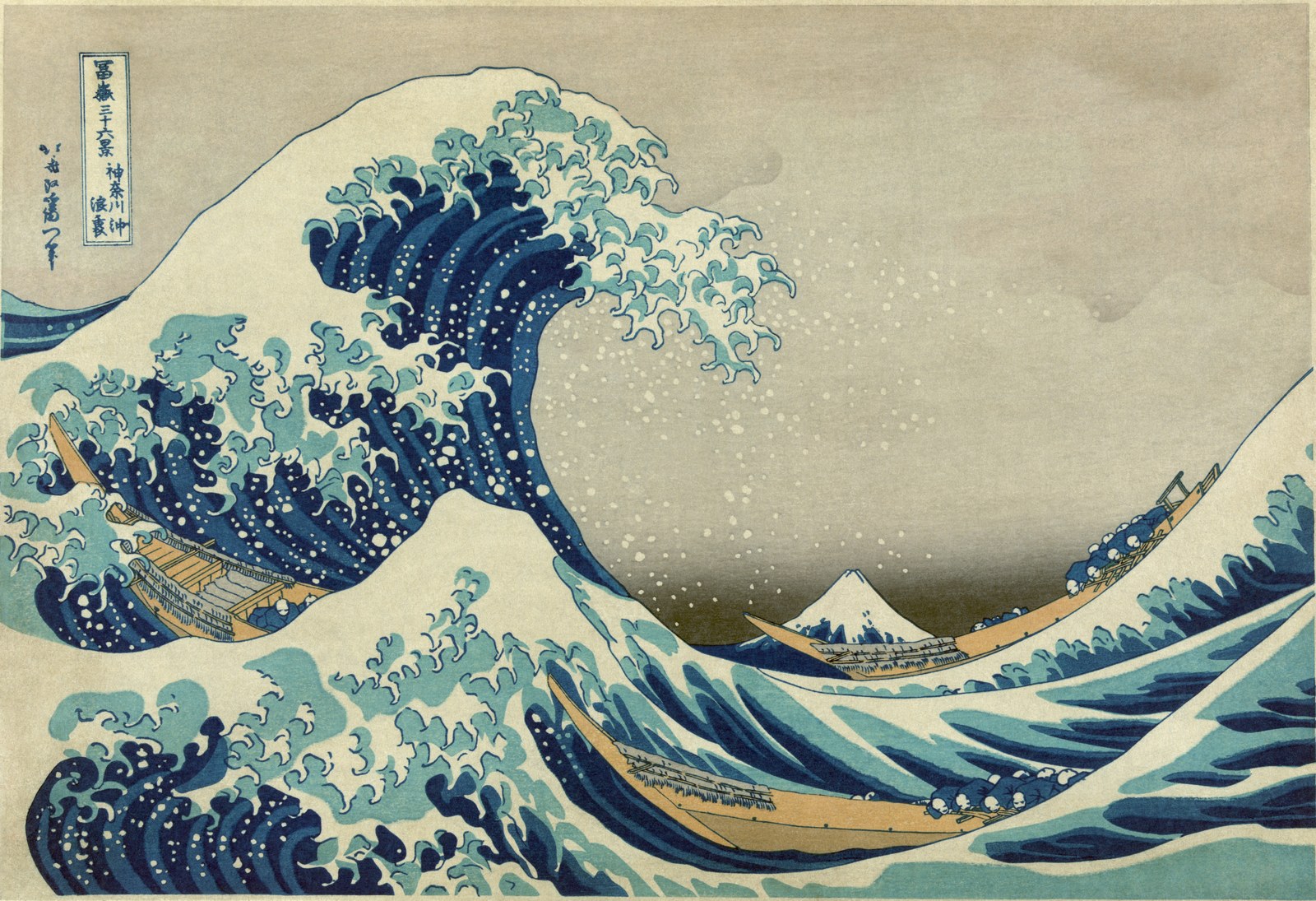
Japanese: 『神奈川沖浪裏』 - Kanagawa oki nami ura. Image: After Katsushika Hokusai · Public domain · Wikimedia Commons, accessed 2026-08-04
Japonisme is not a movement with a shared studio practice but a broad cultural phenomenon, the enthusiastic European adoption and adaptation of Japanese aesthetics following Japan's forced opening to Western trade under the 1854 Convention of Kanagawa, after more than two centuries of largely closed borders. It is often distinguished from Japonaiserie, the practice of depicting Japanese objects, kimonos, fans, porcelain, as exotic props within an otherwise conventional Western painting. Japonisme describes a deeper absorption of Japanese compositional principles into an artist's own visual language: flattened space, cropped and asymmetrical framing, bold outline, decorative pattern, unmodulated color fields, and unusual vantage points borrowed from ukiyo-e prints. Beyond painting, Japonisme shaped ceramics, textiles, jewelry, and garden design, with department stores and specialist boutiques across Paris and London selling Japanese goods to a broad middle-class clientele eager to furnish a fashionably Japanese-inspired interior.
The context was rich with new exposure: the Paris Expositions Universelles of 1867 and 1878 featured Japanese pavilions and objects, and ukiyo-e prints circulated widely in Paris through dealers, with the art dealer Siegfried Bing becoming a particularly influential promoter of Japanese art. Japonisme represented a break from the entrenched Western tradition of illusionistic linear perspective, chiaroscuro modeling, and academic finish inherited from the Renaissance; Japanese prints offered an alternate, non-illusionistic pictorial logic that felt strikingly modern to painters searching for new formal approaches.
The phenomenon matters because it became one of the crucial catalysts for the formal innovations of Impressionism and Post-Impressionism and fed directly into Art Nouveau's decorative line and pattern. It stands as a pivotal case study in cross-cultural artistic exchange, one now examined with attention to questions of exoticism, cultural appropriation, and the real asymmetries of the historical encounter between an industrializing West and a newly opened Japan. Later scholarship has also examined how selectively European artists borrowed, adopting formal devices while frequently setting aside the specific cultural and religious meanings those devices carried in their original context.
What defines Japonisme
Flattened pictorial space
Artists reduced modeling and shading in favor of compressed depth and pattern, borrowing the flat picture plane characteristic of Japanese woodblock prints.
Asymmetrical, cropped framing
Compositions favor off-center subjects and figures or objects cut abruptly by the frame edge, a device borrowed directly from ukiyo-e rather than traditional Western centered composition.
Bold outline and flat color
Forms are defined by strong contour and filled with flat, unblended color areas rather than the graduated tonal modeling of academic painting.
Decorative motif and pattern
Cherry blossoms, cranes, waves, and other Japanese textile and print motifs appear worked into Western compositions, sometimes as background pattern and sometimes as the central subject.
Unusual, elevated viewpoints
Bird's-eye and tilted vantage points, adapted from Japanese prints, replace the fixed eye-level perspective standard in Western picture-making since the Renaissance.
Japanese objects as subject
Kimonos, fans, folding screens, and porcelain appear repeatedly as both subject matter and studio props, reflecting the broader European vogue for collecting Japanese goods.
History
Japan's two-century policy of near-total isolation ended with the 1854 Convention of Kanagawa, opening the country to Western trade; Japanese goods, including ukiyo-e prints, began reaching Europe through this new trade and through world's fairs, notably the Paris Expositions Universelles of 1867 and 1878, and the 1862 International Exhibition in London. Parisian dealers and shops specializing in Japanese goods multiplied through the 1860s and 1870s; the dealer and gallerist Siegfried Bing became a key promoter, publishing the journal Le Japon Artistique from 1888 to 1891 and later lending his gallery name, L'Art Nouveau, to the decorative movement Japonisme helped inspire.
Artists across Paris absorbed the aesthetic at different depths. James McNeill Whistler collected and depicted Japanese objects from the early 1860s, a phase closer to Japonaiserie. Claude Monet, Edgar Degas, and others incorporated Japanese compositional devices into otherwise Western subjects through the 1870s and 1880s. Vincent van Gogh, working in the later 1880s, directly copied Hiroshige prints and cited ukiyo-e as a model of clarity and color. Henri de Toulouse-Lautrec applied flat color and bold outline learned from Japanese prints to his poster designs of the 1890s. Mary Cassatt produced a celebrated 1890 to 1891 series of color prints directly modeled on ukiyo-e technique after seeing a major exhibition of Japanese prints in Paris in 1890.
The craze extended beyond painting into decorative arts, fashion, garden design, and architecture. By the 1890s and 1900s, Japonisme's formal vocabulary had been substantially absorbed into and superseded by Art Nouveau, and as direct novelty wore off, the distinct Japonisme label faded even as its influence persisted within mainstream modern art.
Key works
| Work | Artist | Year | Why it matters |
|---|---|---|---|
| La Princesse du pays de la porcelaine | James McNeill Whistler | 1864 | An early, direct example of Japanese-object fascination feeding into a Western painted portrait. |
| La Japonaise (Camille Monet in Japanese Costume) | Claude Monet | 1876 | A striking large-scale portrait built entirely around a Japanese kimono, showing the craze at its most literal. |
| Flowering Plum Orchard (after Hiroshige) | Vincent van Gogh | 1887 | A direct painted copy of a Hiroshige print, documenting how closely some artists studied ukiyo-e technique firsthand. |
| The Letter | Mary Cassatt | 1891 | Part of a ten-print color series in which Cassatt adapted Japanese woodblock composition and technique to her own subjects. |
| Divan Japonais | Henri de Toulouse-Lautrec | 1893 | A poster applying flat color and bold outline learned from Japanese prints to the modern medium of commercial advertising. |
How to make art in this style
Composition. Study how Japanese prints crop and frame their subjects, then apply the same logic to a Western scene; let a figure, branch, or object run off the edge of the frame, and place your focal point off-center rather than in the middle.
Space and perspective. Compress depth by overlapping flat planes of color rather than relying on linear perspective or atmospheric haze. Try an elevated or oblique vantage point looking down or across a scene rather than a fixed eye-level view.
Line and color. Outline forms with confident, continuous line and fill with flat, saturated color rather than blended tonal modeling. Limit your palette and let color areas read as distinct shapes.
Pattern. Introduce a decorative element deliberately, a patterned textile, wallpaper, or stretch of foliage, and treat it as rhythmic surface design rather than naturalistic texture.
Subjects. Everyday Western subjects, a portrait, a garden, an interior, work well reframed this way; an explicitly Japanese subject is not required to apply the sensibility. Garden and still-life subjects also lend themselves well to the approach, letting a single branch, blossom, or vessel carry the whole composition. If including actual Japanese objects such as fans or screens, treat them as compositional devices, shape and pattern, rather than exotic props.
Legacy
Japonisme was a foundational influence on Impressionism and Post-Impressionism's formal innovations and, through Art Nouveau, on the whole decorative-arts vocabulary of the 1890s and 1900s, its whiplash line, flattened pattern, and asymmetry. Its taste for graphic clarity and bold outline fed directly into the modern poster and later 20th-century graphic design; Toulouse-Lautrec's poster designs of the 1890s translated the same flat-color, bold-outline vocabulary into mass-produced commercial art, a lineage that runs forward into modern branding and editorial illustration.
The cross-cultural encounter it represents remains a touchstone in discussions of how modern Western art absorbed non-Western sources, prompting ongoing scholarly reassessment of credit, exoticism, and exchange. Its visual habits, cropped framing, flattened space, decorative pattern, are now so embedded in Western visual culture as to be nearly invisible, still detectable in editorial design, branding, and illustration today. Fashion and interior design absorbed Japonisme just as thoroughly as fine art, embedding kimono-inspired silhouettes, asymmetrical layout, and Japanese-derived motifs into Western decorative taste well into the 20th century, a diffusion so complete that many of its conventions are no longer recognized as having a specific origin.
Frequently asked questions
What is Japonisme?
Japonisme is the term for the wave of European fascination with Japanese art and design that followed Japan's opening to Western trade in 1854, encompassing everything from collecting Japanese objects to absorbing Japanese compositional principles into Western painting and design.
Japonisme vs Japonaiserie, what's the difference?
Japonaiserie refers to depicting Japanese objects, kimonos, fans, porcelain, as exotic props within an otherwise conventional Western painting. Japonisme describes a deeper absorption of Japanese compositional ideas, such as flattened space, cropping, and asymmetry, into an artist's own visual language.
How did Japonisme influence Impressionism?
Impressionist and Post-Impressionist painters adopted Japanese print devices, cropped framing, elevated viewpoints, flat color, and asymmetrical composition, which pushed their work further from academic illusionism and toward the flattened, pattern-conscious space associated with early modern painting.
Which artists were most influenced by Japonisme?
James McNeill Whistler, Claude Monet, Edgar Degas, Vincent van Gogh, Mary Cassatt, and Henri de Toulouse-Lautrec all directly engaged with Japanese prints and objects in their work, to varying degrees.
Did Japonisme lead to Art Nouveau?
Yes, in large part. Japonisme's flattened pattern, decorative line, and asymmetry fed directly into Art Nouveau's visual vocabulary during the 1890s, and dealer Siegfried Bing, a key promoter of Japanese art in Paris, lent his gallery's name, L'Art Nouveau, to the movement.