 Art
Art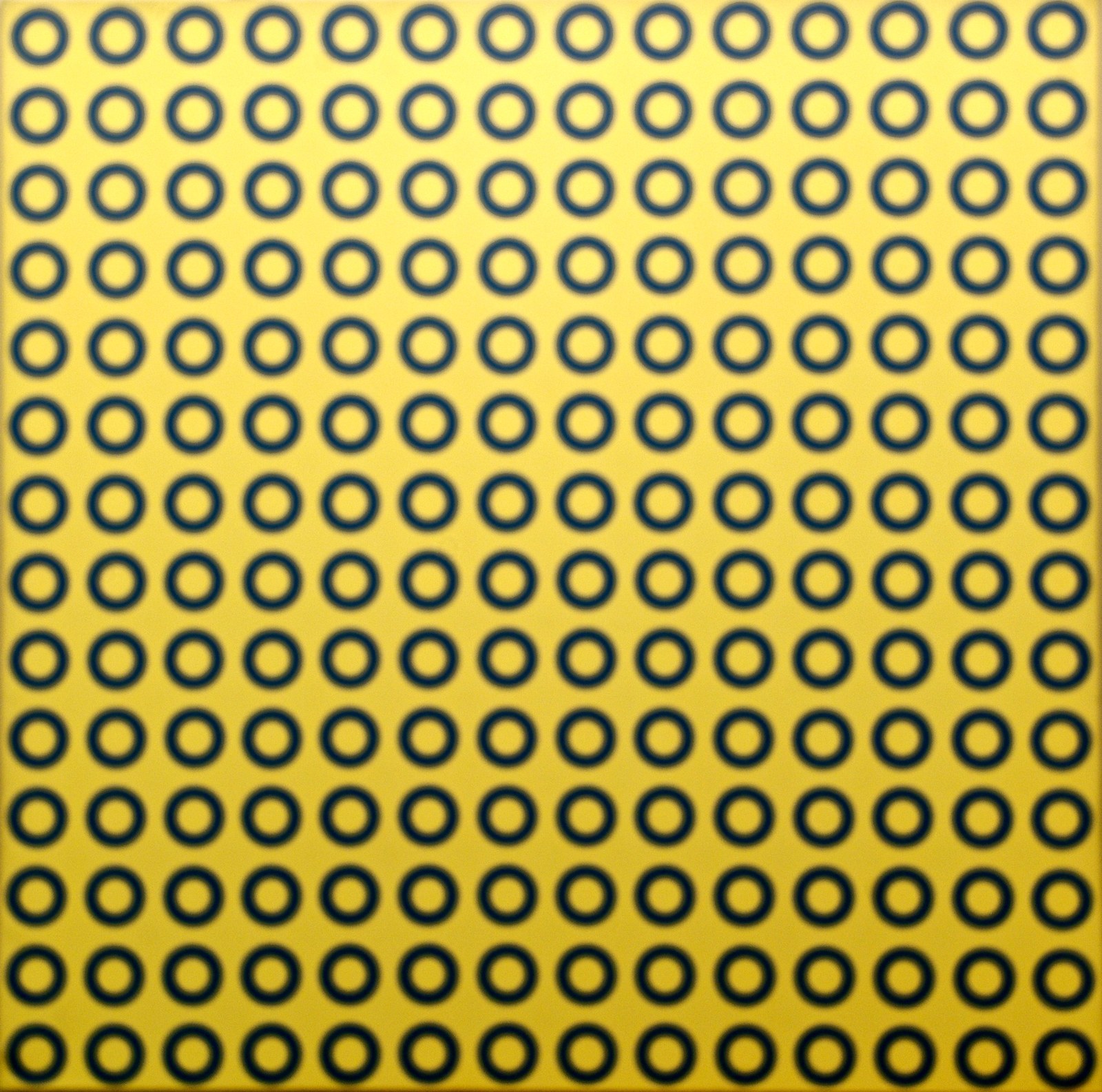
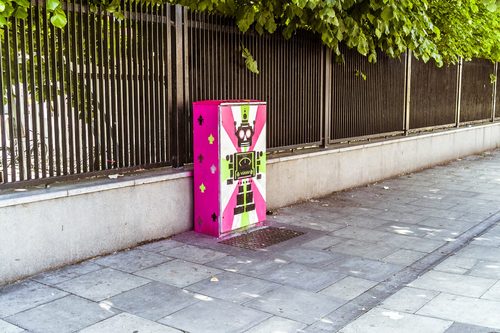
Douglas (1985-1986) - Olivier Mosset (1944) (45436477491). Image: Pedro Ribeiro Simões from Lisboa, Portugal · CC BY 2.0 · Wikimedia Commons, accessed 2026-08-04
Neo-Geo—short for Neo-Geometric Conceptualism—was a movement of painters and sculptors who surfaced in New York's East Village gallery scene in the early-to-mid 1980s. Where the decade's dominant style, Neo-Expressionism, prized raw gesture and emotional intensity, Neo-Geo artists went cold: hard edges, fluorescent color, and industrial finishes replaced visible brushwork, and geometric abstraction—the vocabulary of Minimalism, Op Art, and Constructivism—was revived not as pure form but as a loaded sign system to be quoted, recombined, and mocked.
The movement's key figures shared a fascination with how images circulate under capitalism. Peter Halley painted flat, neon-lit "cells" linked by pipe-like "conduits," a private iconography he read as a diagram of modern confinement—prison cells, apartments, computer terminals—wired together by unseen networks of power and information. Jeff Koons took the opposite tack, presenting unaltered consumer goods, from vacuum cleaners sealed in fluorescent-lit vitrines to inflatable toys cast in gleaming stainless steel, as sculpture requiring no transformation at all. Ashley Bickerton built wall-mounted constructions bristling with invented corporate logos, treating the artwork itself as a branded product. Across these different approaches ran a shared irony: geometric abstraction, once a vehicle for utopian spiritual or social ideals, was redeployed as a mirror held up to advertising, packaging, and the sealed glass surfaces of the modern city.
Neo-Geo rebelled specifically against the market for gestural, expressive painting that had dominated galleries since the late 1970s, and against the idea that abstraction was inherently pure or apolitical. Instead it treated geometric form as always already commercial—a design language shared by corporate logos, product packaging, and city grids as much as by museum abstraction. Critics grouped the artists loosely under labels including Neo-Geo, Neo-Conceptualism, and Commodity Art, and the work circulated through influential East Village and SoHo galleries before the market cooled toward the end of the decade.
The movement matters because it marked one of the first sustained attempts by painters to fold Pop Art's interest in consumer imagery and Conceptual Art's skepticism about authorship into the language of hard-edge abstraction itself, previewing the appropriation-heavy, market-aware strategies that would define much art of the following decades.
What defines Neo-Geo
Fluorescent, Industrial Color
Neo-Geo paintings favor Day-Glo and acid-bright hues—hot pink, acid yellow, electric blue—applied in flat, unmodulated fields. The palette borrows from commercial signage and packaging rather than the earth tones of traditional painting.
Hard-Edge Geometric Vocabulary
Grids, circles, and cell-like rectangles are rendered with taped, machine-precise edges. Forms are often connected by tube- or pipe-like "conduits," suggesting circuitry, plumbing, or confinement rather than pure abstraction.
Industrial Surface Texture
Rather than visible brushwork, Neo-Geo painters used rollers, masking tape, and textured commercial paints to produce a mechanical, storefront-like finish. The hand of the artist is deliberately effaced.
Readymade Commodities as Sculpture
Unaltered consumer objects—vacuum cleaners, basketballs, inflatable toys—were presented encased in vitrines or cast in stainless steel, requiring no formal transformation. The object's status as a manufactured commodity was the point.
Ironic Appropriation of Abstraction's History
The movement quoted Minimalism, Op Art, and Constructivism directly, but stripped these styles of their original spiritual or utopian claims, treating geometric form as a found commercial language.
Corporate and Branding Imagery
Invented logos, packaging motifs, and glossy display formats recur across the movement, framing the artwork itself as a product circulating within a market it simultaneously critiques.
History
Neo-Geo coalesced in New York's East Village around 1984–1986, in galleries such as International With Monument and later at Sonnabend Gallery in SoHo, which gave several of its key figures their first major shows. The term "Neo-Geometric Conceptualism" was coined by critics trying to describe painters who combined the flat geometry of Minimalism with the appropriation strategies of Conceptual Art—a combination that set them apart from the emotionally charged Neo-Expressionist painting that had dominated the market since the late 1970s.
Peter Halley emerged as the movement's most articulate theorist as well as its central painter, developing his "cell and conduit" imagery and writing essays that framed geometric abstraction as a diagram of postindustrial social control. Jeff Koons, working in parallel, moved from his early vacuum-cleaner vitrines through suspended-basketball sculptures to stainless-steel readymades, each body of work treating the commodity as sculpture. Ashley Bickerton and other artists associated with the scene extended the critique to corporate branding and the art market itself.
By the late 1980s the label had spread through art magazines and museum surveys, and the artists were increasingly discussed alongside European Simulationists making related arguments about images and commodities. The movement's commercial peak coincided with the booming late-1980s art market; when that market contracted sharply around 1990–1991, gallery support for the tightly knit Neo-Geo scene thinned quickly. Individual artists continued working long after—Koons in particular went on to build one of the most prominent careers in contemporary art—but Neo-Geo as a cohesive, named movement effectively dissolved by the early 1990s, absorbed into the broader, looser category of postmodern appropriation art.
Key works
| Work | Artist | Year | Why it matters |
|---|---|---|---|
| New Hoover Convertibles | Jeff Koons | 1981 | Unaltered vacuum cleaners sealed in fluorescent-lit vitrines, presenting the manufactured commodity as sculpture without formal transformation. |
| Rabbit | Jeff Koons | 1986 | A stainless-steel cast of an inflatable toy rabbit that became one of the era's most recognized images of commodity fetishism. |
| Tormented Self-Portrait (Susie at Arles) | Ashley Bickerton | 1988 | A wall-mounted construction covered in invented corporate logos, treating the artwork itself as a branded, marketable product. |
How to make art in this style
Working in a Neo-Geo Style
Palette: Reach for fluorescent and Day-Glo colors—acid yellow, hot pink, electric cyan, safety orange—set against black, white, or metallic gray grounds. Avoid blended or naturalistic tones; colors should read as manufactured rather than mixed by hand.
Composition: Build the image from hard-edge geometric units—rectangles, circles, grids—organized as discrete "cells" and linked by straight or curved "conduit" lines, evoking circuit boards, plumbing, or floor plans. Keep compositions frontal and diagrammatic rather than dynamic.
Technique: Mask edges with tape for razor-sharp boundaries and apply paint in flat, even coats using rollers or airbrush rather than visible brushstrokes. Textured commercial paints or synthetic finishes reinforce the industrial, storefront quality central to the style. Suppress any trace of the artist's hand.
Subjects: Treat manufactured goods—appliances, packaging, sporting equipment, corporate logos—as legitimate subject matter requiring no distortion; presenting an object plainly, perhaps behind glass or under gallery lighting, can itself be the artistic gesture. Invented brand marks and diagrammatic symbols for networks or confinement support the movement's core theme: geometric order as a lens on consumer culture.
Tone: Favor cool irony over sincerity. The strongest Neo-Geo-influenced work holds its critique of commodity culture at arm's length, presenting glossy, seductive surfaces that only reveal their satirical edge on reflection.
Legacy
Neo-Geo's central insight—that abstraction is never neutral, but always entangled with commerce, branding, and systems of power—became a durable premise for art made after it. Jeff Koons carried the movement's readymade-as-object logic into a decades-long career built on fabrication, spectacle, and market savvy, influencing a generation of artists who treat production value and branding as legitimate artistic material rather than a compromise. Peter Halley's cell-and-conduit paintings anticipated later art's fascination with networks, surveillance, and infrastructure, themes that only grew more urgent with the rise of digital culture.
More broadly, Neo-Geo helped normalize appropriation, irony, and cool detachment as viable modes for serious painting, paving the way for later artists who treated consumer imagery and corporate aesthetics as primary subject matter rather than as targets external to art. Its fluorescent, hard-edge visual language also resurfaces regularly in graphic design, fashion, and album art whenever designers reach for a "corporate futurist" or clinical mood. Though rarely exhibited today under its original name, Neo-Geo's fusion of geometric abstraction with commodity critique remains a reference point for artists examining branding, digital networks, and the aesthetics of consumer capitalism.
Frequently asked questions
What is Neo-Geo art?
Neo-Geo, short for Neo-Geometric Conceptualism, is a 1980s New York movement that revived hard-edge geometric abstraction as a vehicle for ironic commentary on consumer capitalism, using fluorescent color, industrial finishes, and readymade commodities.
Who founded Neo-Geo?
Peter Halley is usually credited as the movement's central figure and principal theorist, alongside artists like Jeff Koons and Ashley Bickerton, who showed together in New York's East Village galleries in the mid-1980s.
How is Neo-Geo different from Minimalism?
Minimalism treated geometric form as a pure, self-referential object, while Neo-Geo quoted that same vocabulary ironically, loading it with references to branding and commodities that Minimalism had deliberately excluded.
Is Jeff Koons a Neo-Geo artist?
Yes—Koons's early work, including his vitrine-encased vacuum cleaners and suspended basketballs, is closely associated with Neo-Geo's use of unaltered consumer objects as sculpture, though his later career expanded well beyond the movement's original circle.
Why did Neo-Geo end?
The tightly knit East Village and SoHo gallery scene that supported Neo-Geo largely collapsed when the art market contracted around 1990–1991; the movement dispersed into the broader category of postmodern appropriation art rather than ending abruptly.