 Art
Art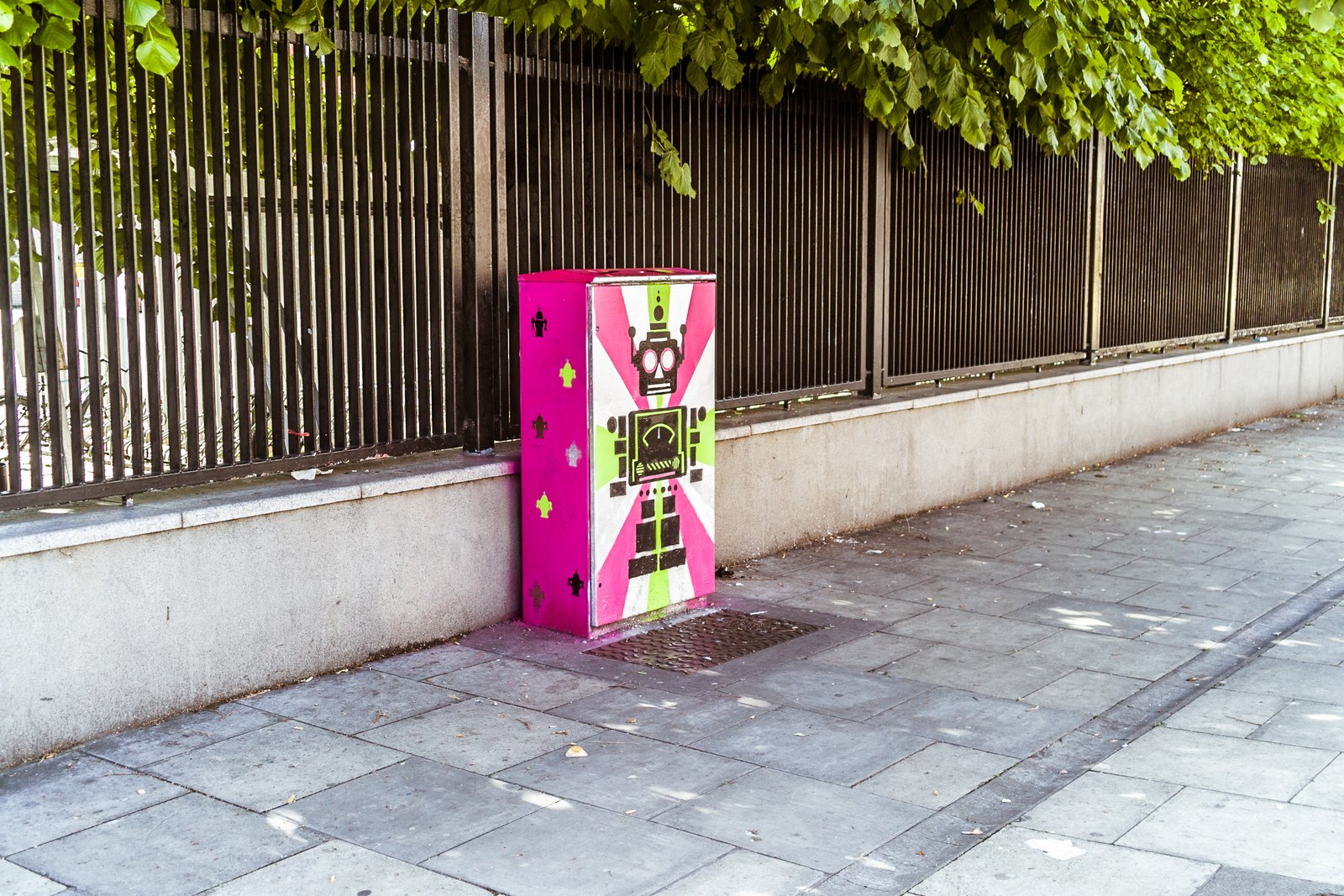
"Bolt On" The Robot - Street Art On Bolton Street (Anna Doran) (7334852754). Image: William Murphy from Dublin, Ireland · CC BY-SA 2.0 · Wikimedia Commons, accessed 2026-08-04
Street Art describes a broad, internationally diffuse family of public artmaking that grew out of graffiti culture in the 1980s but shifted its core techniques and aims. Where graffiti centers on stylized lettering and writer-culture reputation, street art favors imagery legible to any passerby, using stencils, wheatpaste posters, stickers, and large-scale murals to communicate quickly and often anonymously with a general public audience rather than primarily with other writers.
Visually, street art is defined less by a single style than by its methods and its relationship to public space. Stencils, pioneered in the form most associated with the movement by the French artist Blek le Rat in early-1980s Paris, allow an image to be reproduced quickly and repeatedly across a city with minimal time exposed to legal risk. Wheatpaste posters and stickers extend the same logic of rapid, repeatable dissemination. Large-scale murals, sometimes made legally with property owner or municipal permission, allow for more elaborate, often photorealistic or graphically bold imagery meant to transform an entire building facade. Humor, irony, and pointed political or social commentary are common threads, frequently addressing consumerism, war, surveillance, or authority directly and accessibly.
Anonymity and pseudonymity remain important, both as protection from legal consequences for unsanctioned work and, in the view of many observers, as a rejection of the individual-genius model of the traditional art market, even as several street artists, notably Banksy, built substantial global fame while maintaining anonymity. The movement treats the urban environment itself, not a gallery wall, as its primary exhibition context, often engineering works to interact directly with existing architecture, signage, or street furniture.
Street Art matters because it took graffiti's foundational insight — that public space could be claimed as an unsanctioned exhibition venue — and extended it toward a broader, more explicitly communicative and often overtly political practice aimed at general audiences rather than a specific subculture. Its eventual embrace by museums, auction houses, and municipal tourism campaigns represents one of contemporary art's most striking journeys from criminalized activity to institutionally celebrated and commercially valuable practice, a transition that remains actively debated within the movement itself.
What defines Street Art
Stencils for fast, repeatable imagery
Pre-cut stencils allow an artist to spray an identical image repeatedly across many locations in minimal time, reducing legal exposure while building citywide visual presence.
Wheatpaste posters and stickers
Paper posters adhered with wheat-based paste, along with printed stickers, allow rapid, low-cost dissemination of an image across many surfaces without on-site painting.
Large-scale murals
Where graffiti favored trains and walls painted quickly and often illegally, street art increasingly includes large, sometimes legally commissioned murals covering entire building facades with elaborate imagery.
Anonymity and pseudonymity
Many street artists work under invented names and conceal their identities, both for legal protection and as a stance against the individual-celebrity model of the conventional art market.
Site-specific engagement with urban architecture
Works are frequently designed to interact directly with existing walls, signage, drainpipes, or street furniture, making the specific location part of the work's meaning rather than an interchangeable backdrop.
Accessible political and social commentary
Humor, irony, and directly legible critique of consumerism, war, surveillance, or authority are common, aimed at communicating instantly with a general public audience rather than an art-world insider group.
History
Street Art's techniques trace substantially to early-1980s Paris, where Blek le Rat began stenciling life-size rat and figure imagery across the city, pioneering the fast, repeatable stencil approach that became one of the movement's signature methods. In the United States, Shepard Fairey launched his "Andre the Giant Has a Posse" sticker campaign in 1989 while a student, later evolving it into the widely recognized Obey Giant image, an early example of a street art campaign built around sticker and poster saturation rather than painted pieces.
Through the 1990s and 2000s, street art spread internationally and diversified technically, incorporating wheatpaste posters, elaborate stencil compositions, yarn-bombing, and large-scale murals alongside more graffiti-descended spray techniques. Banksy, working from Bristol and later internationally while maintaining public anonymity, became the movement's most commercially and culturally prominent figure through the 2000s, producing stenciled murals combining dark humor and political critique that circulated globally through photography and, eventually, social media, well beyond the physical location of any individual work.
Institutional recognition accelerated through the 2000s and 2010s: Tate Modern staged a major street art exhibition in 2008, and the Museum of Contemporary Art Los Angeles mounted "Art in the Streets" in 2011, signaling mainstream museum acceptance of a practice still substantially illegal in its original form. Commercial and market crossover followed, including gallery representation, branded corporate collaborations, and record-setting auction sales, most famously Banksy's 2018 stunt in which a print of "Girl with Balloon" partially self-shredded immediately after selling at auction, a widely covered commentary on the very market absorbing the work.
This institutional and commercial embrace generated ongoing tension within the movement between its anti-establishment origins and its increasing commodification, a debate street artists themselves frequently address directly in their work. Today street art spans a spectrum from illegal, ephemeral interventions to municipally commissioned murals and international mural festivals, with cities worldwide actively commissioning large-scale public murals as tourism and urban-renewal strategy.
Key works
| Work | Artist | Year | Why it matters |
|---|---|---|---|
| Girl with Balloon | Banksy | 2002 | A stenciled mural and later print image of a girl reaching for a heart-shaped balloon, among the artist's most widely reproduced works and the subject of a famous 2018 auction self-shredding. |
| Andre the Giant Has a Posse (Obey Giant) | Shepard Fairey | 1989 | A sticker and poster campaign begun while Fairey was a student, establishing the saturation-based sticker approach that became a street art hallmark. |
| Hope | Shepard Fairey | 2008 | A stylized portrait poster made during the 2008 US presidential campaign, one of the most widely circulated street-art-descended images in contemporary political culture. |
| Kissing Coppers | Banksy | 2004 | A stenciled mural depicting two police officers kissing, characteristic of the artist's use of authority-figure imagery for pointed social commentary. |
How to make art in this style
Working in a Street Art sensibility today
Choose a technique suited to fast, repeatable, or site-specific public installation, since method and context are as central to the movement as visual style.
Stencils. Cut a design from cardboard, acetate, or similar material so it can be reproduced quickly and consistently. Stencils favor bold, simplified imagery with clear positive and negative shapes, since fine detail is difficult to cut cleanly and to spray fast.
Palette. Favor bold, high-contrast color, often limited to two or three tones per stencil layer for speed and legibility. Black-and-white or black-and-single-accent-color combinations are common, especially for stenciled figures meant to read instantly from a distance.
Wheatpaste and stickers. Print or paint an image on paper, then adhere it with wheat-based paste (flour and water) to a wall, or produce a printed sticker for rapid, low-risk placement across many surfaces. This approach favors graphic, poster-like compositions with strong outlines.
Murals. For large-scale legal work, plan compositions that respond directly to the specific wall, window placement, or architectural features of the site rather than treating it as a blank rectangle.
Subjects. Political and social commentary, humor, irony, and recognizable pop-cultural or authority-figure imagery are traditional territory. Aim for instant legibility to a general passerby rather than insider-only meaning.
Practice note. Work only on walls with explicit permission from the property owner; legal community mural programs and sanctioned walls exist in most cities for practicing these techniques.
Legacy
Street Art completed graffiti's foundational move of treating public space as an unsanctioned exhibition venue, extending it into a globally recognized contemporary art category with its own museum surveys, market values, and dedicated festivals. Its stencil and wheatpaste techniques, valued for speed and reproducibility, have become standard reference points across activist graphics, protest art, and commercial guerrilla marketing well beyond gallery or museum contexts.
The movement's most visible figures, particularly Banksy and Shepard Fairey, achieved a level of global public recognition unusual for contemporary visual artists, carrying street art's political and satirical visual language into mainstream news coverage, social media circulation, and popular culture generally. Municipalities worldwide now actively commission large-scale murals as tourism and urban-renewal strategy, a striking reversal from the movement's origins in criminalized, unsanctioned public marking.
The unresolved tension between street art's anti-establishment roots and its subsequent institutional and commercial embrace remains one of contemporary art's most actively debated dynamics, with individual artists and works, including Banksy's own market interventions, frequently addressing that tension directly as ongoing subject matter rather than settled history.
Frequently asked questions
What is Street Art?
It is an internationally diffuse art movement that grew out of graffiti in the 1980s, using stencils, wheatpaste posters, stickers, and murals to communicate quickly and often anonymously with a broad public audience in public space.
What is the difference between graffiti and street art?
Graffiti centers on stylized lettering and reputation within writer culture, while street art uses a broader range of techniques like stencils and wheatpaste to create imagery aimed at a general public audience rather than primarily other writers.
Who is considered the founder of street art?
The French artist Blek le Rat is widely credited with pioneering the stencil technique most associated with the movement in early-1980s Paris, though the movement has no single founder and developed across multiple cities.
Why is Banksy anonymous?
Banksy has maintained anonymity primarily for legal protection, since much of the work is created without permission; many observers also read it as a stance against the celebrity-driven, individual-genius model of the conventional art market.
Is street art legal?
It depends on the work: unsanctioned pieces on private or public property without permission are generally illegal, while commissioned murals made with property owner or municipal approval are entirely legal and increasingly common.
How did street art become accepted by museums?
Major institutional exhibitions, including Tate Modern's 2008 street art show and MOCA Los Angeles's 2011 "Art in the Streets," along with rising auction prices for artists like Banksy, drove mainstream museum and market acceptance from the 2000s onward.