 Art
Art AI-generated
 AI-generated
 AI-generated
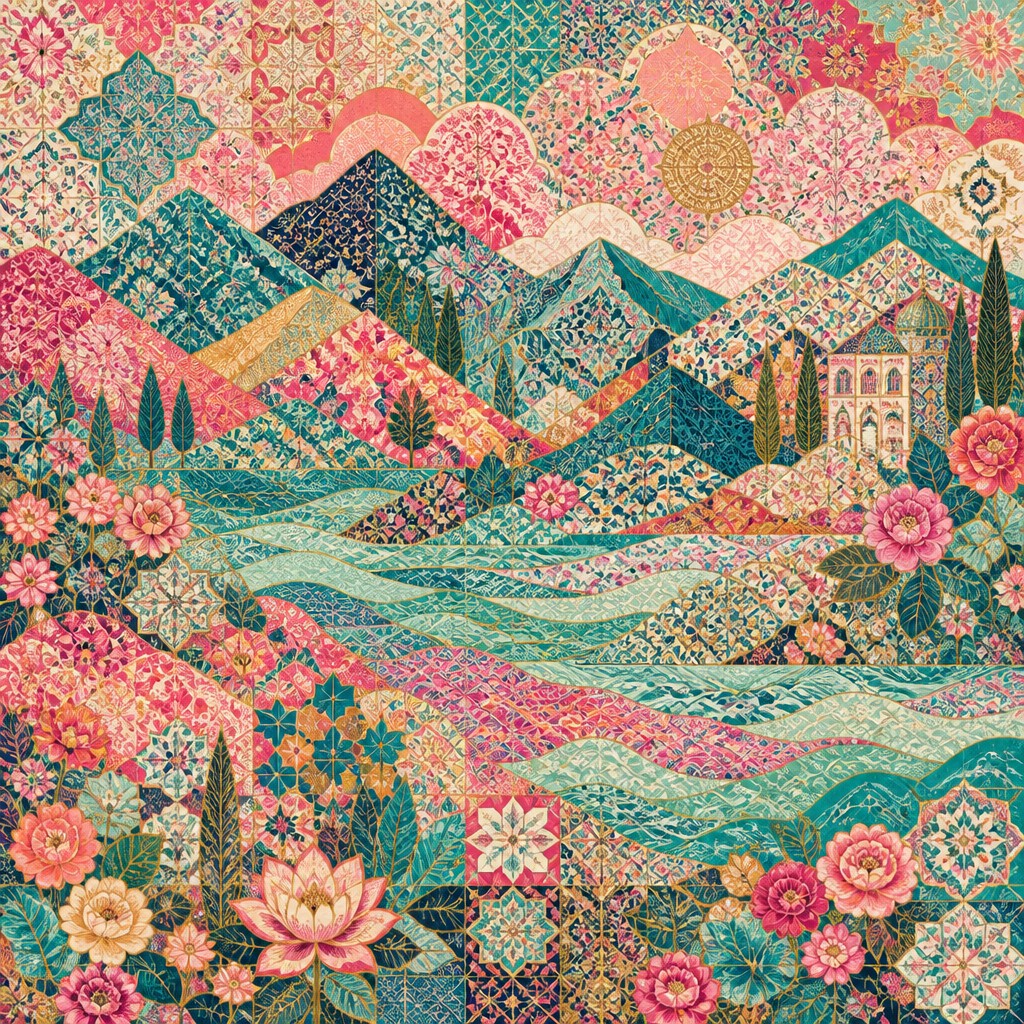
Pattern and Decoration, often shortened to P&D, formed in New York in the mid-1970s among a loose group of painters and sculptors who had grown restless with the reductive vocabulary of Minimalism and the dry theoretical rigor of Conceptual Art. Where those movements stripped art down to bare structure, gesture, or idea, P&D artists went the opposite direction: they piled on color, ornament, and surface pattern until the works became dense, maximalist fields with no single focal point for the eye to rest on.
Visually, P&D paintings and installations pulled motifs from a deliberately global range of decorative traditions — Islamic tile and arabesque, Persian carpets, American quilts, Mexican textiles, wallpaper design, and Middle Eastern architectural ornament. Artists combined paint with fabric, sequins, glitter, and other unconventional materials, often working at large scale and in saturated, high-key color. The result was intentionally excessive: pattern repeated across the entire surface, resisting the modernist demand for a clear compositional hierarchy or a single legible image.
The movement rebelled directly against two entangled prejudices. The first was Minimalism and Conceptual Art's austere seriousness, which P&D artists found emotionally cold and increasingly exhausted as a vocabulary. The second, and more pointed, target was the modernist hierarchy that ranked "fine art" above craft and decoration — a hierarchy that not coincidentally devalued traditions historically associated with women, non-Western cultures, and domestic life. Several P&D artists, including Miriam Schapiro, came directly out of the Feminist Art Movement, and P&D can be understood as extending feminist art's reclamation of craft into a fuller, more explicitly ornamental abstract language.
The movement matters because it was one of the first coordinated efforts to dismantle the fine-art-versus-decoration divide from within the gallery system rather than outside it, anticipating the eclectic appropriation and maximalism that later defined postmodern art more broadly. Though its commercial and critical moment was brief, its central argument — that ornament is not inherently lesser than "pure" form — resurfaces whenever contemporary art turns back toward pattern, color, and craft.
What defines Pattern and Decoration
Allover pattern with no single focal point
Compositions filled the entire surface with repeating motifs, refusing the modernist convention of a dominant central image or clear hierarchy of attention.
Sources drawn from global ornamental traditions
Artists borrowed openly from Islamic tile and arabesque, Persian carpets, quilts, and wallpaper design, treating decorative traditions from many cultures as equally valid source material.
Mixed, often unconventional materials
Paint was combined with fabric, sequins, glitter, and collaged textile fragments, blurring the line between painting and craft object.
Saturated, high-key color
Palettes favored intense, sometimes clashing color combinations rather than the restrained tonal ranges common in Minimalism, reinforcing the movement's maximalist energy.
Deliberate rejection of the craft/fine-art hierarchy
By presenting textile- and ornament-derived work in gallery contexts at painting scale, P&D artists argued directly against modernism's ranking of decorative traditions beneath abstract painting and sculpture.
Dense, layered composition
Multiple pattern systems were often layered within a single work, creating visual complexity that rewarded close, sustained looking rather than instant legibility.
History
Pattern and Decoration coalesced in New York around 1975, when a group of painters — including Miriam Schapiro, Robert Kushner, Joyce Kozloff, Robert Zakanitch, Valerie Jaudon, and Kim MacConnel — began meeting informally to discuss a shared dissatisfaction with Minimalism's austerity and a shared interest in pattern, ornament, and craft traditions. Many participants, especially Schapiro, brought direct ties to the Feminist Art Movement, and P&D can be read partly as that movement's aesthetic extension into abstraction.
The Holly Solomon Gallery in New York became the group's central exhibition venue, giving P&D artists sustained gallery visibility through the late 1970s and early 1980s. Their work drew on an unusually wide range of sources — Islamic architectural tile, Persian and Turkish carpets, American quilting traditions, Mexican and Middle Eastern textiles — treated not as exotic decoration but as serious formal and historical resources on par with any Western painting tradition. Critics and curators debated whether the work constituted a coherent movement or a loose affinity group, but its consistent maximalist, anti-hierarchical stance gave it enough identity to be treated and exhibited as one.
P&D's visibility peaked in the late 1970s and began fading by the mid-1980s as the art market's attention shifted toward the more market-friendly, expressionistic figurative painting of Neo-Expressionism, which offered dealers and collectors a different kind of dramatic, individually authored canvas. Several P&D artists continued working in related idioms for decades, but the movement as an organized critical category largely dissolved by 1985. Its arguments about craft, ornament, and cultural hierarchy resurfaced repeatedly in later decades, particularly as museums staged retrospective surveys reassessing the group's importance to postmodern and feminist-adjacent art history.
Key works
| Work | Artist | Year | Why it matters |
|---|---|---|---|
| Anatomy of a Kimono | Miriam Schapiro | 1976 | A large fan-and-kimono-shaped fabric-and-paint work, an early example of Schapiro's "femmage" technique fusing collage, textile, and painting. |
| An Interior Decorated | Joyce Kozloff | 1979 | An immersive installation covering an entire room in patterned surfaces, exemplifying the movement's rejection of the single easel-painting format. |
How to make art in this style
Working in a Pattern and Decoration sensibility today
Begin from a decorative source rather than a blank composition: choose a specific ornamental tradition — Islamic tile, a textile pattern, wallpaper design, quilting motifs — and let it structure the entire surface rather than treating it as background detail.
Palette. Favor saturated, high-key color and combine several strong hues rather than a restrained, tonal range. Jewel tones, gold, magenta, and deep teal paired together read as characteristic of the movement's maximalist energy.
Composition. Reject a single focal point. Fill the entire surface edge-to-edge with repeating or layered pattern so the eye moves continuously across the work rather than resting on one central image. Consider working at large scale, since P&D artists frequently used mural-sized or room-filling formats.
Materials. Combine paint with fabric, sequins, glitter, or collaged textile fragments to blur the line between painting and craft object. Layer multiple pattern systems within a single piece — a printed textile motif over a painted geometric ground, for instance — to build the dense complexity central to the style.
Process. Treat historically "lesser" craft techniques, such as embroidery, appliqué, or ceramic tilework, as equal in seriousness to painting, and let visible handwork remain part of the finished surface rather than disguising it.
Subjects. The movement was largely non-representational and pattern-driven; where imagery appears, it tends toward stylized florals, architectural ornament, or textile-derived motifs rather than figures or landscapes.
Legacy
Pattern and Decoration's core argument — that ornament and craft deserve full artistic standing alongside "pure" abstraction — anticipated debates that later ran through postmodern art's embrace of appropriation, eclecticism, and cultural quotation. Though the movement's organized visibility was brief, it kept alive a decorative, maximalist counter-tradition inside contemporary painting that resurfaced whenever artists turned back toward color, pattern, and textile-derived form.
Its feminist roots, shared with the broader Feminist Art Movement, helped keep pressure on museums and art history to reconsider craft media and non-Western ornamental traditions as legitimate fine-art resources rather than lesser, merely applied arts. Later waves of maximalist and pattern-driven painting, along with a broader contemporary interest in textile art, ceramics, and craft-based practice within gallery and museum contexts, echo P&D's central claims even where artists are unaware of the movement's specific history. Museum retrospectives in recent decades have reassessed the group, arguing for its underrecognized importance to the development of postmodern American art.
Frequently asked questions
What is Pattern and Decoration in art?
It is an American art movement of the mid-1970s to mid-1980s that filled paintings and installations with dense, saturated ornament drawn from global textile, tile, and wallpaper traditions, rejecting Minimalism's austerity.
Who were the key Pattern and Decoration artists?
Central figures included Miriam Schapiro, Robert Kushner, Joyce Kozloff, Robert Zakanitch, Valerie Jaudon, and Kim MacConnel, many of whom exhibited together at New York's Holly Solomon Gallery.
How is Pattern and Decoration different from Minimalism?
Minimalism reduced art to spare geometric form and neutral color, while Pattern and Decoration deliberately filled the entire surface with dense, saturated, allover ornament, arguing against Minimalism's austerity.
Why is it sometimes called P&D?
P&D is simply the movement's common abbreviated nickname, used in exhibition catalogs and art criticism interchangeably with the full name Pattern and Decoration.
What is the connection between Pattern and Decoration and feminist art?
Several P&D artists, notably Miriam Schapiro, came directly out of the Feminist Art Movement, and the movement extended feminist art's reclamation of "feminine" craft traditions into a broader abstract, decorative vocabulary.
Why did Pattern and Decoration decline by the mid-1980s?
The art market's attention shifted toward the more dramatic, individually authored figurative canvases of Neo-Expressionism, and P&D lost the sustained gallery and critical attention that had defined its brief prominence.