 Art
Art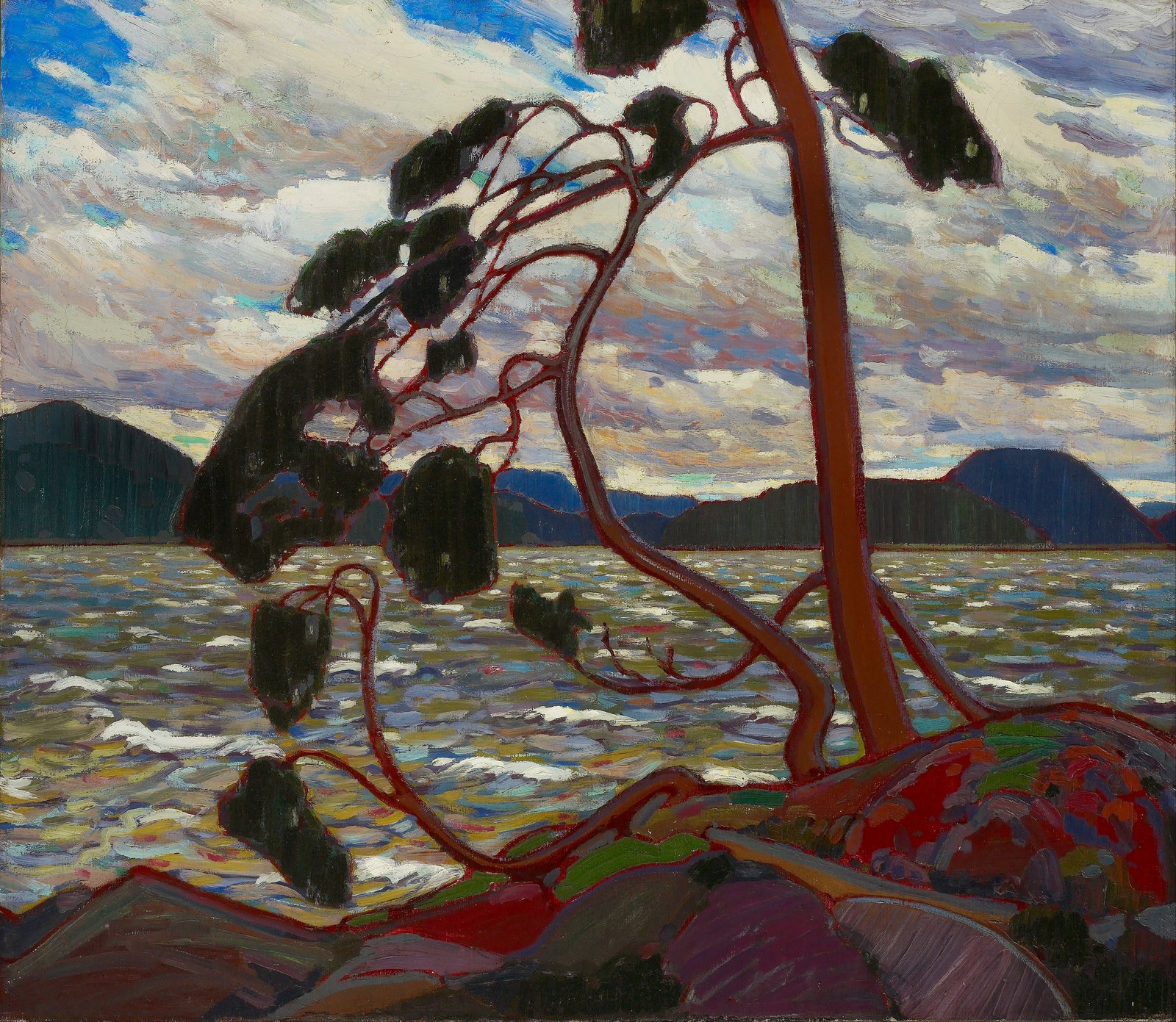
The West Wind. Image: Tom Thomson · Public domain · Wikimedia Commons, accessed 2026-08-04
The Group of Seven was a collective of Canadian landscape painters, formally organized in Toronto in 1920, though its style and mission took shape years earlier through the friendship and shared sketching trips of artists including Tom Thomson, Lawren Harris, A.Y. Jackson, and Arthur Lismer. Thomson, who drowned in 1917 before the group's official founding, is nonetheless considered its spiritual founder: his rugged, thickly painted sketches of Algonquin Park set the visual template the others would formalize and promote.
Visually, Group of Seven paintings are bold, simplified, and unmistakably northern. Jagged pines, wind-bent trees, granite outcrops, ice-choked lakes, and vast empty skies are rendered in thick, confident brushwork and often heightened, near-decorative color — flame-orange autumn foliage, deep blue-black storm clouds, stark white snow. Compositions favor strong graphic shapes over fine detail, closer in spirit to the flattened forms of Art Nouveau and Post-Impressionism than to the polished naturalism of academic landscape painting.
The group rebelled explicitly against the Canadian art establishment's continued reliance on European models — soft, pastoral landscapes deemed appropriate training but ill-suited to depicting Canada's actual terrain. The painters argued that a distinctly Canadian art had to be forged directly from the country's own wilderness, often reached only by canoe, train, and long overland treks into Algonquin Park, Georgian Bay, and later the Arctic and the Rockies.
The movement matters because it became, deliberately and successfully, the visual foundation of a national artistic identity for a young country still defining itself apart from British and American cultural influence. Group of Seven paintings are now among the most reproduced and recognizable images in Canadian visual culture, taught in schools and held in the National Gallery of Canada, and the group's insistence on painting directly from the land shaped generations of Canadian landscape and wilderness art that followed.
What defines Group of Seven
Bold, simplified forms
Trees, rocks, and clouds are reduced to strong, graphic shapes rather than rendered in fine naturalistic detail, giving the paintings a decorative, almost poster-like clarity that reads well at a distance.
Thick, confident brushwork
Paint is applied in heavy, visible strokes and sometimes with a palette knife, built up from small oil sketches made outdoors and later enlarged into studio canvases. The texture itself conveys the ruggedness of the terrain.
Heightened, near-unnatural color
Autumn foliage, stormy skies, and northern lights are pushed toward saturated oranges, reds, and blues well beyond naturalistic observation, lending the landscapes an emotional, almost symbolic charge.
Unpeopled wilderness
Human figures and settlements are almost entirely absent; the subject is the land itself — lakes, forests, and rock formations of the Canadian Shield, Algonquin Park, and later the Arctic — presented as untouched and monumental.
Sketch-based method
Artists worked from small oil sketches made on site during canoe and camping trips, then reworked and enlarged the strongest compositions in the studio, a two-stage process that preserved spontaneity while allowing formal refinement.
Flattened, decorative space
Compositions often compress depth into overlapping planes of color rather than deep atmospheric perspective, a design sensibility indebted to Art Nouveau and Scandinavian landscape painting that influenced Lawren Harris before the group's founding.
History
The Group of Seven's roots trace to informal sketching trips taken by a circle of Toronto commercial artists in the 1910s, several of whom worked together at the design firm Grip Ltd. Tom Thomson, technically a guide and fisherman as much as a painter, became the group's defining influence through his sketches of Algonquin Park's wilderness; his death by drowning in Canoe Lake in 1917 came before the group formally existed, but his work set its visual and thematic course.
Lawren Harris, independently wealthy and the group's chief organizer, had seen an exhibition of Scandinavian landscape painting in Buffalo in 1913 that convinced him northern countries needed their own bold, native school of landscape art. He, along with A.Y. Jackson, Arthur Lismer, J.E.H. MacDonald, Frank Johnston, Franklin Carmichael, and Frederick Varley, formally exhibited together as the Group of Seven for the first time in Toronto in May 1920.
Through the 1920s the group expanded its territory beyond Algonquin Park and Georgian Bay to Lake Superior's north shore, the Rockies, and eventually the Arctic, seeking ever more remote and dramatic wilderness subjects. Membership shifted over the decade as some original members withdrew and others, including A.J. Casson, were added.
The group formally disbanded in 1933, reorganizing as the larger and more inclusive Canadian Group of Painters, which welcomed artists from across the country, including women whom the original Group of Seven had excluded from formal membership despite close association with painters like Emily Carr. Though the original group's active life lasted little more than a decade, its paintings had already become, and would remain, the dominant visual reference for Canadian landscape and national identity.
Key works
| Work | Artist | Year | Why it matters |
|---|---|---|---|
| The Jack Pine | Tom Thomson | 1917 | A lone wind-shaped pine against a lake and sky became one of the most reproduced images in Canadian art, though painted just before the group's official founding. |
| The West Wind | Tom Thomson | 1917 | Another iconic Thomson image of a solitary bent pine, often paired with The Jack Pine as the visual template for the group's style. |
| North Shore, Lake Superior | Lawren Harris | 1926 | A stark, simplified depiction of a dead tree and rock outcrop that shows Harris's move toward near-abstract, spiritually charged landscape. |
| A September Gale, Georgian Bay | Arthur Lismer | 1921 | A windswept shoreline scene capturing the group's fascination with dramatic northern weather and wind-bent trees. |
How to make art in this style
Working in the Group of Seven Style
Palette: Lean into strong, saturated seasonal color — deep pine and spruce greens, rust and flame orange for autumn foliage, granite greys and blues, and stark white for snow and ice. Push colors slightly beyond naturalistic observation for emotional impact rather than photographic accuracy.
Composition: Choose a single dominant natural feature — a wind-bent tree, a rock outcrop, a lake framed by hills — and let it fill and organize the canvas. Favor strong diagonal or silhouetted shapes against simplified sky and water planes; avoid clutter, incident, or human figures, which have almost no place in this style.
Brushwork: Apply paint thickly and directly, in visible, confident strokes or with a palette knife for rock and cloud forms. If working from life, make small, quick oil sketches on site to capture light and structure, then rework the strongest sketch into a larger, more resolved studio composition.
Subjects: Northern wilderness — lakes, forests, rocky shorelines, and skies — observed directly and preferably outdoors, in remote or rugged terrain rather than cultivated or settled landscape. Weather (wind, storm, snow) should read as a visible physical force shaping the trees and land.
Mood: Aim for monumental stillness and a sense of untouched, elemental nature — vast, rugged, and slightly stark rather than picturesque or pastoral.
Legacy
Few art movements have shaped a national visual identity as thoroughly as the Group of Seven shaped Canada's. Their paintings became, and remain, the default mental image of the Canadian wilderness for generations of Canadians, reproduced on stamps, currency, calendars, and in classrooms; the National Gallery of Canada's deep holdings of their work have made them central to the country's art-historical canon.
Their influence extended directly to later Canadian landscape and abstract painters, including members of the Canadian Group of Painters that succeeded them, and indirectly to how Canadian art distinguished itself from British and American traditions through the twentieth century. Emily Carr, though never a formal member, is closely associated with the group's spirit through her own paintings of the Pacific Northwest, and later critics have complicated the group's legacy by noting how their vision of "empty" wilderness overlooked Indigenous presence on that land.
Today the Group of Seven is often invoked, admiringly or critically, whenever discussions turn to national landscape painting, environmental art, or the mythologizing of wilderness in settler-colonial visual culture, ensuring the movement remains as historically significant as it is contested.
Frequently asked questions
What is the Group of Seven?
The Group of Seven was a collective of Canadian landscape painters, formally founded in Toronto in 1920, known for bold, simplified paintings of the country's northern wilderness. They aimed to create a distinctly Canadian style of art independent of European academic tradition.
Who were the members of the Group of Seven?
Founding members included Lawren Harris, A.Y. Jackson, Arthur Lismer, J.E.H. MacDonald, Frank Johnston, Franklin Carmichael, and Frederick Varley. Tom Thomson, though he died in 1917 before the group formed, is considered its essential inspiration.
Was Tom Thomson a member of the Group of Seven?
Not formally — Thomson drowned in 1917, three years before the group's official 1920 founding. His paintings of Algonquin Park nonetheless established the visual style the group would build on, and he is widely treated as its spiritual founder.
When did the Group of Seven end?
The group formally disbanded in 1933 and reorganized as the larger, more inclusive Canadian Group of Painters, which admitted artists from across Canada, including women excluded from the original group.
What did the Group of Seven paint?
They painted Canada's wilderness — lakes, forests, rocky shores, and later the Arctic and Rocky Mountains — almost always without human figures, using bold color and simplified, graphic forms rather than detailed naturalism.