 Art
Art AI-generated
 AI-generated
 AI-generated
Superflat is a Japanese art movement and critical framework introduced by artist Takashi Murakami around 1999–2000, named for its central formal claim: that Japanese visual culture, from Edo-period woodblock prints to contemporary anime and manga, has always favored a radically flat picture plane over the layered depth and single-point perspective prized in Western painting since the Renaissance. Murakami extended this observation into a broader cultural argument, proposing that postwar Japan's social hierarchies—including the boundary between fine art and commercial art, and between adult and childlike culture—had themselves become "flattened" by the trauma of defeat in World War II and the country's subsequent embrace of consumer and otaku (obsessive fan) culture.
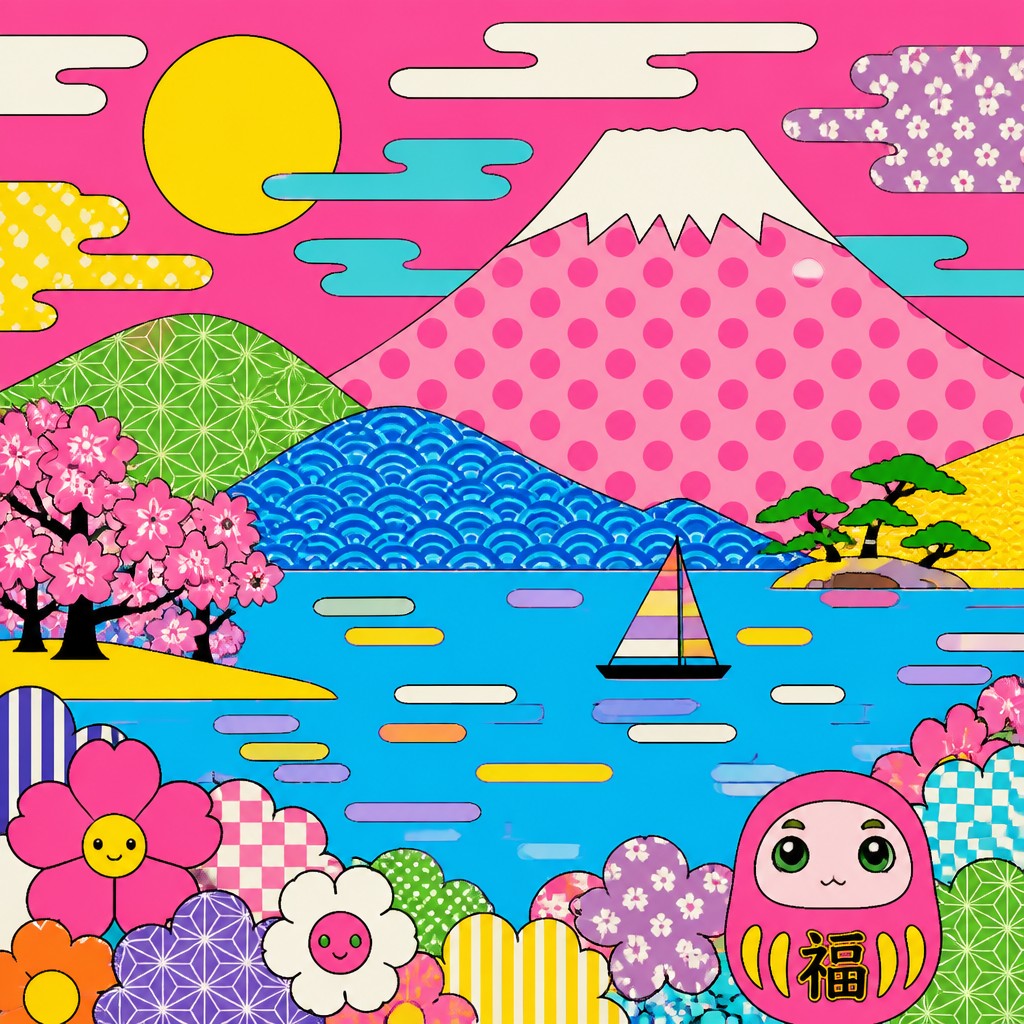
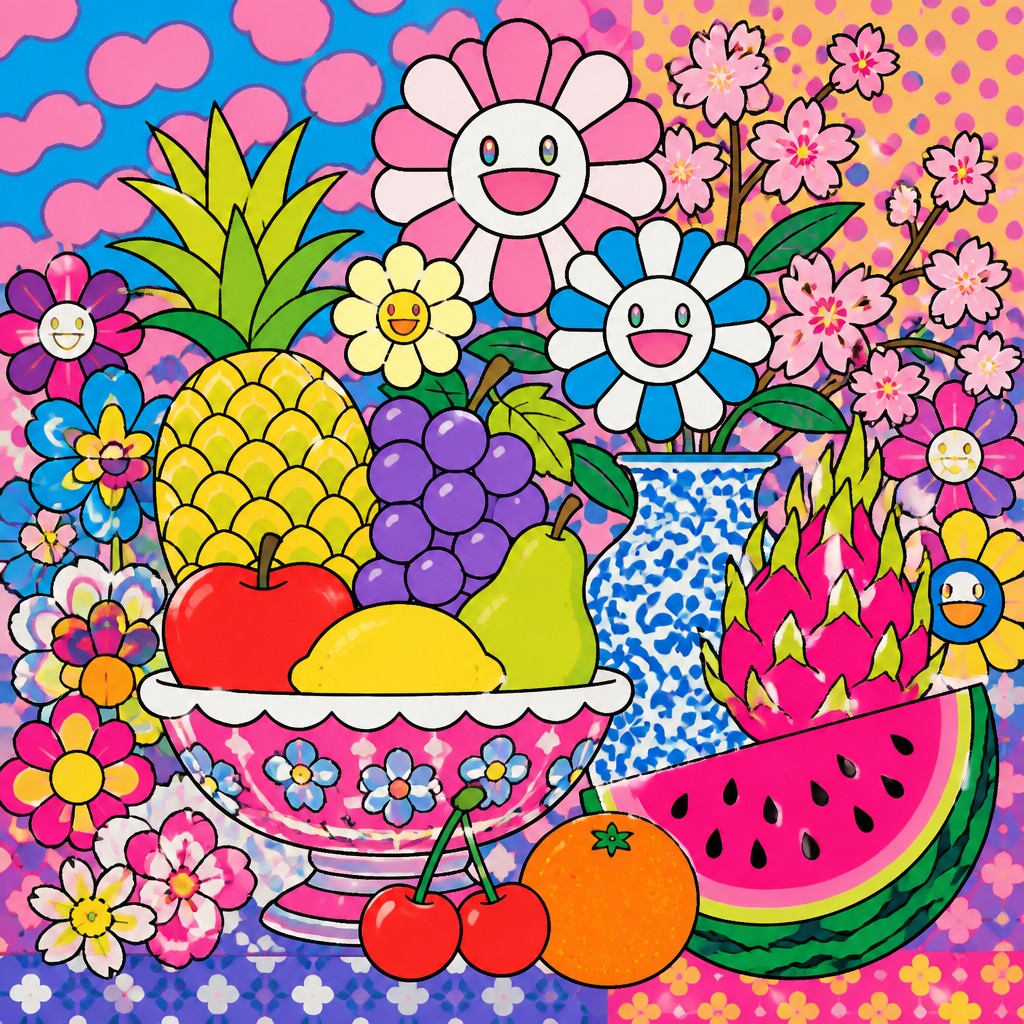
Visually, Superflat art borrows the bright, saturated color and crisp outlines of anime and manga, populates its compositions with mascot-like characters and decorative, all-over patterning, and eliminates cast shadow and perspectival recession in favor of a smooth, glossy, evenly lit surface. Beneath the cheerful palette, the imagery frequently carries an unsettling edge: grinning, multi-eyed characters and wide-eyed children holding concealed weapons pair childlike cuteness with menace or anxiety, refusing the innocence their style superficially promises.
Superflat rebelled against the strict separation, inherited from Western modernism, between serious gallery art and commercial illustration, and against Japanese art institutions that had long treated anime, manga, and otaku culture as beneath fine-art consideration. Murakami additionally built Superflat into a genuine commercial enterprise, founding the Kaikai Kiki company to produce and merchandise his own and other artists' work and collaborating directly with fashion houses, treating market crossover as an extension of the movement's argument rather than a compromise of it.
Superflat matters because it offered one of the most influential non-Western contributions to contemporary art discourse in decades, giving international audiences and institutions a vocabulary for taking anime- and manga-derived visual language seriously, and demonstrating that a movement could operate simultaneously as gallery art, curatorial theory, and a functioning commercial brand.
What defines Superflat
Radical Pictorial Flatness
Compositions eliminate cast shadow, modeling, and single-point perspective, favoring the flat picture plane inherited from ukiyo-e woodblock prints and contemporary anime cel animation.
Saturated, Candy-Bright Palette
Colors are glossy, high-key, and evenly applied—hot pinks, electric blues, sunflower yellows—recalling the printed color of manga and toy packaging rather than mixed painterly tone.
Cute-Grotesque Hybrid Characters
Recurring mascot-like figures combine kawaii cuteness—oversized eyes, rounded forms—with unsettling details such as concealed weapons, multiplied eyes, or menacing grins, undercutting their apparent innocence.
All-Over Decorative Pattern
Backgrounds are frequently filled edge-to-edge with repeating motifs—flowers, smiling faces, eyeballs—derived from textile and product design rather than a traditional framed background.
Immaculate, Airbrushed Surface
Finishes are smooth and glossy, closer to commercial printing or vinyl toy manufacture than visible hand-painted brushwork, reinforcing the movement's collapse of fine art and product design.
Fine Art–Commerce Crossover
Imagery moves fluidly between gallery paintings, limited-edition figures, and fashion collaborations, treating merchandise and museum work as equally legitimate expressions of the same visual language.
History
Superflat's roots lie in Takashi Murakami's academic training in nihonga, traditional Japanese painting, at the Tokyo University of the Arts in the 1980s, which gave him a formal grounding in the same flat, linear picture-making conventions found in ukiyo-e. Through the 1990s, Murakami increasingly incorporated the visual language of anime, manga, and otaku fan culture into his gallery work, developing recurring mascot characters and a glossy, mass-producible finish.
Murakami crystallized the movement's name and theory with the 2000 exhibition and catalog Superflat, staged in Tokyo, which grouped his own work with that of other Japanese artists working in related idioms, including Yoshitomo Nara and Chiho Aoshima, and argued for the historical continuity between Edo-period flatness and contemporary anime aesthetics. He founded the company Kaikai Kiki in 2001 to produce, exhibit, and merchandise Superflat-associated art, and launched the recurring GEISAI art fair in 2002 as a platform for younger Japanese artists.
International visibility grew rapidly in the early 2000s: Murakami's 2003 collaboration with fashion house Louis Vuitton put Superflat imagery on luxury handbags worldwide, and the 2005 exhibition Little Boy at Japan Society in New York, curated by Murakami, connected the movement explicitly to postwar Japanese history and otaku culture for an American audience. Yoshitomo Nara built an independent international following with his own paintings and sculptures of childlike, emotionally ambiguous figures, while Chiho Aoshima developed large-scale digital and mural work extending the movement's flat, decorative vocabulary.
Superflat has no fixed end date; unlike many twentieth-century movements defined by a specific rise and dissolution, it persists as an active curatorial framework and a loosely shared aesthetic among artists working at the intersection of Japanese pop culture and contemporary gallery practice, with Murakami himself remaining its most prominent and commercially visible figure.
Key works
| Work | Artist | Year | Why it matters |
|---|---|---|---|
| My Lonesome Cowboy | Takashi Murakami | 1998 | A fiberglass sculpture blending anime-derived imagery with pop iconography, later notable for setting a major contemporary art auction record. |
| Tan Tan Bo Puking – a.k.a. Gero Tan | Takashi Murakami | 2002 | A large-scale painting exemplifying the movement's cute-grotesque hybrid characters and dense decorative patterning. |
| Knife Behind Back | Yoshitomo Nara | 2000 | A painting of a childlike figure concealing a weapon, capturing the deceptively innocent menace central to Nara's work. |
| Fountain of Life | Yoshitomo Nara | 2001 | A sculptural fountain populated by multiple small child-like heads, extending Nara's imagery into three-dimensional, communal form. |
How to make art in this style
Working in a Superflat Style
Palette: Use flat, saturated, high-key color straight from the tube or digital swatch—hot pink, cobalt, sunflower yellow, pure white—applied in even, unblended fields rather than gradated tones.
Composition: Eliminate perspective and cast shadow; build the image on a single, shallow picture plane like a printed page or animation cel. Fill backgrounds edge-to-edge with repeating decorative motifs—flowers, faces, simple icons—rather than leaving empty negative space.
Line and form: Outline forms with crisp, confident contour lines, keeping interior shading minimal or entirely absent. Character proportions can exaggerate childlike cuteness—large heads, oversized eyes—while introducing one unsettling detail to complicate that innocence.
Technique: Favor smooth, glossy, airbrushed or vector-clean surfaces over visible brushwork; the finish should read as closer to commercial printing or manufactured toy than hand-painted canvas. Digital illustration and screen printing both suit this approach well.
Subjects: Mascot-like characters, childlike figures, and recognizable pop-culture motifs work best when treated with the same formal seriousness as traditional gallery subjects. Consider pairing a cheerful surface with an ambiguous emotional undertone—melancholy, menace, or anxiety—rather than settling for straightforward cuteness.
Format: The style translates naturally across scales and media, from small collectible-style objects to large murals, reinforcing the movement's core idea that there is no meaningful hierarchy between gallery painting and mass-produced image.
Legacy
Superflat gave international contemporary art a serious critical vocabulary for engaging with anime, manga, and otaku culture at a moment when these forms were still widely dismissed by Western art institutions as merely commercial. It helped open the door for a generation of artists worldwide who draw directly on comics, animation, and toy design without treating that lineage as a lesser tradition, and it accelerated the now-common practice of high-profile collaborations between fine artists and fashion or luxury brands.
Murakami's commercial model—operating simultaneously as gallery artist, brand, and producer of limited-edition merchandise through Kaikai Kiki—anticipated a broader shift in how contemporary artists build careers across gallery, collectible, and product markets. Yoshitomo Nara's paintings and sculptures, meanwhile, have become some of the most widely reproduced images in contemporary art, their childlike-but-unsettling figures echoed across streetwear, toy design, and internet visual culture.
Superflat's flattened, saturated visual language continues to shape graphic design, animation, and youth-oriented branding well beyond the artists directly associated with the movement, and it remains a key reference point whenever contemporary art engages seriously with anime, manga, or East Asian pop visual culture.
Frequently asked questions
What is Superflat art?
Superflat is a Japanese art movement founded by Takashi Murakami around 2000 that uses the flat picture plane of traditional ukiyo-e prints and contemporary anime to erase distinctions between fine art and commercial pop culture.
Who started the Superflat movement?
Takashi Murakami coined the term and framework, first articulating it fully in his 2000 exhibition and catalog Superflat, though artists like Yoshitomo Nara and Chiho Aoshima are closely associated with the same aesthetic.
What does "superflat" actually mean?
The term refers both to the literal flatness of the picture plane, without Western-style perspective or shadow, and to Murakami's argument that Japanese cultural hierarchies—including the line between fine art and commerce—have themselves become flattened.
How is Superflat different from Pop Art?
While both engage commercial and mass-media imagery, Superflat is grounded specifically in Japanese visual traditions like ukiyo-e and anime, and its artists often operate their own merchandising companies, treating market crossover as part of the movement's argument.
Is Superflat still an active movement?
Yes—unlike many twentieth-century movements with a clear end date, Superflat continues as an active curatorial and commercial framework, with Murakami and related artists still producing new work within its visual language.