 Art
Art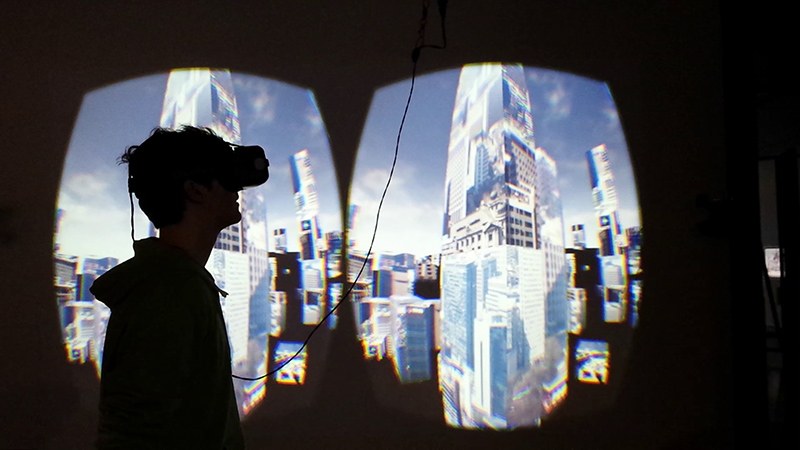
10'000 moving cities V3, net-and-telepresence-based installation, 2015. Image: Marc Lee · CC BY-SA 4.0 · Wikimedia Commons, accessed 2026-08-04
New Media Art is an umbrella term for work that uses digital and electronic technologies not merely to produce images but as the actual substance of the artwork—computer code, networked data, video signals, sensors, robotics, and virtual environments. Unlike painting or photography, where technology serves as a tool to render a scene, new media art foregrounds the technology's own behavior: how a signal degrades, how a network routes information, how a viewer's movement can trigger a response. The result is art that is frequently interactive, time-based, and unstable—built to change with each encounter rather than sit fixed on a wall.
Visually, new media art resists a single look. It can appear as a bank of televisions playing manipulated broadcast signals, a gallery room wired with motion sensors that respond to bodies passing through it, a modified video-game cartridge looping abstract patterns, or a public installation using projected light and biometric data. What unites these disparate forms is the artist's engagement with contemporary technological infrastructure as both material and subject: the same systems that carry entertainment, surveillance, and communication become the raw stuff of the artwork.
The movement grew out of two earlier practices—1960s and '70s video art, which first treated the television signal as a plastic medium, and conceptual art, which had already shifted attention from crafted objects to ideas, processes, and systems. As personal computers, the internet, and affordable digital cameras became widely available in the 1990s, artists absorbed these tools directly into their practice, and museums began building dedicated media-art departments and biennials to support work that didn't fit painting or sculpture categories.
New Media Art rebelled against the idea that fine art belonged to traditional materials and passive viewing. It insisted that the computer, the network, and the interface were as legitimate an artistic terrain as bronze or canvas, and that an artwork could be authored collaboratively with a viewer or even a machine. It matters because it anticipated—decades before smartphones and social media saturated daily life—that screens and networks would become the primary environment in which most people experience images, and it built a critical vocabulary for thinking about that environment as art rather than mere infrastructure.
What defines New Media Art
Screen and Signal as Material
Televisions, monitors, and projections are used as physical objects and manipulated at the level of the signal—scrambled, looped, or fed live data—rather than treated as neutral display surfaces for pre-made footage.
Interactivity and Viewer Participation
Sensors, cameras, and touch interfaces let the audience's presence or movement change the work in real time, shifting the viewer from observer to co-author and making each encounter with the piece unique.
Time-Based and Unstable Forms
Works often exist as processes rather than fixed objects—looping video, generative code, or live data feeds that never repeat identically, which raises ongoing questions about how such pieces should be preserved and exhibited.
Networked and Site-Distributed Work
Pieces can be built to run across the internet or multiple locations simultaneously, using networks not just to distribute the work but as part of its subject matter—speed, surveillance, and global connection.
Hybrid Technical Materials
Circuit boards, custom software, robotics, and repurposed consumer electronics such as game consoles and webcams sit alongside more traditional gallery materials, blurring the line between artwork, engineering project, and laboratory experiment.
Institutional and Alternative Venues
Because the technology often outpaces conventional gallery infrastructure, the work has circulated through dedicated media-art festivals, university labs, and public installations as much as through traditional museums and commercial galleries.
History
New Media Art's lineage begins earlier than its 1990s emergence as a named field. Nam June Paik, working from the 1960s, treated television sets as sculptural and signal-based material, and by the 1970s a broader video art scene had established that electronic media could be authored rather than merely broadcast. Conceptual art's turn toward systems, instructions, and process gave these experiments a critical framework.
The field crystallized as "new media art" in the 1990s, when the spread of personal computers, CD-ROMs, and the World Wide Web gave artists direct, affordable access to digital tools. A net.art scene emerged internationally, with artists building work that lived natively on websites and browsers rather than in galleries. Interactive installation also matured in this decade, using sensor technology to let audiences physically affect a piece. Institutions responded: festivals such as Ars Electronica and transmediale, along with university-based media labs, became key venues and incubators, since mainstream museums were often slow to collect or exhibit unstable, technology-dependent work.
Through the 2000s and 2010s, the field broadened further as smartphones, social platforms, big data, and machine learning entered artists' toolkits, and museums began actively acquiring and conserving such work, developing new strategies for preserving software-dependent pieces as hardware became obsolete. Large-scale immersive installations, using projection mapping and real-time data, brought new media approaches to mass audiences by the 2010s and 2020s.
Rather than ending, New Media Art has largely diffused into and merged with several successor and adjacent fields—bio art, post-internet art, crypto art, and AI art among them—each inheriting its core premise that contemporary technology is legitimate artistic material. It persists today as both a distinct category and as the shared root from which these newer, more specialized digital practices grew.
Key works
| Work | Artist | Year | Why it matters |
|---|---|---|---|
| Electronic Superhighway: Continental U.S., Alaska, Hawaii | Nam June Paik | 1995 | A monumental multi-channel video map of the United States, treating broadcast signal and television hardware as sculptural material. |
| Text Rain | Camille Utterback and Romy Achituv | 1999 | An early interactive installation in which falling letters respond to viewers' body silhouettes, a landmark of participatory new media work. |
| Super Mario Clouds | Cory Arcangel | 2002 | A hacked Nintendo cartridge stripped down to loop only its drifting cloud graphics, repurposing gaming hardware as fine art. |
| Pulse Room | Rafael Lozano-Hemmer | 2006 | A room of pulsing incandescent bulbs triggered by visitors' heartbeats, exemplifying biometric interactive installation. |
| teamLab Borderless | teamLab | 2018 | A large-scale immersive digital museum in which projected, responsive imagery flows continuously between connected rooms. |
How to make art in this style
Working in a New Media Art Style Today
Concept first. Start with a system, not a picture—decide what data, signal, or interaction will drive the piece (a live sensor feed, a networked input, a piece of found footage) before deciding what it will look like. The behavior of the system is the artwork's real content.
Palette and materials. There is no fixed palette; instead, choose materials for what they can do. Raw video signal, monitor glow, LED light, and screen artifacts such as scan lines and pixelation are common visual textures. Working with actual hardware—old televisions, modified game consoles, webcams, small sensors and microcontrollers—keeps the piece grounded in physical, tactile technology rather than purely digital simulation.
Composition. Think in terms of time and behavior rather than a single frozen frame: looping sequences, feedback loops (a camera pointed at its own output), and layered, glitching signals are core compositional tools. Plan for how the piece changes across a five-minute or five-hour viewing, not just its first impression.
Interaction. If including a participatory element, keep the mechanism legible—a viewer should be able to sense, even briefly, how their movement or input is changing the work. Motion sensors, proximity triggers, and simple cause-and-effect responses read more successfully than overly complex ones.
Subjects. Common territory includes surveillance and data collection, the body's relationship to machines, the behavior and failure of electronic systems, and the texture of broadcast and network signals. Documentation matters: because these works are unstable, thorough photographic and video records of the piece in action are part of the practice.
Legacy
New Media Art established that computers, networks, and interactive systems were legitimate artistic media, a premise now taken for granted across contemporary art. Its insistence on viewer participation reshaped exhibition design broadly—museums now routinely commission interactive and immersive installations, and audiences expect some works to respond to their presence. Its early confrontation with the problem of preserving unstable, software-dependent work forced museums and conservators to develop new conservation methodologies, from emulation to detailed documentation of process, which now inform how institutions handle any technology-based acquisition.
The movement's DNA runs through nearly every digital art practice that followed. Bio art extended its embrace of unconventional technical materials into biotechnology; post-internet art inherited its engagement with networks as both subject and distribution system; crypto art and AI art both depend on infrastructure—blockchains, neural networks—that new media artists had already treated as legitimate artistic terrain decades earlier. Commercially, its techniques now appear in large-scale public and corporate installations, immersive ticketed experiences, and projection-mapped spectacles that bring interactive, screen-based art to mass audiences far beyond the gallery system, testifying to how thoroughly its core ideas have entered mainstream visual culture.
Frequently asked questions
What is New Media Art?
New Media Art is a category of contemporary art that uses digital and electronic technologies—video, computers, networks, sensors, and code—as its actual medium, not just as tools for making traditional images. It typically emphasizes interactivity, time-based experience, and technological process over a fixed, static object.
How is New Media Art different from digital art in general?
"Digital art" often refers broadly to any art made with digital tools, including digital painting or photography. New Media Art specifically foregrounds the technology's own systems and behavior—networks, code, sensors, live data—as central subject matter, and frequently involves interactivity or installation rather than a single displayed image.
Who are important New Media artists?
Nam June Paik is widely regarded as a foundational figure, having treated television as an artistic medium from the 1960s onward. Later prominent practitioners include Cory Arcangel, known for repurposing video game hardware, and Rafael Lozano-Hemmer, known for large-scale interactive installations.
Why is New Media Art hard to preserve?
Much of the work depends on specific, often obsolete hardware and software, and many pieces are inherently time-based or generative rather than fixed objects. Museums have had to develop specialized conservation strategies, including emulation, hardware replacement, and detailed documentation of the artist's original process and intent.
Where did New Media Art originate?
It grew out of 1960s–70s video art and conceptual art, and became a recognized field in the 1990s as personal computers and the internet gave artists broad, affordable access to digital tools, supported by dedicated festivals such as Ars Electronica.