 Art
Art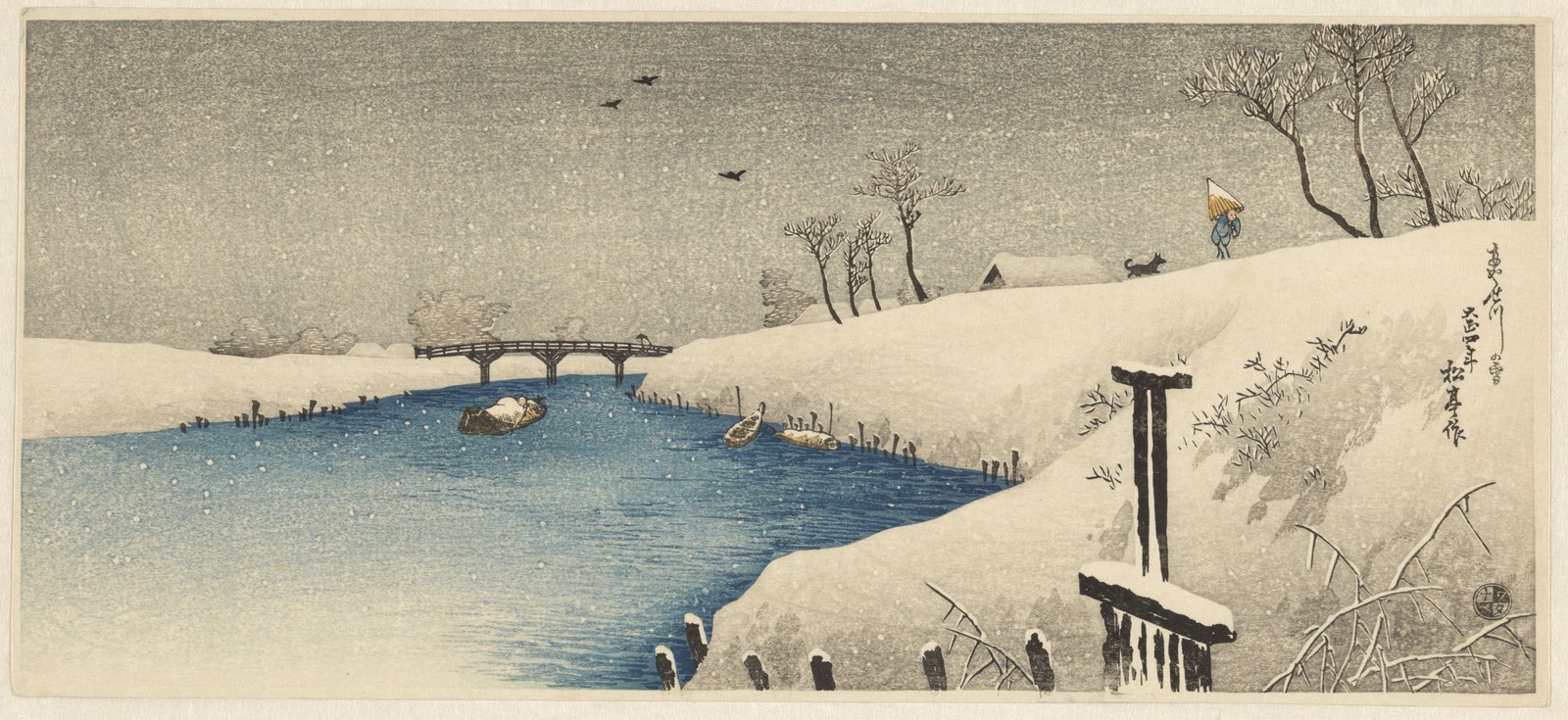
Snow on Ayase river. Image: Shōtei Takahashi · Public domain · Wikimedia Commons, accessed 2026-08-04
Shin-hanga, meaning "new prints," emerged in Tokyo around 1915 as a deliberate revival of the ukiyo-e woodblock tradition that had dominated Japanese printmaking for over two centuries but had faded with the rise of photography and Western-style painting. The movement was largely the vision of publisher Watanabe Shōzaburō, who recognized that the old ukiyo-e production system — an artist supplying a design, a carver cutting the woodblocks, a printer pulling the impressions, and a publisher coordinating and marketing the result — still had commercial and artistic life if updated for modern tastes.
Visually, shin-hanga prints look at once traditional and new. They use the flattened perspective, bold outlines, and multi-block color printing inherited from ukiyo-e masters, but they layer in atmospheric effects — soft gradients of dusk and dawn, reflected moonlight on water, falling snow, mist over mountains — borrowed from European Impressionism and from direct observation. Subjects fall into familiar ukiyo-e categories: landscapes (fukeiga), beautiful women (bijin-ga), and kabuki actors (yakusha-e), but rendered with a new interest in mood, weather, and fleeting light rather than pattern and gossip.
Shin-hanga rebelled against two things at once. Domestically, it pushed back against the idea that woodblock printing was a dying craft with nothing to offer modern Japan, insisting the medium could still produce serious, contemporary art. Internationally, it stood apart from sōsaku-hanga ("creative prints"), a rival movement that insisted a print was only authentic art if a single artist personally designed, carved, and printed the work. Shin-hanga defended the older collaborative studio system, arguing that specialization, not solitary authorship, produced the finest prints.
The movement matters because it kept a major branch of Japanese visual culture alive and evolving at a moment when it could easily have died out, and because it found an appreciative export market — particularly in the United States — that sustained Japanese printmaking financially through the interwar decades. Shin-hanga prints, with their quiet lyricism and technical polish, offered a gentler counterpart to the era's Western avant-gardes, and they remain some of the most collected and reproduced Japanese prints outside the classical ukiyo-e canon.
What defines Shin-hanga
Bokashi gradation
Prints rely heavily on bokashi, a hand-applied gradation technique where the printer wipes ink unevenly across the block to create smooth transitions of color, most often seen in skies, water, and twilight scenes. This soft blending gives shin-hanga its atmospheric, almost photographic sense of light.
Collaborative studio production
Each print passed through four specialists — artist, carver, printer, and publisher — continuing the ukiyo-e workshop model rather than the single-author printmaking championed by rival sōsaku-hanga artists. The publisher, often Watanabe Shōzaburō, oversaw design choices and coordinated editions.
Landscape and travel themes
Many shin-hanga series depict famous sites, temples, and rural scenes at specific times of day or seasons, echoing the format of earlier ukiyo-e travel prints. Snow, rain, dusk, and moonlight recur as vehicles for mood.
Bijin-ga portraiture
Portraits of women, updated for the twentieth century, replace the stylized courtesans of classical ukiyo-e with softer, more naturalistic faces and contemporary hairstyles or dress, often set against plain or textured backgrounds.
Western pictorial depth
Unlike the flat, decorative space of much earlier ukiyo-e, shin-hanga compositions often use atmospheric perspective, cast shadows, and a single implied light source, giving scenes a sense of depth and specific time of day.
Fine, controlled linework
Outlines remain crisp and confidently carved, preserving the graphic clarity of the woodblock medium even as color and gradation grow more painterly and naturalistic.
History
Shin-hanga began around 1915 when publisher Watanabe Shōzaburō, who had trained in the export print trade, started commissioning new designs from painters and illustrators rather than reprinting old ukiyo-e stock. His early collaborators included the Austrian painter and printmaker Fritz Capelari, followed soon by a stable of Japanese artists such as Kawase Hasui, Itō Shinsui, and Hiroshi Yoshida. Watanabe supplied the vision of a modernized print — one that kept the traditional woodblock process but responded to Impressionist ideas of light and mood that had filtered into Japan through Western art education.
The movement gained real momentum in the 1920s. Kawase Hasui became its most prolific landscape artist, touring Japan to sketch temples, coastlines, and rural villages later translated into prints by Watanabe's carvers and printers. Itō Shinsui specialized in bijin-ga, updating the genre with contemporary women in naturalistic poses. Hiroshi Yoshida, already an established Western-style painter, adopted the medium and became known for meticulous series depicting Japan, and eventually the American West and Europe, in shifting light.
The 1923 Great Kantō earthquake destroyed much of Watanabe's stock and printing blocks, but the studio rebuilt and shin-hanga continued through the late 1920s and 1930s, aided heavily by American and European collectors who prized its blend of exoticism and craftsmanship.
The movement declined as Japan moved toward war in the late 1930s and effectively ended by the early 1940s, as materials grew scarce and the market for luxury prints collapsed. Kawase Hasui and Itō Shinsui continued producing work into the postwar decades, but the collective, publisher-driven shin-hanga movement as a coordinated artistic enterprise had run its course by the time World War II ended.
Key works
| Work | Artist | Year | Why it matters |
|---|---|---|---|
| Shiba Zōjō-ji | Kawase Hasui | 1925 | A snow-covered temple scene from the Twenty Views of Tokyo series, prized for its atmospheric gradation and quiet nocturnal mood. |
| Sailing Boats | Hiroshi Yoshida | 1926 | A series depicting the same harbor scene at different times of day, showcasing shin-hanga's fascination with shifting light. |
| Ten Views of Mt. Fuji | Hiroshi Yoshida | 1928 | A landscape series capturing Japan's iconic mountain in varied seasons and atmospheric conditions. |
How to make art in this style
Working in the Shin-Hanga Style
Palette: Favor a restrained, atmospheric range — deep indigo and Prussian blue for night skies and water, muted violet-greys for dusk, warm ochre or amber for lantern and firelight, and soft cream for snow or paper ground. Avoid saturated primary contrasts; shin-hanga's color is about mood, not intensity.
Composition: Choose a single, specific place and moment — a temple gate at dusk, a harbor at dawn, rain on a street — and commit to one light source and one time of day. Use flattened, layered space: a foreground silhouette, a middle-ground subject, and a graded sky or water plane behind it. Leave generous quiet areas; shin-hanga compositions are rarely crowded.
Technique: If working traditionally, carve crisp, confident outlines first, then plan color separations for each block. The signature effect is bokashi — graduated color applied by hand-wiping ink unevenly across a dampened block — used for skies, water, and mist. If painting or drawing digitally, mimic this with soft, directional gradients rather than flat fills, and keep linework clean and unbroken beneath the color.
Subjects: Landscapes at transitional light (dawn, dusk, snowfall, moonrise), architecture such as temples, gates, and bridges, and figures — especially women in quiet domestic or contemplative poses — rendered naturalistically rather than stylized. Weather and season should read clearly and immediately.
Mood: Aim for lyricism over drama. The goal is a single, sustained emotional note — stillness, melancholy, quiet beauty — rather than narrative incident.
Legacy
Shin-hanga's reputation was, for decades, stronger abroad than at home, where the print medium carried less prestige than painting; American and European collectors preserved and popularized much of the surviving material long before Japanese museums took serious interest. Today the movement is recognized as a vital bridge between historic ukiyo-e and modern Japanese printmaking, and its serene, light-filled landscapes remain some of the most widely reproduced Japanese images in the world, appearing constantly in posters, book covers, and design.
Its influence is visible less in a direct lineage of imitators than in a broader visual sensibility: the moody, atmospheric treatment of familiar places, the use of gradation to suggest time of day and season, and the idea that traditional craft techniques could carry thoroughly modern content. Contemporary Japanese woodblock printmakers and illustrators still draw on shin-hanga's palette and compositional habits, and its emphasis on quiet, contemplative landscape has parallels in later travel photography and design aesthetics that prize stillness and atmosphere over incident. Museums and print dealers continue to treat shin-hanga as the last great flowering of the traditional Japanese woodblock print before industrial and wartime disruption changed the medium permanently.
Frequently asked questions
What is shin-hanga?
Shin-hanga ("new prints") was an early twentieth-century Japanese art movement that revived traditional ukiyo-e woodblock printing techniques while incorporating Western ideas of light, atmosphere, and naturalism. It flourished in Tokyo roughly from 1915 to 1942, led by publisher Watanabe Shōzaburō.
What's the difference between shin-hanga and sōsaku-hanga?
Shin-hanga kept the traditional collaborative system of separate artist, carver, printer, and publisher, while sōsaku-hanga ("creative prints") insisted a single artist should design, carve, and print their own work to count as authentic art. The two movements developed alongside each other but represented opposing philosophies of authorship.
Who started shin-hanga?
Publisher Watanabe Shōzaburō is generally credited as the driving force behind shin-hanga, commissioning new print designs from artists starting around 1915 and coordinating the carvers and printers who produced them.
How is shin-hanga different from classical ukiyo-e?
Classical ukiyo-e favored flat decorative color and graphic pattern, often depicting courtesans, actors, and urban entertainment. Shin-hanga used the same woodblock process but added Western-influenced atmospheric light, shading, and a calmer, more naturalistic sense of place and mood.
Who were the major shin-hanga artists?
Kawase Hasui, known for atmospheric landscapes; Itō Shinsui, known for portraits of women; and Hiroshi Yoshida, known for meticulously observed scenes of Japan and abroad, were among the movement's most prominent and prolific artists.