 Art
Art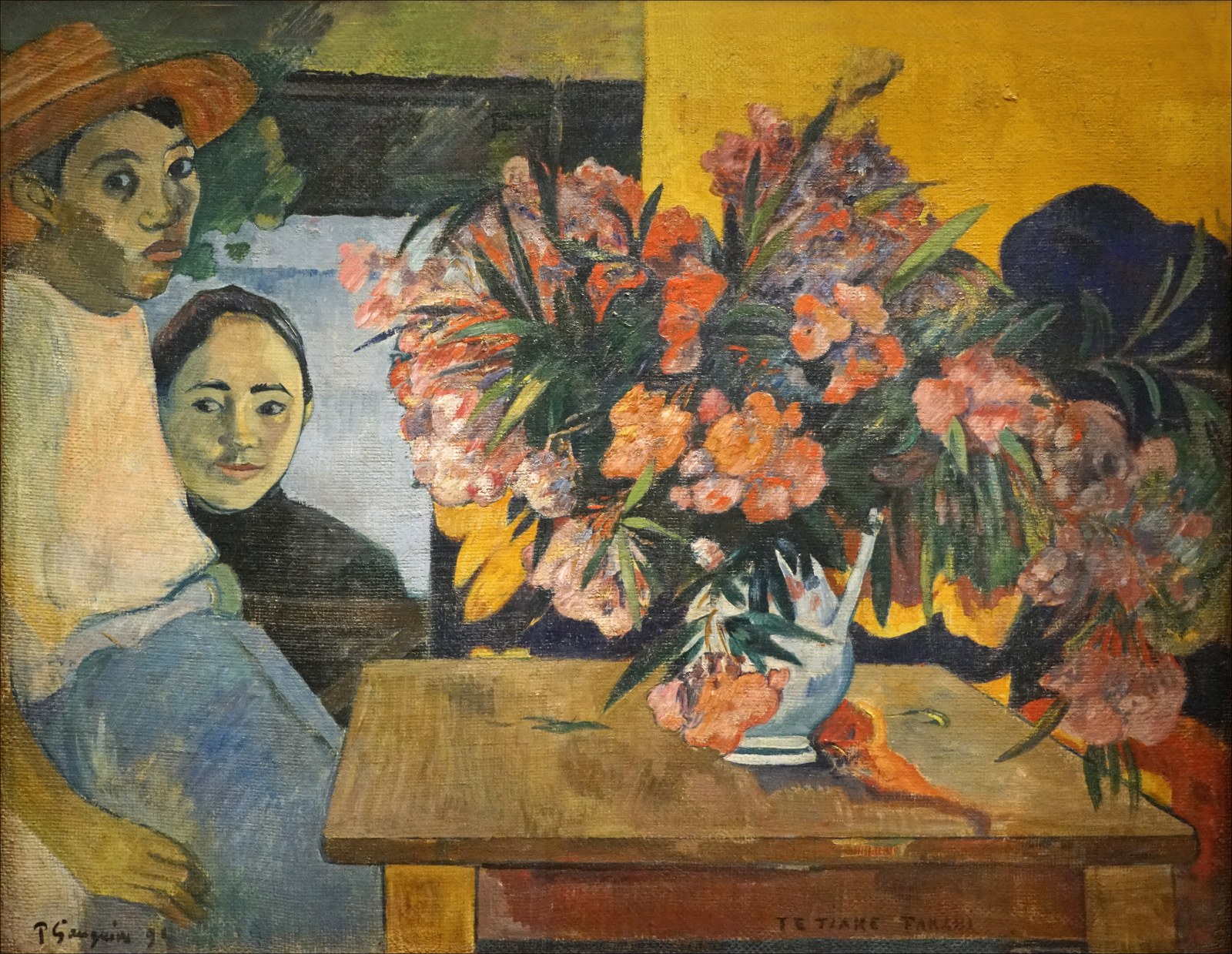
"Te Tiare Farani" de Paul Gauguin (Fondation Louis Vuitton, Paris). Image: dalbera · CC BY 2.0 · Wikimedia Commons, accessed 2026-08-04
Post-Impressionism is not a style but a label — coined retrospectively by the critic Roger Fry for a 1910 London exhibition — that gathers a generation of painters who came of age under Impressionism and then pushed past it. Vincent van Gogh, Paul Cézanne, Paul Gauguin, Georges Seurat, and Henri de Toulouse-Lautrec all absorbed the Impressionists' commitment to modern subject matter and heightened color, but each rejected the idea that painting should stop at recording a fleeting optical impression.
Where Monet chased the flicker of light on a haystack, Cézanne wanted to find the geometric bones beneath appearances, building form through small, repeated planes of color that seem to construct the object as you look. Van Gogh used thick, directional brushstrokes — sometimes squeezed straight from the tube — to carry feeling as much as description; a wheat field becomes a record of agitation, a night sky a vision. Seurat, working almost scientifically, broke color into tiny dots of pure pigment, trusting the eye to blend them at a distance. Gauguin, disenchanted with urban modernity, flattened his forms into bold, unmodulated shapes bounded by dark outlines, and painted from memory and symbol rather than observation.
What unites them is a shared conviction that Impressionism, for all its innovations, had left painting too passive — too willing to be a retina rather than a mind. Post-Impressionist artists reasserted the picture's structure, its emotional charge, and its right to depart from visual fact. They painted in flatter, more decorative color; they distorted perspective and proportion for expressive ends; they treated the canvas as a constructed object rather than a window.
The movement matters because it is the hinge between nineteenth-century naturalism and twentieth-century modernism. Cézanne's faceted planes anticipate Cubism; Van Gogh's emotive color anticipates Expressionism; Gauguin's flat symbolic shapes anticipate Fauvism and much of early abstraction. Without Post-Impressionism's insistence that a painting could carry meaning, structure, and feeling beyond mere appearance, the radical departures of the early twentieth century are difficult to imagine.
What defines Post-Impressionism
Expressive, Non-Naturalistic Color
Color was chosen for emotional or structural effect rather than fidelity to observed light. Saturated yellows and cobalt blues, flat vermilions, and cool green-and-ochre modeling all depart from what the eye actually records.
Visible, Purposeful Brushwork
Paint application became expressive in its own right. Thick, directional strokes build rhythm and urgency across a canvas, while small constructive touches accumulate into solid, almost architectural form.
Structure Over Instantaneity
Rather than chasing a single fleeting moment of light, these painters sought underlying order. Landscape and still life were reduced to essential geometric planes, aiming for something as solid and durable as the art of museums.
Symbolic and Emotional Subject Matter
Subjects carried private meaning, memory, or mood rather than pure observation. Distant lands were painted as much from imagination and myth as from life; skies and trees pulse with personal feeling.
Flattened Space and Bold Outline
Many Post-Impressionists reduced deep perspective in favor of flatter, more decorative arrangements, often influenced by Japanese woodblock prints, with strong contour lines separating areas of color.
Scientific Color Theory (Pointillism)
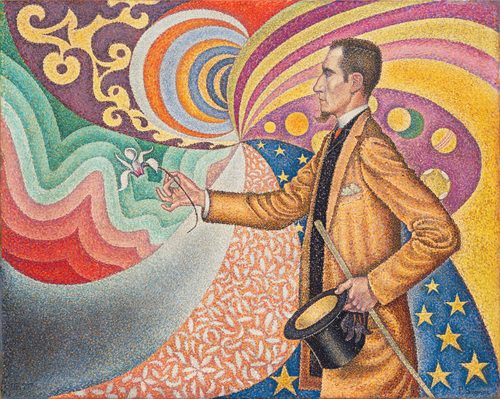
Some painters applied optical and color theory directly to the canvas, juxtaposing tiny dots of pure, unmixed pigment that the viewer's eye blends at a distance, producing a shimmering, mosaic-like surface.
History
Post-Impressionism has no founding manifesto or single studio of origin; it describes what happened after Impressionism's last group exhibition in 1886, as its most ambitious former participants and admirers went their separate ways. Georges Seurat had already shown a rigorously scientific approach to color at that final Impressionist exhibition, introducing a technique critics soon dubbed Neo-Impressionism or pointillism. Paul Cézanne, who had exhibited with the Impressionists in the 1870s, retreated increasingly to Aix-en-Provence to develop his structural analysis of landscape and still life in relative isolation. Vincent van Gogh arrived in Paris in 1886, absorbed Impressionist color firsthand, and within two years moved to Arles, where his mature, emotionally charged style emerged in a burst of productivity before his death in 1890. Paul Gauguin, initially an Impressionist collector and Sunday painter, broke decisively with naturalism at Pont-Aven in 1888, developing Synthetism and Cloisonnism before departing for Tahiti in 1891 in search of an unspoiled visual language.
The term itself is retrospective: the English critic and curator Roger Fry coined "Post-Impressionism" for his landmark 1910 exhibition Manet and the Post-Impressionists at London's Grafton Galleries, which introduced British audiences to this generation as a coherent, if loosely defined, tendency. The label stuck because it was useful — a way of naming a generation without imposing a shared style they never claimed.
By the time of Cézanne's death in 1906 and the memorial retrospectives that followed, younger Parisian painters moving toward Fauvism and Cubism were already absorbing these lessons directly. Post-Impressionism did not end so much as get metabolized, its innovations in color, structure, and expressive distortion becoming the shared inheritance of nearly every early modernist movement that followed.
Key works
| Work | Artist | Year | Why it matters |
|---|---|---|---|
| The Starry Night | Vincent van Gogh | 1889 | A swirling, visionary night sky rendered in thick impasto that epitomizes Post-Impressionism's expressive brushwork. |
| The Card Players | Paul Cézanne | 1892 | A geometric structuring of figures and space that anticipated Cubism's dismantling of single-point perspective. |
| Where Do We Come From? What Are We? Where Are We Going? | Paul Gauguin | 1897 | A mural-scale, philosophically ambitious summation of Gauguin's Tahitian period. |
| A Sunday on La Grande Jatte | Georges Seurat | 1886 | The landmark pointillist canvas applying optical color theory to a modern leisure scene. |
| At the Moulin Rouge | Henri de Toulouse-Lautrec | 1892 | A flattened, poster-influenced view of Parisian nightlife that fused fine art and graphic design. |
How to make art in this style
Working in a Post-Impressionist spirit starts with choosing which of its several toolkits you want to borrow, since the movement covers genuinely different approaches.
Palette: Favor saturated, often non-naturalistic hues — cobalt and ultramarine blues, chrome yellow, vermilion, emerald green — used in bold juxtaposition rather than smooth blending. Complementary contrasts (blue against orange, yellow against violet) create vibration and energy.
Composition: Simplify. Reduce a scene to a few large shapes and a clear rhythm — a tree's spiral, a mountain's triangular mass, a fruit bowl's stacked ovals. Perspective can be tilted or compressed rather than strictly linear; decorative flatness is welcome.
Brushwork: This is where the real character lives. For an energetic, expressive feel, apply paint thickly in short, directional strokes that follow the form — swirling for sky, vertical for grass, curved for trees — letting the brushwork itself carry emotion. For a more structural, sculptural feel, build form with small, patchy, repeated planes of color, allowing edges to stay slightly open rather than fully blended, so the object seems constructed rather than copied. For a pointillist effect, apply small dots or dashes of pure, unmixed color side by side and let the eye do the mixing at a distance.
Subjects: Landscapes, orchards, wheat fields, portraits, still lifes, and café or theater scenes all suit the approach. What matters less is what you paint than how visibly your hand and feeling are present in the paint itself — the goal is a personal, structured, or symbolic vision, not a neutral record.
Legacy
Post-Impressionism's fingerprints are on nearly every major current of early twentieth-century art. Cézanne's analysis of form into constituent planes directly inspired Cubism's founders, who regarded him as a foundational figure. Van Gogh's saturated, emotionally driven color and agitated brushwork fed directly into German Expressionism and the Fauves, and his posthumous fame — he sold almost nothing in his lifetime — turned him into the archetype of the misunderstood visionary artist, a myth that still shapes popular ideas about creative genius. Gauguin's flattened forms, non-Western sources, and symbolic color prepared the ground for Fauvism, Expressionism, and later (fraught) engagement with art beyond the European tradition. Seurat's systematic color science anticipated both Op Art's optical rigor and the broader modernist interest in process and system.
Beyond the history of painting, Post-Impressionism reshaped popular visual culture: Van Gogh's Starry Night is arguably the most reproduced painting in the world, appearing on everything from mugs to immersive digital exhibitions, while Post-Impressionist color and brushwork remain a default visual shorthand for "expressive" or "passionate" art in advertising, animation, and design.
Frequently asked questions
What is Post-Impressionism?
Post-Impressionism is an umbrella term for painters — chiefly Van Gogh, Cézanne, Gauguin, and Seurat — who worked after and reacted against Impressionism between roughly 1885 and 1910. Rather than sharing one technique, they shared a belief that painting should go beyond recording light to express structure, emotion, or symbolic meaning.
What's the difference between Impressionism and Post-Impressionism?
Impressionism aimed to capture the fleeting effect of light and atmosphere at a specific moment, often painted quickly outdoors. Post-Impressionists kept the bright palette but slowed down, reintroducing deliberate structure, symbolic content, or scientific color theory that Impressionism had set aside.
Who coined the term "Post-Impressionism"?
The British critic Roger Fry coined it for his 1910 London exhibition Manet and the Post-Impressionists, which introduced this generation of painters to English audiences under a single, deliberately loose banner.
Who are the major Post-Impressionist artists?
The core figures are usually Vincent van Gogh, Paul Cézanne, Paul Gauguin, and Georges Seurat, with Henri de Toulouse-Lautrec often included for his graphic, flattened depictions of Parisian nightlife.
Is pointillism part of Post-Impressionism?
Yes — pointillism is usually classified as a Post-Impressionist technique (sometimes separately labeled Neo-Impressionism), applying color theory through tiny dots of pure pigment.
Why is Post-Impressionism considered important to modern art?
It broke the link between painting and pure visual observation, giving later movements like Cubism, Fauvism, and Expressionism permission to distort form and color for structural or emotional ends rather than accuracy.