 Art
Art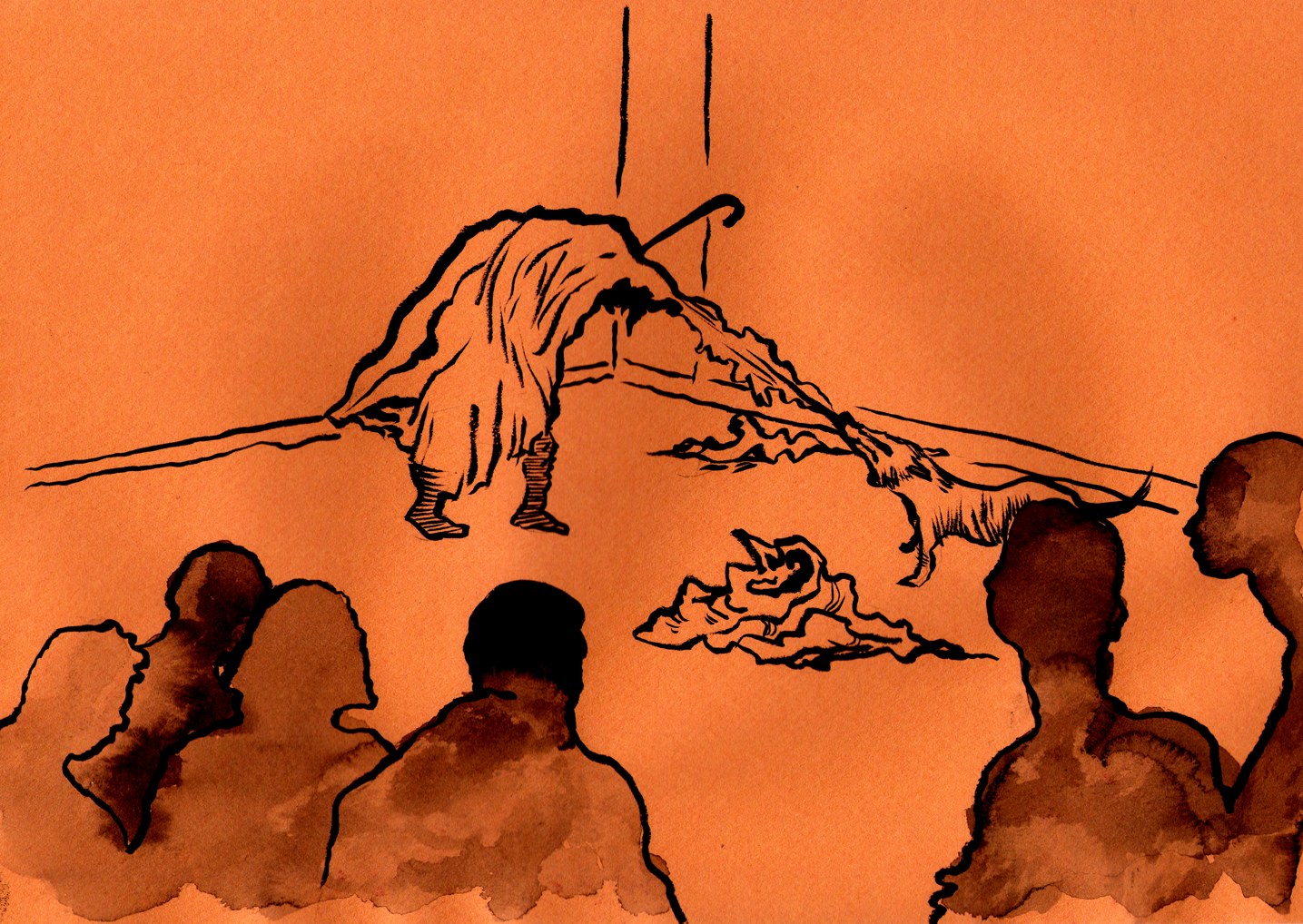
Acció de Joseph Beuys. Image: Oriol Tuca · CC BY-SA 3.0 · Wikimedia Commons, accessed 2026-08-04
Fluxus was less a style than a loose, international community of artists, composers, and poets who agreed on one thing: art did not need to look like art. Founded around 1961–62 by the Lithuanian-American organizer George Maciunas, the group grew out of experimental music circles in New York—especially John Cage's composition class at the New School, which introduced ideas of chance, indeterminacy, and everyday sound as legitimate artistic material.
What Fluxus produced rarely resembled paintings or sculptures. Its core forms were the "event score"—a few typed lines instructing a simple, often absurd action (drop a bean, follow a straight line, drip water into a piano)—and the "Fluxkit," a small box of cheap objects, games, and instructions mailed or sold for a few dollars. Performances, called "actions" or "concerts," might involve smashing a violin, filling a room with balloons, or reading a list of instructions aloud to a bewildered audience. Humor, chance, and audience participation were constants; polish and permanence were not.
Fluxus rebelled against the art market's obsession with unique, expensive, expert-made objects. Following Dada's lead, it treated the gallery system, the signature masterpiece, and the cult of artistic genius as targets for ridicule. Maciunas explicitly wanted Fluxus works to be cheap, mass-producible, and available to anyone—an "anti-art" that any person could perform or own. The name itself, Latin for "flow," signaled a commitment to process and change rather than fixed objects.
The group's roster read like a directory of postwar experimentation: Nam June Paik, who would go on to found video art; Yoko Ono, whose instruction pieces doubled as poetry; Joseph Beuys, who folded Fluxus actions into his broader idea of "social sculpture"; and dozens of composers, poets, and visual artists across Europe, Japan, and the Americas. The first major Fluxus festivals took place in Wiesbaden, Germany, in 1962, followed by events across a dozen cities.
Fluxus matters because it permanently widened the definition of art to include gesture, instruction, chance, and everyday behavior. It anticipated conceptual art's emphasis on idea over object, performance art's use of the body, and mail art's distribution networks—while insisting, with deadpan humor, that art could be as ordinary and as free as a joke.
What defines Fluxus
Event Scores
Fluxus works were often just a few typed sentences instructing a simple action, such as George Brecht's "Drip Music." Anyone could perform the score, which mattered more than any resulting object.
Fluxkits
Small boxes containing toys, games, printed cards, and found objects were assembled and sold cheaply, often through mail order. They turned the art multiple into something closer to a novelty item than a precious edition.
Deadpan Humor and Absurdity
Performances leaned on slapstick, puns, and controlled chaos—smashing instruments, filling rooms with objects, or performing mundane tasks with exaggerated seriousness. The humor doubled as a critique of art's self-importance.
Chance and Indeterminacy
Following John Cage, Fluxus artists let random or audience-driven outcomes shape the work. No two performances of the same score were identical.
Intermedia
Fluxus deliberately worked between disciplines—music, poetry, visual art, and theater—coining the term "intermedia" for art that could not be filed under a single medium.
Cheap and Ephemeral Materials
Objects were made from paper, rubber stamps, found toys, and household items rather than costly art materials, keeping works affordable and disposable rather than monumental.
History
Fluxus coalesced in New York around 1960–61, where composer John Cage's classes at the New School for Social Research gathered a circle of young artists—including George Brecht, Dick Higgins, Al Hansen, and Jackson Mac Low—interested in chance operations and the boundary between art and life. George Maciunas, a graphic designer and self-appointed organizer, gave the loose network its name and its manifesto-like ambitions around 1961, envisioning Fluxus as an international collective that would replace precious art with cheap, mass-distributed multiples.
The movement went public with the Fluxus International Festival of New Music in Wiesbaden, Germany, in September 1962, where European and American artists staged a week of concerts and actions. Similar festivals followed in Copenhagen, Paris, Amsterdam, and New York over the next several years, expanding the network to include Nam June Paik, Yoko Ono, Ben Vautier, Alison Knowles, Emmett Williams, and Robert Filliou. Maciunas coordinated much of this activity from New York, designing publications, organizing mail-order Fluxkits, and drafting manifestos that were often revised but never finished.
Fluxus never had a fixed membership or headquarters; it operated as a shifting network connected by newsletters, mail art, and shared festivals rather than a single gallery or city. Its loose structure let it absorb artists from Japan, Germany, and Eastern Europe, giving it a genuinely international character unusual for its time. Joseph Beuys became associated with the German wing in the early 1960s, taking part in the Festum Fluxorum Fluxus in Düsseldorf in February 1963, and folded Fluxus actions into his own performance and teaching practice.
The movement's momentum slowed through the 1970s as members pursued independent careers—Paik into video, Ono into music and activism, Beuys into a singular performance-based practice. George Maciunas's death in 1978 is often treated as Fluxus's symbolic end, though former members continued organizing Fluxus-labeled events and reunions for years afterward. Rather than dissolving cleanly, Fluxus dispersed into the wider vocabulary of conceptual, performance, and mail art that it had helped invent.
Key works
| Work | Artist | Year | Why it matters |
|---|---|---|---|
| Drip Music | George Brecht | 1962 | A short event score instructing a performer to pour water from one vessel into another, exemplifying Fluxus's reduction of art to a simple instructed action. |
| Cut Piece | Yoko Ono | 1964 | A performance in which audience members were invited to cut away the artist's clothing, an early and influential work of participatory, body-based art. |
| Grapefruit | Yoko Ono | 1964 | A book of poetic instruction pieces that became one of the most widely read Fluxus-associated texts. |
| How to Explain Pictures to a Dead Hare | Joseph Beuys | 1965 | A solo action in which Beuys, his head covered in honey and gold leaf, murmured explanations of art to a dead hare, blending Fluxus performance with his own mythic symbolism. |
| Composition 1960 #10 to Bob Morris | La Monte Young | 1960 | An instruction piece reading simply "Draw a straight line and follow it," anticipating Fluxus's event-score format just before the movement's founding. |
How to make art in this style
Working in the Fluxus Spirit
Fluxus was never about a visual style, so there is no signature palette or brushwork to imitate—its medium was the instruction and the action, not the object. Start with a score: write a short, clear set of instructions for a simple, slightly absurd action anyone could perform, such as "balance three spoons on your face" or "trace the shadow of a passing cloud." Keep the language plain and the action achievable without special skill.
If you want a physical trace of the piece, assemble a small kit rather than a finished artwork: a cigar box or envelope holding a few cheap, everyday objects—rubber stamps, dice, seed packets, printed cards—paired with a typed instruction sheet. Favor materials that are inexpensive, replaceable, and slightly worn, since Fluxus deliberately avoided the preciousness of fine-art materials.
For a documented performance, keep it brief, deadpan, and open to chance: let an audience member's response, a spilled liquid, or a random outcome finish the piece rather than controlling every variable. Photograph or film the action plainly, without theatrical lighting, so the documentation reads as evidence rather than as a polished art photograph.
Above all, resist resolving the work into a single beautiful object. The point is the gap between the ordinary action and the frame of "this is art"—humor, surprise, or a small shift in attention is the actual medium. If a piece feels too composed or precious, it has probably drifted away from Fluxus and toward something else.
Legacy
Fluxus's insistence that art could be an instruction, a gesture, or a cheap mailed object rather than a precious painting reshaped what counted as art for the rest of the twentieth century. Conceptual art's emphasis on idea over execution owes a direct debt to the event score; performance art inherited Fluxus's use of the body and live action as primary medium; and mail art, artist's books, and the multiple as an affordable art form all trace back to Maciunas's distribution schemes.
Nam June Paik carried Fluxus's playful use of technology into the founding of video art, while Yoko Ono's instruction pieces prefigured much of today's participatory and relational art, in which the audience completes the work. Joseph Beuys expanded Fluxus performance into a broader theory of art as social action, influencing generations of socially engaged artists.
Today, Fluxus's fingerprints are visible in participatory museum exhibits, artist-run zines and mail projects, absurdist performance art, and any practice that treats instructions or scores as the artwork itself. Its refusal to separate art from ordinary life remains a touchstone for artists skeptical of the gallery system and interested in humor, chance, and audience involvement as legitimate artistic tools.
Frequently asked questions
What is Fluxus?
Fluxus was an international network of artists active from the early 1960s through the late 1970s who treated everyday actions, simple instructions, and cheap mailed objects as art. Founded around George Maciunas, it drew on Dada and John Cage's ideas about chance to blur the line between art and ordinary life.
Who started Fluxus?
George Maciunas is generally credited as Fluxus's founder and chief organizer, giving the movement its name around 1961 and coordinating its festivals and mail-order publications. The network quickly grew to include Nam June Paik, Yoko Ono, Joseph Beuys, and dozens of other artists and composers.
What is a Fluxus "event score"?
An event score is a short set of typed instructions for a simple, often absurd action—such as pouring water or drawing a line—that anyone can perform. The score itself, not any resulting object, was considered the artwork.
How is Fluxus different from Dada?
Fluxus shared Dada's anti-art humor and rejection of the art market, but it emphasized instructions, participation, and mail-distributed multiples rather than assembled objects and manifestos. It was also more international and collaborative, organized as an ongoing network rather than a single wartime reaction.
Is Fluxus still active today?
Fluxus as an organized movement effectively ended with George Maciunas's death in 1978, though former members continued staging Fluxus-labeled events for years after. Its methods—event scores, participatory actions, and artist multiples—remain widely practiced in contemporary performance and conceptual art.