 Art
Art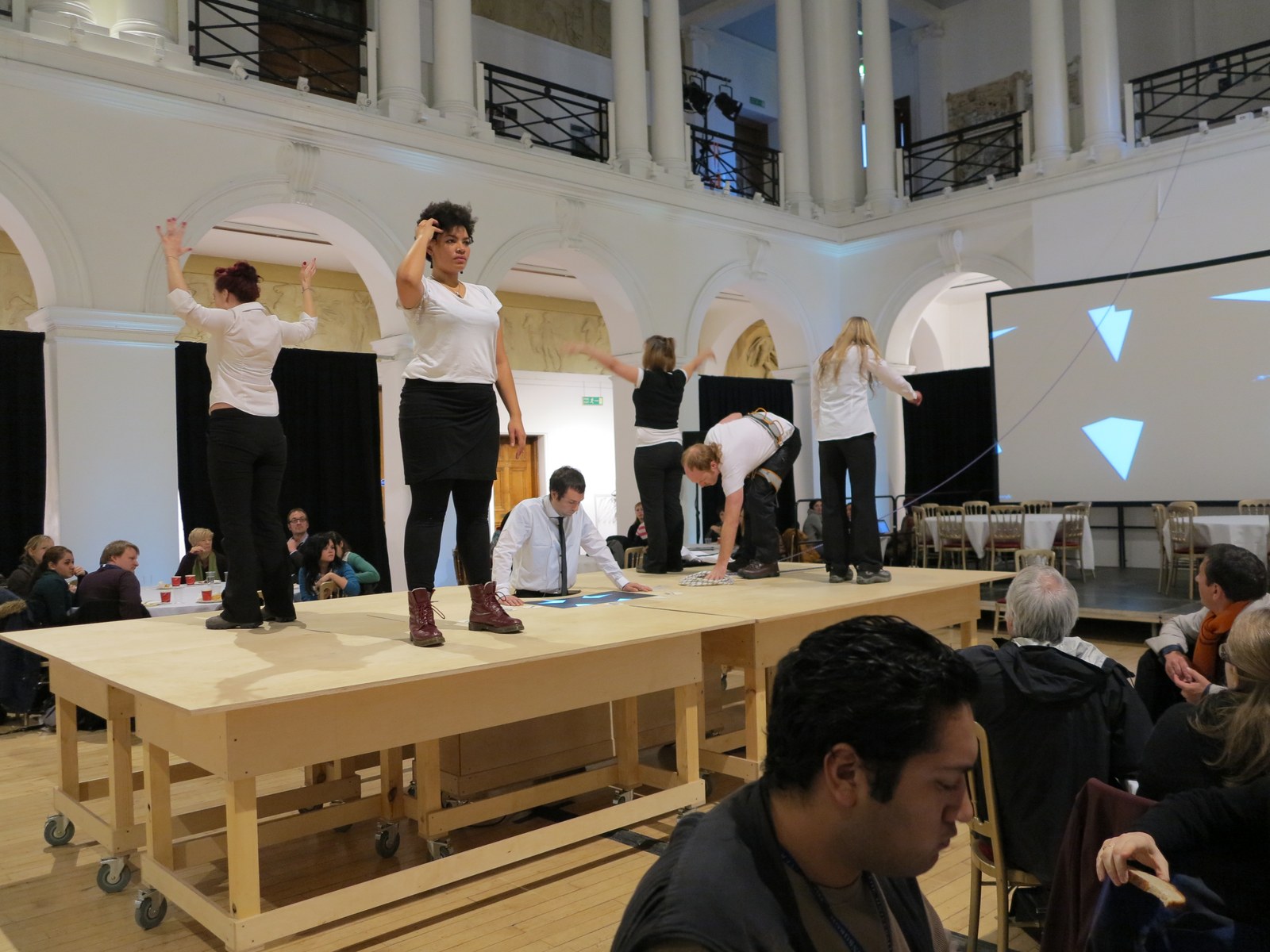
"The Final Problem" performed at lunch on Nov 2. Image: Jill · CC BY-SA 2.0 · Wikimedia Commons, accessed 2026-08-04
Performance Art treats the live, unrepeatable action of an artist—usually involving their own body—as the artwork itself, rather than as a step toward making a painting, sculpture, or photograph. A performance might last a few minutes or many hours; it might take place before a small invited audience or in a public street; it might be scripted in advance or largely improvised. What unites the field is the insistence that the work exists fully only in its live occurrence, with any resulting photographs, video, or objects serving as documentation rather than the artwork proper.
Performance Art grew out of the same postwar ferment as Fluxus and the Happenings staged by artists like Allan Kaprow, both of which treated action and audience participation as art in the early 1960s. It also drew on the confrontational body-based work of Japan's Gutai group and on earlier Futurist and Dada performance evenings. From these roots, artists across the 1960s and 1970s developed performance into a distinct, recognized medium with its own history, vocabulary, and canon of major works.
Visually and physically, Performance Art has taken extraordinarily varied forms: Marina Abramović standing passive for six hours while an audience was invited to use any of 72 objects on her body; Chris Burden having himself shot in the arm; Carolee Schneemann pulling a scroll of text from her body while reading it aloud; Yves Klein directing nude models covered in blue paint to press their bodies onto canvas before a formally dressed audience. Endurance, risk, vulnerability, ritual, and direct confrontation with the viewer recur across otherwise very different practices.
Performance Art rebelled against the idea that art must result in a permanent, sellable object, and against the distance a painting or sculpture keeps between artist and audience. By putting the artist's actual body at stake—sometimes literally, through pain or physical risk—it made art immediate, ethically charged, and impossible to fully own or display in a conventional sense. It matters because it established live action as a legitimate, museum-recognized medium in its own right, one that continues to evolve today through new generations of artists working with the body, audience, and time.
What defines Performance Art
The Body as Medium
The artist's own body—its endurance, vulnerability, gestures, or presence—serves as the primary material, replacing paint, stone, or canvas as the work's substance.
Liveness and Unrepeatability
Each performance is a singular event, unfolding in real time before an audience; even a scripted repeat is understood as a new occurrence rather than an identical copy.
Audience Participation or Confrontation
Many works directly involve the audience—inviting them to touch, alter, or interact with the artist—collapsing the usual distance between viewer and artwork.
Documentation as Trace, Not Original
Because the live event cannot be resold or exhibited after the fact, photographs, film, and written accounts stand in for the work, raising ongoing questions about how a performance can be collected or historicized.
Endurance and Risk
Performances frequently push physical or psychological limits—prolonged stillness, pain, exhaustion, danger—using the artist's own risk as a source of the work's intensity.
Ritual and Repetition
Simple actions are often repeated, extended, or slowed down well beyond ordinary behavior, giving everyday gestures a ritual, meditative, or unsettling quality.
History
Performance Art's roots reach back to Futurist and Dada performance evenings of the 1910s, but it emerged as a distinct, named medium in the postwar period, developing alongside Allan Kaprow's "Happenings" in New York around 1959–60 and the Gutai group's body-based actions in Japan from the mid-1950s. Fluxus's event scores and actions through the early 1960s further established the idea that a live, often absurd or ritualistic action could stand as a complete artwork.
Through the 1960s and 1970s, performance developed its own vocabulary distinct from theater or dance, emphasizing the artist's actual, unscripted presence rather than a rehearsed character. Yves Klein's 1960 "Anthropometries," in which nude models covered in blue paint pressed their bodies onto canvas before a formally dressed audience, brought performance into a fine-art gallery context. Carolee Schneemann's body-based works of the mid-1960s, including "Meat Joy" (1964), and Vito Acconci's confrontational solo actions of the early 1970s, such as "Seedbed" (1972), pushed the medium toward increasingly direct, sometimes unsettling engagement with the artist's own body and the audience's presence.
Feminist artists used performance extensively through the 1970s to address the body, sexuality, and gendered experience directly, with Schneemann's "Interior Scroll" (1975) and Marina Abramović and Ulay's collaborative endurance pieces becoming touchstones. Chris Burden's extreme physical-risk works, including having himself shot in "Shoot" (1971), tested how far bodily danger could extend the medium.
By the 1980s and 1990s, performance had become an established, museum-recognized category, taught in art schools and collected through documentation and reperformance agreements. Marina Abramović's 2010 retrospective and accompanying performance "The Artist Is Present" at a major New York museum brought unprecedented mainstream visibility to the medium. Performance Art has no clear endpoint: it remains an active, continuously practiced medium today, central to biennials, museum programming, and contemporary art more broadly.
Key works
| Work | Artist | Year | Why it matters |
|---|---|---|---|
| Anthropometries | Yves Klein | 1960 | Nude models covered in blue paint pressed their bodies onto canvas before a formally dressed audience, staging painting itself as a live performance. |
| Interior Scroll | Carolee Schneemann | 1975 | The artist read from a text pulled in a continuous scroll from her body, a foundational work of feminist body-based performance. |
| Shoot | Chris Burden | 1971 | The artist had an assistant shoot him in the arm before a small audience, pushing performance toward genuine physical risk as artistic material. |
| The Artist Is Present | Marina Abramović | 2010 | A months-long performance at a major museum in which the artist sat silently across from visitors one at a time, bringing broad public attention to the medium. |
How to make art in this style
Approaching Performance Art Today
Performance art begins with an action and a body, not a material palette, so start by defining precisely what will happen, for how long, and under what conditions. Write it down as clearly as a Fluxus-style score if that helps: what you will do, what the audience can or cannot do, where it starts and ends.
Decide early whether the audience is a passive witness or an active participant. Some of the medium's strongest works depend on inviting the audience to touch, alter, or otherwise complete the piece; others depend on strict, unbroken distance between performer and viewer. Be deliberate about which you want, since it shapes the entire emotional register of the piece.
Consider duration carefully. Performance art often works through repetition, stillness, or extended time rather than a single dramatic gesture—holding a position, repeating a simple motion, or remaining present for hours can build a different kind of intensity than a brief, theatrical action.
Keep props, costume, and setting minimal and purposeful; anything present should earn its place rather than decorate the piece. Plain, even harsh lighting and an unadorned space keep attention on the action itself rather than on production values.
Plan documentation before you perform, not after. Decide who will photograph or film the piece, from what angle, and how much of the performance's real duration the documentation should preserve, since this record will likely be how most people ever encounter the work. Above all, be honest about genuine risk or vulnerability in the piece and prepared for its real consequences, not just its symbolic ones.
Legacy
Performance Art established live action, endurance, and the artist's own body as fully legitimate, museum-collectible artistic material, permanently expanding what counts as an artwork beyond painted or sculpted objects. Its emphasis on the audience's direct, often uncomfortable proximity to the artist reshaped how museums think about participation, ritual, and duration in exhibition-making.
The medium's influence extends well beyond dedicated performance art: video art, installation, and socially engaged practice all inherited its interest in live presence, documentation, and audience involvement. Feminist performance work of the 1970s remains foundational to how contemporary art addresses the body, identity, and gendered experience. Endurance-based performance, in particular, has become a recurring strategy across generations of artists testing physical or psychological limits before an audience.
Today, performance art is a standard category in biennials, art fairs, and museum programming worldwide, with institutions developing formal methods for acquiring, reperforming, and archiving works that were originally designed to exist only once. Its basic proposition—that a live, time-based action can be as complete and serious an artwork as a painting—now goes largely unquestioned, a measure of how thoroughly the medium succeeded in establishing itself since its more marginal, experimental beginnings in the 1960s.
Frequently asked questions
What is Performance Art?
Performance Art is a medium in which a live action by the artist, usually involving their own body, constitutes the artwork itself rather than a step toward making a painted or sculpted object. It emerged as a distinct, named field in the 1960s, building on earlier Dada and Futurist performance traditions.
Who started Performance Art?
Performance Art doesn't have a single founder; it developed through the convergence of Allan Kaprow's Happenings, the Japanese Gutai group's body-based actions, and Fluxus events in the late 1950s and early 1960s. Artists including Yves Klein, Carolee Schneemann, and Joseph Beuys helped establish it as an independent medium through that decade.
How is Performance Art different from theater?
Performance Art artists typically present themselves rather than a scripted character, working without the narrative structure, rehearsal, and repeatability conventional theater relies on. Each performance is generally treated as a singular, often partly improvised event rather than a repeatable production of the same play.
How is a performance artwork preserved or sold?
Since the live event itself cannot be resold, performances are typically preserved through photographs, video, and written scores, and some works are acquired by museums along with rights and instructions to reperform them with new performers over time.
Is Performance Art still practiced today?
Yes. Performance remains an active, widely practiced medium, central to contemporary biennials, art fairs, and museum programming, with new generations of artists continuing to use live action, endurance, and audience interaction as primary material.