 Art
Art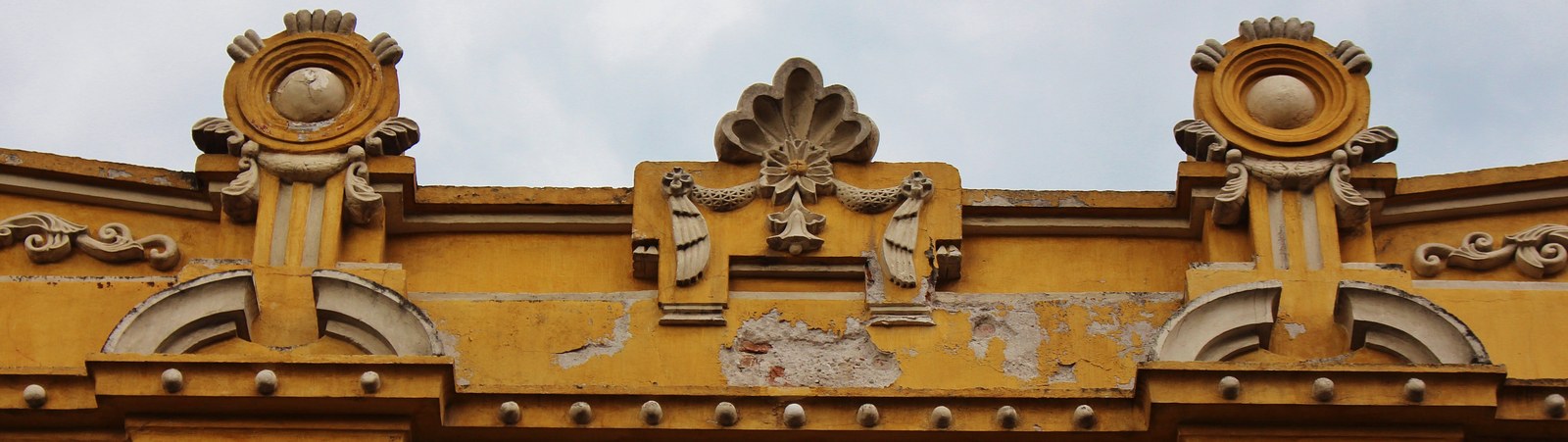
Detalle Art Nouveau de una casa en Puebla. Image: Mario Yaír TS · CC BY-SA 4.0 · Wikimedia Commons, accessed 2026-08-04
Art Nouveau ("new art") was an international decorative style that swept across Europe and the United States between roughly 1890 and 1910, treating ornament not as decoration applied to an object but as its very structure. Its signature is the "whiplash line" — a long, asymmetrical curve borrowed from plant tendrils, wave crests, and flowing hair — which artists wound through posters, stained glass, wrought-iron balconies, furniture, and even door handles and typefaces. The style aimed for a Gesamtkunstwerk, a total work of art in which architecture, interior design, and every decorative object shared one coherent visual language.
The movement rebelled against two things at once: the mechanical, ornament-free output of industrial manufacturing, and the tired historicism of the academic establishment, which recycled Greek, Gothic, and Renaissance forms without inventing anything new. Art Nouveau designers looked instead to nature's own structures — irises, lilies, dragonflies, peacock feathers, the curve of a woman's hair — and to the flat, asymmetrical compositions of Japanese woodblock prints, which had flooded into Europe after Japan opened to trade. The Arts and Crafts movement's insistence on honest, hand-finished craftsmanship, and Symbolism's taste for dreamlike, decorative mood, fed into the same current.
Visually, Art Nouveau looked different depending on where it landed. In Brussels, Victor Horta bent iron into vine-like staircases and window frames. In Paris, Hector Guimard's cast-iron Métro entrances turned the daily commute into ornament, while Alphonse Mucha's posters of flowing-haired women advertising theater and champagne became some of the era's most reproduced images. In America, Louis Comfort Tiffany translated the style into iridescent Favrile glass lamps and windows. Regional names multiplied — Jugendstil in Germany and Austria, Stile Liberty in Italy, Modernisme in Catalonia (home to Antoni Gaudí's biomorphic buildings) — but all shared the same organic vocabulary.
Art Nouveau matters because it was the first fully international modern style, one that refused to separate fine art from applied art and elevated the poster, the vase, and the door handle to the status of serious design. It burned brightly but briefly: by 1910 its dense ornament felt outdated next to the streamlined geometry that would become Art Deco, and the First World War closed the door on its dreamlike optimism. Its curling lines nonetheless remained a touchstone for graphic designers, illustrators, and architects for the rest of the twentieth century.
What defines Art Nouveau
The Whiplash Line
A long, asymmetrical curve modeled on plant stems, waves, and flowing hair runs through Art Nouveau design, giving even static objects a sense of organic motion.
Botanical and Natural Motifs
Irises, water lilies, peacocks, dragonflies, and vines recur constantly, rendered with close observation of natural growth rather than as stiff decorative borrowing.
Total Design
Architects and designers aimed to unify every element of a building or object under one visual idea, a Gesamtkunstwerk in which nothing was left undesigned, from a facade down to its cutlery.
Flat Color and Japanese Influence
Borrowing from ukiyo-e woodblock prints, many Art Nouveau posters and graphics use flat, outlined fields of color and asymmetrical, cropped compositions instead of traditional perspective and modeling.
New Craft Materials
Wrought iron, stained and iridescent glass, and cast bronze were pushed into fluid, plant-like shapes, treating industrial materials with the sinuous freedom once reserved for carving or painting.
The Idealized Female Figure
Long-haired women in flowing drapery appear constantly in posters, jewelry, and stained glass, their hair and gowns dissolving into the surrounding decorative line.
History
Art Nouveau's first fully realized building is usually dated to 1893, when Victor Horta completed the Hôtel Tassel in Brussels, its interior stairway wrapped in iron and paint that mimicked climbing vines. The style took its lasting name two years later, in 1895, when the dealer Siegfried Bing opened a Paris gallery called "Maison de l'Art Nouveau," which showcased furniture, glass, and objects in the new manner.
Paris crystallized the style's public image around the 1900 Exposition Universelle, where Hector Guimard's cast-iron Métro entrances, with their insect-like lamps and tendril supports, became instant landmarks. Alphonse Mucha had already made his name overnight in 1894 with "Gismonda," a poster for actress Sarah Bernhardt whose flowing lines and decorative border defined a new visual grammar for advertising. Louis Comfort Tiffany, working in New York, translated the same organic sensibility into Favrile glass lamps and windows, patenting his iridescent glass process in 1894.
The style spread rapidly and unevenly across the continent, absorbing local names and inflections: Jugendstil in Germany, Stile Liberty in Italy (after the London department store that sold Art Nouveau goods), Modernisme in Barcelona, where Antoni Gaudí pushed the organic idiom into architecture of startling structural invention. Vienna developed a related but distinct, more geometric offshoot through the Secession group.
By the years just before the First World War, Art Nouveau's dense, hand-crafted ornament had begun to look expensive and old-fashioned next to the machine-age geometry emerging in Vienna, and later in Art Deco and early modernism. The war itself, with its rupture of prewar optimism and craft economies, effectively closed the movement's active period. Its influence persisted underground for decades before resurfacing explicitly in the psychedelic poster art of the 1960s.
Key works
| Work | Artist | Year | Why it matters |
|---|---|---|---|
| Gismonda (poster for Sarah Bernhardt) | Alphonse Mucha | 1894 | This overnight sensation established Mucha's decorative poster style and helped define Art Nouveau's public image. |
| The Peacock Skirt | Aubrey Beardsley | 1893 | An illustration for Oscar Wilde's Salome whose stark black-and-white linework became a touchstone of Art Nouveau graphic art. |
| Hôtel Tassel | Victor Horta | 1893 | Widely considered the first Art Nouveau building, its iron staircase translated botanical curves into architecture. |
How to make art in this style
Creating Art Nouveau-Style Work Today
Palette: work with muted, natural jewel tones — moss and forest green, mustard and old gold, dusty mauve, burnt sienna, and cream or ivory grounds. Avoid bright, saturated primaries; Art Nouveau color is closer to stained glass and aged metal than to poster-paint brightness.
Composition: build the image around one long, sinuous curve — a line of hair, a vine, a ribbon of drapery — and let secondary elements branch from it asymmetrically. Leave generous flat background space rather than filling the whole frame, and consider a decorative border or frame as part of the composition itself, echoing the poster tradition.
Line and technique: draw with a confident, unbroken contour line, then fill the shapes it creates with flat or lightly modulated color rather than heavy shading. Keep brushwork smooth and controlled rather than textured or gestural — the goal is a graphic clarity closer to printmaking than to painterly impasto. For a more architectural or craft approach, study wrought-iron and stained-glass structures, where the "line" is literally the material's edge.
Subjects: botanical forms (irises, lilies, poppies, vines), insects and birds (dragonflies, peacocks, swans), and idealized female figures with flowing hair or drapery are the movement's core repertoire. Letting hair, fabric, or plant tendrils dissolve into the surrounding ornament — so figure and background share one continuous line — is the single most identifiable Art Nouveau device, and the one most worth practicing directly.
Legacy
Art Nouveau's direct descendants are easiest to trace in graphic design: its flowing line and decorative female figure resurfaced almost unchanged in the psychedelic concert posters of 1960s San Francisco, and Mucha's compositions remain among the most reproduced images in poster history, still sold as prints and used in branding today. The style's insistence on unifying architecture, furniture, and object design anticipated the twentieth century's broader idea of total design, later carried forward by movements like the Bauhaus, even though the Bauhaus rejected Art Nouveau's ornament in favor of stripped-down geometry.
Tiffany lamps remain a fixture of American decorative taste, still widely reproduced and collected, and Gaudí's Barcelona buildings — Casa Batlló, Park Güell, the unfinished Sagrada Família — are now among the most visited architectural sites in the world, keeping the movement's organic structural logic in front of millions of visitors a year. Art Nouveau's whiplash curves also live on in tattoo art, jewelry design, and typography, wherever a designer reaches for an organic, hand-drawn alternative to geometric modernism. Few movements have moved so freely between fine art, architecture, and mass-produced commercial graphics, and that cross-media reach is a large part of why its imagery still feels immediately recognizable.
Frequently asked questions
What is Art Nouveau?
Art Nouveau is an international decorative art and architecture style, active roughly from 1890 to 1910, defined by sinuous, plant-inspired lines and the ambition to unify fine art, architecture, and everyday design under one ornamental language.
What does 'Art Nouveau' mean?
The name is French for 'new art.' It comes from a Paris gallery, Maison de l'Art Nouveau, opened by dealer Siegfried Bing in 1895 to showcase the emerging style.
What is the difference between Art Nouveau and Art Deco?
Art Nouveau (c. 1890-1910) uses organic, asymmetrical, plant-derived curves, while Art Deco, which followed it in the 1920s and 1930s, favors symmetrical, geometric, streamlined forms influenced by machine-age design and Cubism.
Who were the key Art Nouveau artists?
Alphonse Mucha and Aubrey Beardsley defined its graphic and illustrative side, Victor Horta and Hector Guimard its architecture, and Louis Comfort Tiffany its decorative glass, with regional figures like Antoni Gaudí extending the style further.
Why did Art Nouveau end?
Its dense, hand-crafted ornament grew expensive and started to look old-fashioned next to simpler geometric styles emerging elsewhere in Europe, and the disruption of the First World War closed out its optimistic, decorative mood.