 Art
Art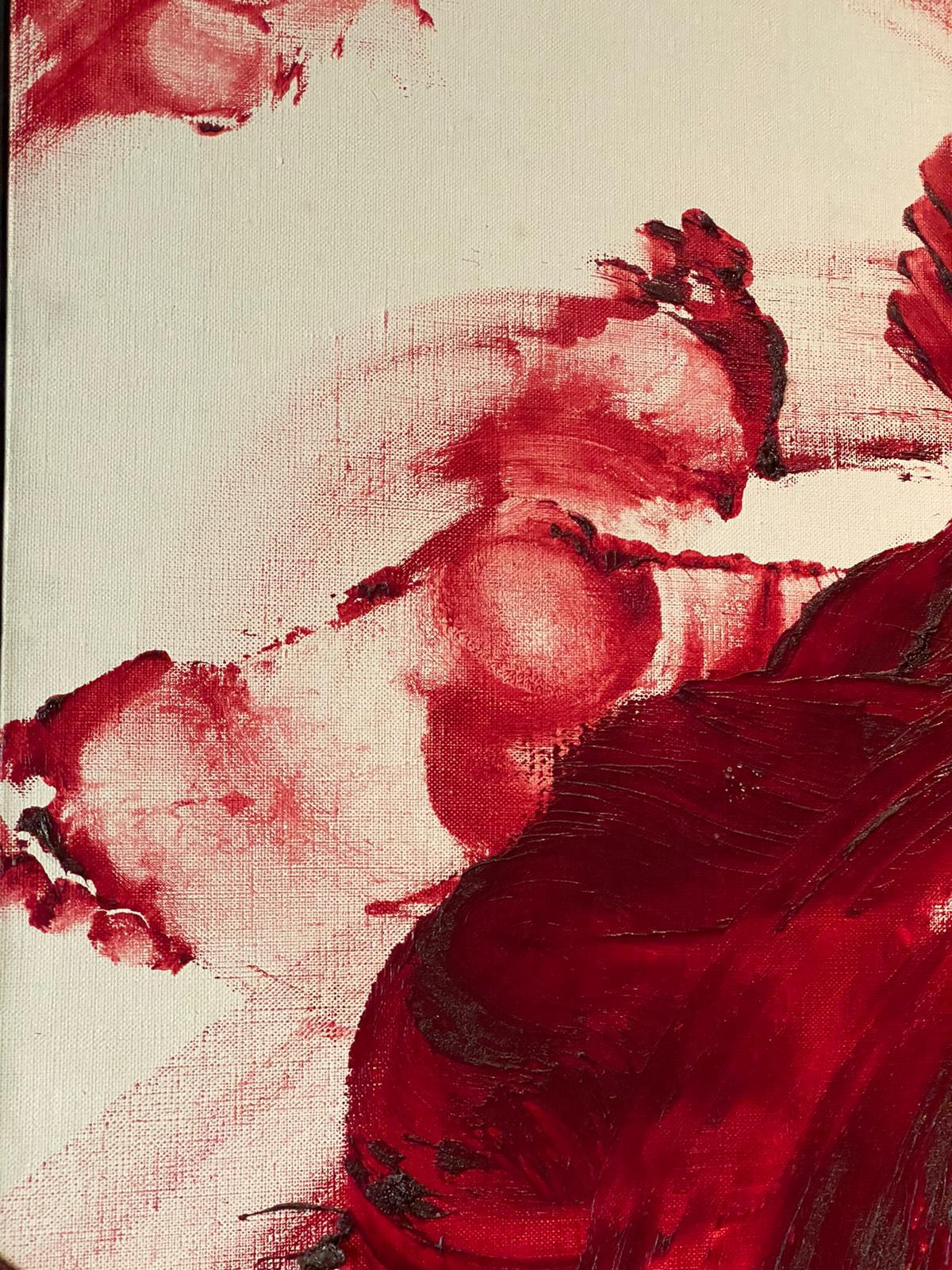
Using his feet. Image: Jean-marc.bottazzi · CC BY-SA 4.0 · Wikimedia Commons, accessed 2026-08-04
Gutai — short for Gutai Bijutsu Kyōkai, the Gutai Art Association — was founded in 1954 in the Kansai region of Japan by the painter Jirō Yoshihara, who gathered a group of younger artists around a single, radical instruction: "Do what no one has done before." Working in Osaka and the nearby city of Ashiya, the group treated painting and sculpture as secondary to the physical act of making — matter, the body, and unconventional tools mattered more than any finished image.
Gutai's signature works were often events as much as objects. Kazuo Shiraga painted by gripping a rope suspended from the ceiling and dragging his bare feet through pools of paint on the floor below, and in 1955 wrestled a mountain of mud in a performance called Challenging Mud. Atsuko Tanaka built and wore Electric Dress, a costume of hundreds of painted lightbulbs and flashing neon tubes wired to blink in sequence. Saburo Murakami leapt through stretched paper screens, leaving a body-shaped tear as the finished "painting." Shōzō Shimamoto fired paint-filled glass bottles from a homemade cannon at canvas, letting the explosion compose the image.
Gutai rebelled against the idea that painting had to remain a static, framed object made with brush and pigment on canvas — an assumption shared by both prewar Japanese academic art and the abstract painting fashionable internationally at the time. Its members insisted that "concrete" (gutai) engagement with real materials — mud, glass, electricity, torn paper, smoke — was more honest than any illusionistic or purely formal image. The group staged its work in outdoor exhibitions, on stage, and in specially built indoor halls, anticipating installation and environmental art by years.
Gutai matters because it independently arrived, in provincial postwar Japan, at ideas the international art world would not fully embrace until the 1960s and '70s: performance as artwork, the body as medium, and process as content over finished product. Long overlooked outside Japan, it is now recognized as one of the most forward-looking movements of the postwar period.
What defines Gutai
Body as primary tool
Artists painted with feet, whole-body motion, or physical combat with materials rather than relying on brushes and hands alone, making the artist's body part of the finished work.
Unconventional, raw materials
Mud, glass, electric light, smoke, water, and torn paper stood alongside or replaced paint and canvas, treated as legitimate artistic media in their own right.
Performance as artwork
Many key Gutai pieces existed primarily as timed, physical events performed before an audience, with any resulting object serving as a secondary trace of the action.
Destructive and violent gesture
Cannon-fired paint bottles, torn paper screens, and wrestled mud incorporated force, damage, and even danger as legitimate compositional methods.
Outdoor and staged exhibitions
Gutai works were frequently shown outdoors, on a theater stage, or in purpose-built exhibition halls rather than conventional galleries, extending art into real space.
Anti-illusionistic honesty of material
Rather than representing anything, the works aimed to present materials and actions directly and "concretely," rejecting metaphor in favor of literal physical presence.
History
Gutai formed in July 1954 when Jirō Yoshihara, an established Kansai-region abstract painter, brought together a group of younger artists that came to include Kazuo Shiraga, Atsuko Tanaka, Saburo Murakami, and Shōzō Shimamoto. Yoshihara, who had connections to prewar Japanese avant-garde circles, positioned Gutai explicitly against academic painting and against what he saw as the imitative abstraction dominating both Japanese and international art at the time.
The group's first public exhibition, the Experimental Outdoor Exhibition of Modern Art to Challenge the Midsummer Sun, was staged in July 1955 in a pine grove beside the Ashiya River, with works installed among the trees; the 1st Gutai Art Exhibition followed indoors at the Ohara Kaikan in Tokyo in October 1955, with pieces incorporating light, sound, and physical action. Its early exhibitions and the group's journal, also titled Gutai, which Yoshihara mailed internationally, brought the work to the attention of the French critic Michel Tapié, who visited Japan in 1957 and championed the group in Europe, connecting it loosely, if imperfectly, to the gestural abstraction of Art Informel.
Through the late 1950s and 1960s, Gutai staged annual exhibitions, outdoor shows, and "Gutai Art on the Stage" performance events combining painting, sculpture, music, and theatrical action. The group evolved over its nearly two-decade existence, with later work moving toward large-scale installation, kinetic and light-based pieces, and technology, as younger members joined and earlier techniques were absorbed and extended.
Gutai continued until Yoshihara's death in 1972, after which the group formally disbanded. For decades afterward it remained comparatively obscure outside Japan, known mainly through Tapié's writing and a handful of international showings. Beginning in the 1990s and accelerating after later international traveling retrospectives, museums and scholars reassessed Gutai as a pioneering source for performance, installation, and process art, restoring it to a central position in the global history of postwar art.
Key works
| Work | Artist | Year | Why it matters |
|---|---|---|---|
| Challenging Mud | Kazuo Shiraga | 1955 | A performance in which the artist physically wrestled a large mound of mud, treating the struggle itself as the artwork. |
| Electric Dress | Atsuko Tanaka | 1956 | A wearable sculpture of painted, wired lightbulbs and neon tubing, an early landmark in technology-based art. |
| Passing Through | Saburo Murakami | 1956 | A performance in which the artist leapt bodily through stretched paper screens, leaving torn openings as the finished work. |
| Please Walk on Here | Shōzō Shimamoto | 1955 | An installation of unstable planks over springs that invited viewers to physically experience the artwork underfoot. |
How to make art in this style
Working in a Gutai Style
Palette: Color is secondary to material and action; when used, favor bold, raw pigment — red, black, white — applied straight and unmixed, or let the natural color of mud, glass, and found material stand in for paint.
Composition: Let the process determine the composition rather than planning an image beforehand. Think in terms of an event with a beginning and end — a single dragged gesture, a thrown or fired mark, a torn opening — rather than a built-up picture.
Technique: Experiment with painting tools beyond the brush: bare feet, whole-body movement, thrown or dropped material, even controlled destruction. Try dragging paint with your feet across a horizontal surface, or applying paint by throwing, pouring, or launching it at the canvas rather than brushing it on.
Materials: Look past paint and canvas to mud, sand, glass, torn paper, rope, and light. Treat these as full artistic media rather than novelty additions, letting their real physical properties — weight, fragility, texture — shape what the work can do.
Subjects: There is no representational subject; the material and the action are the content. Resist metaphor and let the work stay "concrete" — what you see is what happened, not a symbol for something else.
Process: Consider working with a time limit, an audience, or a physical constraint, such as a suspended rope or a fixed amount of material, that forces spontaneous decisions rather than slow deliberation.
Legacy
Gutai's insistence on the body, raw material, and the event over the finished object anticipated Happenings, Fluxus, and body art by a decade or more, even though Western audiences did not fully recognize the connection until much later. Kazuo Shiraga's foot-painting technique and Atsuko Tanaka's Electric Dress are now seen as foundational moments in the histories of performance art and wearable, technology-based sculpture respectively.
Because the group's international profile lagged its actual innovations for so long, Gutai's rediscovery from the 1990s onward reshaped standard art-historical timelines, pushing scholars to treat postwar Japan as a genuine center of avant-garde innovation rather than a follower of European and American developments. Major retrospectives and museum acquisitions since the 2000s have secured Gutai's works a place in the permanent collections of leading international museums.
Its embrace of unconventional materials and the body as medium continues to inform contemporary performance, installation, and process-based art worldwide, and its example — a small, geographically isolated group arriving independently at ideas that would later define entire movements — remains a frequently cited case study in art history for how innovation does not travel in only one direction.
Frequently asked questions
What is Gutai?
Gutai was a Japanese avant-garde art group founded in Osaka in 1954 that treated painting and sculpture as physical action, using the body and unconventional materials like mud, glass, and light rather than relying on brush and canvas alone.
Who founded Gutai?
Gutai was founded by the painter Jirō Yoshihara in 1954, who gathered younger Kansai-region artists including Kazuo Shiraga and Atsuko Tanaka under the instruction to "do what no one has done before."
What does Gutai mean?
Gutai means "concrete" or "embodiment" in Japanese, reflecting the group's belief that art should engage materials and the body directly rather than through illusion or metaphor.
How is Gutai connected to performance art?
Many Gutai works existed primarily as physical events — foot-painting, wrestling mud, wearing a suit of lightbulbs — making the group a direct precursor to Happenings, Fluxus, and later body and performance art.
When did Gutai end?
Gutai remained active for nearly two decades and disbanded in 1972 following the death of its founder, Jirō Yoshihara.