 Art
Art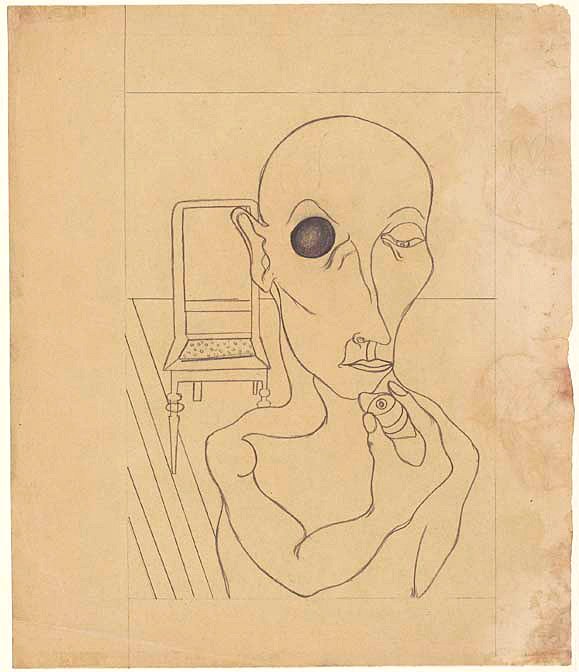
Angelika Hoerle Mann mit Auge. Image: Angelika Hoerle · Public domain · Wikimedia Commons, accessed 2026-08-04
Dada emerged in Zurich, Switzerland, in 1916, founded by a group of artists and writers, many of them war exiles, who gathered at the Cabaret Voltaire to stage deliberately chaotic performances of sound poetry, nonsense recitation, and absurdist theater. The movement's name was reportedly chosen at random from a dictionary and deliberately means nothing — an apt symbol for a movement that rejected logic, tradition, and meaning itself as casualties of a civilization that had produced the industrialized slaughter of World War I. If reason and progress had led to the trenches, Dada artists argued, then art should embrace irrationality, chance, and absurdity instead.
Dada had no single visual style; it was united instead by an attitude of provocation, negation, and irreverence. Marcel Duchamp's "readymades" — ordinary manufactured objects, most notoriously a urinal titled "Fountain," presented as art simply by the artist's selection and signature — questioned the very definition of art and the authority of institutions to confer artistic status. Hannah Höch and Raoul Hausmann in Berlin pioneered photomontage, cutting and reassembling newspaper and magazine imagery into jarring, satirical compositions that mocked politicians, gender roles, and bourgeois society. Jean Arp explored chance composition, famously dropping torn paper shapes onto a surface and gluing them where they fell, treating randomness as a legitimate compositional method. Francis Picabia produced ironic, mechanomorphic drawings that reduced human beings to absurd diagrams of machines.
Dada rebelled against nearly everything the prewar art establishment held sacred: skilled craftsmanship, coherent meaning, national pride, rational composition, and the sanctity of the art object itself. Different Dada groups formed almost simultaneously in Zurich, Berlin, Cologne, Hanover, Paris, and New York, each adapting the movement's confrontational spirit to local concerns, with Berlin Dada leaning toward explicit political satire against German militarism and New York Dada, centered on Duchamp and Picabia, taking a more ironic, conceptual tone.
Dada matters because it fundamentally broke the assumption that art must be beautiful, skillfully made, or even coherent — that provocation, chance, and appropriation could themselves constitute legitimate artistic acts. Nearly every major avant-garde development of the following century, from Surrealism's embrace of chance and the unconscious to Pop Art's use of appropriated imagery to later conceptual and performance art, can trace a direct lineage back to Dada's founding refusal to take art, or the world that produced it, at face value.
What defines Dada
Readymades and found objects
Ordinary manufactured objects were presented as art with little or no alteration, challenging the assumption that artistic skill or craftsmanship was necessary to create legitimate art. The artist's act of selection and framing became the creative gesture itself.
Photomontage and collage
Cut fragments of newspapers, photographs, and printed ephemera were reassembled into jarring, often satirical compositions, mixing text and image to comment directly on politics, media, and society.
Chance and randomness
Several Dada artists deliberately incorporated random or accidental processes into their working method, treating chance as a way to bypass conscious, rational control over composition.
Absurdist performance and sound poetry
Cabaret evenings combined nonsense poetry, invented languages, chaotic costumes, and deliberately provocative performance, using live spectacle to attack conventional theater and literature as much as visual art.
Satire and anti-nationalism
Much Dada imagery directly mocked militarism, nationalist politics, and bourgeois respectability, particularly in Berlin, where photomontage was used as an explicitly political weapon against German authority figures.
Rejection of coherent meaning
Dada deliberately courted contradiction, nonsense, and irrationality, refusing to offer a stable message or a resolved aesthetic, since its central premise held that a rational, coherent civilization had produced an irrational, catastrophic war.
History
Dada began in Zurich in February 1916, when Hugo Ball and Emmy Hennings opened the Cabaret Voltaire, a nightclub that quickly became a gathering point for artists and writers who had fled to neutral Switzerland during World War I, including Tristan Tzara, Jean Arp, and Marcel Janco. The group staged nightly performances mixing sound poetry, nonsense recitation, and absurdist costume and dance, explicitly framing the chaos as a response to a European civilization that had descended into industrialized war. The movement's name, adopted around this time, was chosen for its deliberate meaninglessness.
Dada spread quickly to other cities during and after the war, developing distinct local character in each. In Berlin, artists including Hannah Höch, Raoul Hausmann, and George Grosz turned Dada toward explicit political satire, developing photomontage as a tool for attacking German militarism, the failing Weimar government, and bourgeois hypocrisy. In New York, Marcel Duchamp and Francis Picabia, working somewhat independently of the European groups, pursued a more ironic and conceptual strain, with Duchamp submitting his urinal sculpture "Fountain" to an ostensibly open exhibition in 1917 under a pseudonym, a gesture that became one of the most consequential provocations in twentieth-century art. Dada groups also formed in Cologne, Hanover (where Kurt Schwitters developed his own idiosyncratic collage practice he called "Merz"), and Paris.
By the early 1920s, the Paris Dada circle, which included Tzara after his relocation from Zurich, had become increasingly involved with a younger group of writers and artists, notably André Breton, who were drawn to Dada's embrace of chance and the irrational but wanted to channel it toward a more constructive exploration of the unconscious mind. Tensions between Dada's commitment to pure negation and Breton's more systematic ambitions came to a head in the early 1920s, and by 1924 Breton had published the first Surrealist Manifesto, formally launching Surrealism and effectively absorbing much of Dada's remaining energy and personnel. Dada as an organized movement is generally considered to have ended by 1923–24, though its influence persisted directly through Surrealism and, decades later, through Neo-Dada and Fluxus artists who revived its strategies of chance, readymades, and anti-art provocation.
Key works
| Work | Artist | Year | Why it matters |
|---|---|---|---|
| Fountain | Marcel Duchamp | 1917 | A porcelain urinal signed with a pseudonym and submitted to an exhibition, one of the most influential provocations in modern art, questioning what makes an object art. |
| L.H.O.O.Q. | Marcel Duchamp | 1919 | A reproduction of a famous painting altered with a drawn mustache and goatee, a Dada gesture mocking artistic reverence and originality. |
| Cut with the Kitchen Knife Dada through the Last Weimar Beer-Belly Cultural Epoch of Germany | Hannah Höch | 1919 | A landmark photomontage assembling fragments of German media and politics into a chaotic satirical critique of Weimar society. |
| Untitled (Collage with Squares Arranged According to the Laws of Chance) | Jean Arp | 1917 | A collage composed by dropping torn paper squares and gluing them where they landed, embodying Dada's embrace of chance as a compositional method. |
How to make art in this style
Working in a Dada style
Palette: There is no fixed Dada palette — the movement worked largely in the black-and-white and sepia tones of newsprint and found photographs for collage, while painted works ranged widely. If painting, feel free to use whatever colors suit the found or invented imagery; consistency of palette is not the point.
Composition: Embrace deliberate disorder. Combine unrelated fragments — text, photographs, drawn elements, everyday objects — in ways that create jarring, illogical, or satirical juxtapositions rather than a harmonious whole. Chance methods are legitimate: try tearing paper and letting the pieces fall randomly before gluing them where they land, or combining images pulled at random from unrelated sources.
Technique: Photomontage is a core Dada technique: cut images and text from newspapers, magazines, or printed ephemera and reassemble them into a new composition that creates unexpected or absurd meaning. Readymades are equally valid — select an ordinary object, alter it minimally if at all, and reframe it through title, context, or presentation as a work of art.
Subjects: Favor subjects that let you satirize authority, nationalism, bourgeois respectability, or the pretensions of art itself. Nonsense text, invented words, or deliberately contradictory captions paired with imagery are characteristic devices.
Practical tip: Work quickly and resist the urge to "resolve" a composition into conventional harmony — Dada values provocation and disruption over polish, so if a combination feels too comfortable or tasteful, push it further toward absurdity or discomfort.
Legacy
Dada's core strategies — the readymade, photomontage, chance composition, and outright provocation as artistic method — became foundational tools for nearly every major avant-garde movement that followed. Surrealism absorbed Dada's interest in chance and the irrational and channeled it toward the exploration of dreams and the unconscious, while decades later, Neo-Dada artists and Fluxus in the 1950s and 1960s directly revived Dada's use of found objects, performance, and anti-art gestures.
Duchamp's readymades in particular reshaped the entire course of twentieth-century art, laying the conceptual groundwork for Conceptual Art, Pop Art's use of appropriated commercial imagery, and ongoing debates about authorship, originality, and what qualifies as art that continue in contemporary art discourse today. Höch and Hausmann's photomontage techniques fed directly into later political art, protest graphics, and eventually the collage aesthetics of punk and zine culture.
Beyond fine art, Dada's spirit of irreverent juxtaposition and anti-establishment provocation continues to surface in graphic design, advertising parody, meme culture, and any visual language that deliberately courts absurdity or contradiction to make a point. Because Dada was, by design, a movement of negation rather than a fixed style, its most lasting legacy is less a particular look than a permission structure — the now widely accepted idea that appropriation, chance, humor, and outright refusal can themselves be legitimate and powerful artistic strategies.
Frequently asked questions
What is Dada?
Dada is an anti-art movement that began in Zurich in 1916 as a reaction to the horror of World War I, using absurdity, chance, satire, and found objects to reject reason, tradition, and conventional art-making, which its founders saw as complicit in producing the war.
Who started Dada?
Dada began at the Cabaret Voltaire in Zurich, founded by Hugo Ball and Emmy Hennings, with key early participants including Tristan Tzara, Jean Arp, and Marcel Janco; related groups later formed independently in Berlin and New York.
What does the word Dada mean?
The name was reportedly chosen at random, often said to be picked from a dictionary, and was deliberately meaningless — an appropriate name for a movement that rejected rational sense-making.
What is a Dada readymade?
A readymade is an ordinary manufactured object presented as an artwork with little or no alteration, a strategy pioneered by Marcel Duchamp that challenged the assumption that art required skilled craftsmanship or original making.
Dada vs Surrealism: what's the difference?
Dada was primarily a movement of negation and protest, embracing absurdity and chance to attack rational civilization, while Surrealism, which emerged directly out of Dada in the mid-1920s, channeled similar interests in chance and the irrational toward a more systematic exploration of dreams and the unconscious mind.
How did Dada end?
Dada as an organized movement dissolved by the early-to-mid 1920s as many of its Paris-based participants moved toward Surrealism, formally launched by André Breton's 1924 manifesto, which absorbed much of Dada's remaining energy and personnel.